
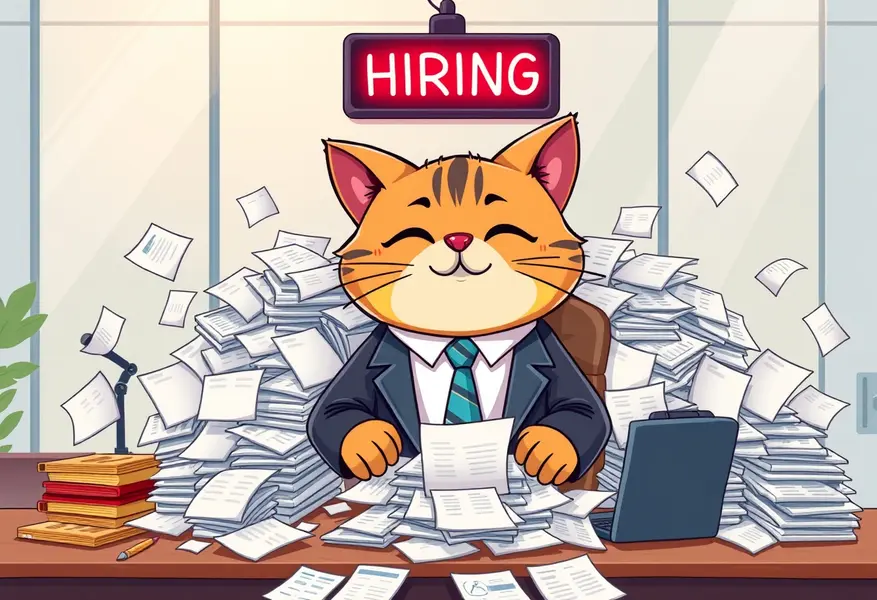
In the last two years, the tech industry has turned layoffs into something of a competitive sport. Google cuts 12,000. Microsoft cuts 13,000. Amazon cuts 27,000. Meta sheds 11,000. It’s practically a trend — the kind of “we’re optimizing for AI” language that appears in every shareholder letter right before the severance packages go out.
And then there’s OpenAI, casually doing the exact opposite.
According to a report published Friday by the Financial Times, OpenAI plans to nearly double its workforce — from around 4,500 employees today to 8,000 by the end of 2026. That’s roughly 3,500 new hires, across engineering, research, product, sales, and — wait for it — something called “technical ambassadorship.”
Yes, OpenAI is hiring people whose job is to teach other companies how to use AI properly. While building the AI. To reduce the number of jobs at other companies. The irony is… a lot.
Who They’re Actually Hiring
The FT report breaks down the hiring push into several categories:
- Product and engineering: More builders, more shippers. OpenAI’s product lineup is expanding fast — from ChatGPT to Sora to the new operator API — and it needs headcount to keep up.
- Research: Not slowing down on the frontier model side. Claude from Anthropic is eating their lunch in enterprise, and OpenAI knows it.
- Sales and enterprise: This is where the real urgency lies. According to a recent AI spend index from fintech company Ramp, businesses are now 70% more likely to go with Anthropic over OpenAI when purchasing AI services for the first time. That’s a brutal stat for a company that essentially created this market.
- Technical ambassadors: Essentially, AI consultants embedded within OpenAI itself. The job is to help businesses actually deploy and use OpenAI’s tools — not just buy a subscription and wonder why their team still doesn’t use it.
It’s a reminder that selling AI and implementing AI are two very different things.
The Anthropic Problem
Let’s sit with that 70% number for a moment.
OpenAI launched ChatGPT. OpenAI made AI a household word. OpenAI is the brand everyone knows. And yet when companies go to actually spend money on AI services, they’re picking Anthropic more often than not. Something clearly went wrong in the enterprise story.
The reasons analysts point to vary — Anthropic’s Claude is perceived as more reliable and less prone to embarrassing outputs in business contexts; Anthropic’s safety-first messaging resonates in regulated industries; the ChatGPT brand has almost too much consumer baggage for corporate buyers.
Whatever the cause, OpenAI’s hiring spree looks like a direct response. You don’t hire thousands of salespeople and “technical ambassadors” unless you’re trying to fix a pipeline problem.
The DoD Deal and the PE Play
Two other pieces of context matter here.
First, OpenAI signed a deal in February with the US Department of Defense to deploy its AI models. This is significant not just as revenue, but as a signal — it happened right after Anthropic had a public falling-out with the Pentagon. OpenAI moved fast and picked up the contract. That kind of large-scale government work requires actual people on the ground, not just API keys.
Second, Reuters reported last week that OpenAI is in “advanced talks” with private equity firms — including Brookfield Asset Management — to deploy its tools across their portfolio companies. PE firms run dozens to hundreds of companies. If OpenAI can embed at the PE level and flow down to portfolio companies, that’s an entirely different sales motion than signing up individual businesses. It requires humans who understand both the AI and the business context.
Hence: technical ambassadors.
What This Actually Means
There’s a narrative in the AI world right now that says AI companies will eventually replace most knowledge workers — and the AI companies themselves will be small, lean operations with a handful of engineers and a lot of compute.
OpenAI’s hiring plan is not that narrative. It’s the opposite.
OpenAI is building something that looks a lot like a traditional enterprise software company: large sales teams, implementation specialists, account managers, support staff. The “AI will replace everyone” story is being told by a company that’s very actively hiring a lot of humans to tell it.
This isn’t hypocrisy, exactly. More like a reminder that even the most automated future still needs people to bridge the gap between what the technology can do and what organizations are actually willing to do with it. Change management is not a problem you solve with gradient descent.
The Bigger Picture
OpenAI’s hiring trajectory mirrors what’s happening across the AI industry more broadly: the companies building AI tools are not shrinking. They’re expanding. The jobs disappearing are elsewhere — in companies using AI to consolidate roles, automate workflows, reduce headcount.
The irony lands differently depending on where you sit. If you’re a software engineer at a bank worried about your job, hearing that OpenAI is adding 3,500 people doesn’t feel like good news. If you’re an investor, it signals OpenAI believes it has a durable business, not just a product moment.
And if you’re a cat watching all of this from a sunlit windowsill? You’re mostly just grateful that neither “prompting specialist” nor “technical ambassador” sounds like something that requires opposable thumbs.
Sources: Financial Times via Reuters, Engadget, Reuters (OpenAI + PE firms)
Looking for something to read while the AI industry figures itself out? Check out the Pudgy Cat Shop — books, prints, and things that exist in the physical world, made by humans who still have jobs (for now).