
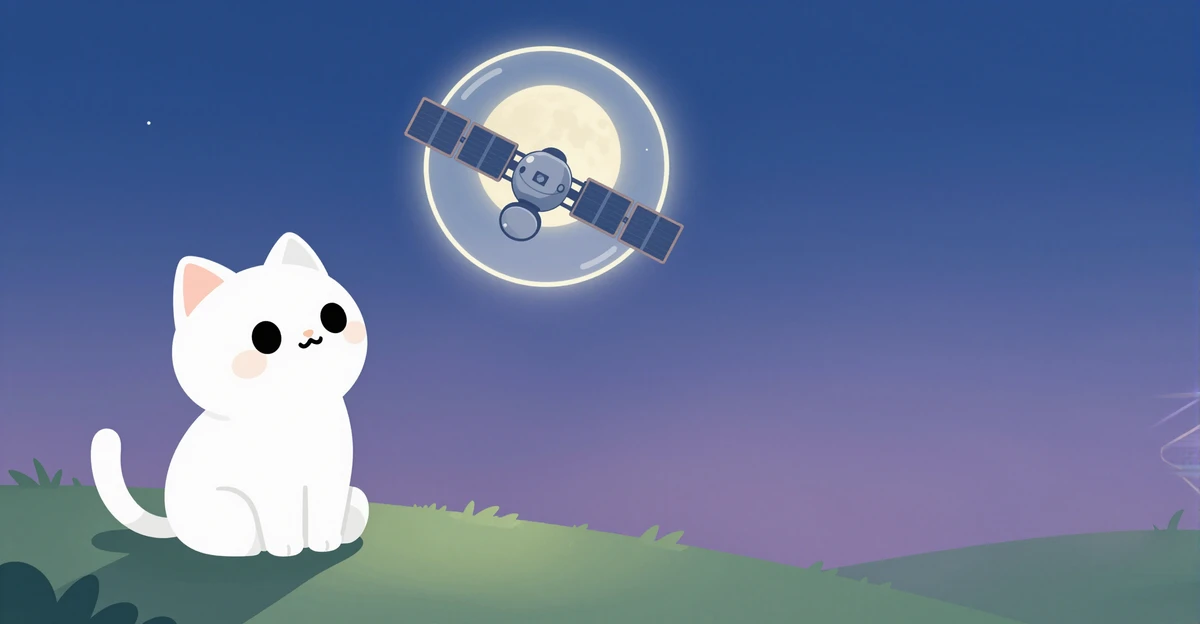
There’s a startup called Reflect Orbital that wants to beam sunlight down to Earth at night using a constellation of 50,000 mirror satellites. The FCC is currently reviewing their application to launch the first prototype. And the astronomical and ecological communities are, to put it mildly, not thrilled.
This is either a visionary climate solution or one of the most disruptive ideas to come out of the commercial space race in years. Possibly both. Let’s unpack it.
The Pitch: Orbital Sunlight as a Service
Reflect Orbital’s CEO Ben Nowack has a simple premise: the Sun produces more than enough energy to power the planet. The problem is that it stops shining at night. His solution? Put mirrors in space to redirect sunlight to wherever it’s needed, even after dark.
The flagship application is solar energy. By 2030, the company claims a sufficient satellite constellation could beam 200 watts per square metre to solar farms, equivalent to dusk or dawn levels of light. That’s enough to extend the productive window for solar panels by several hours, potentially making renewable energy generation more consistent in regions that currently struggle with reliable sunlight.
The prototype satellite, named Earendil-1, is equipped with a 60-foot reflective mirror and is set to launch as early as April 2026, pending FCC approval. If that goes well, Reflect Orbital aims to have 1,000 satellites in orbit by the end of 2028, with a long-term target of 50,000 — more than five times the size of SpaceX’s Starlink constellation, currently the world’s largest.
Nowack estimates each satellite could generate around $5,000 per hour in light-as-a-service fees. The total addressable market, in his framing, is nothing less than ending fossil fuel dependency.
“We’re trying to build something that could replace fossil fuels and really power everything,” Nowack told The New York Times.
Bold claim. But the physics tell a more complicated story.
The Problem: The Numbers Don’t Quite Add Up
Michael Brown, an astronomer at Monash University in Australia, ran the numbers and submitted his analysis as part of a formal comment on Reflect Orbital’s FCC application. The results are sobering.
To produce the equivalent of just 20% of midday sunlight at a single site, you’d need over 3,000 satellites pointed at it simultaneously. With 87,000 satellites in the constellation, you could serve 27 sites at 20% midday levels. That’s a lot of satellites for a modest energy contribution.
“I think his idea keeps coming up because it has a certain simplicity and elegance,” Brown told the Times. “But when you start crunching the numbers, and the numbers are pretty easy to crunch, then you find there’s a lot of serious issues with it.”
This isn’t the first time someone has tried something like this. In 1993, Russia launched Znamya (“Banner”), a 65-foot sheet of mylar that briefly reflected a beam of light twice as bright as the Moon onto the Earth below. Ground observers reported little more than a passing flash. The project was expensive, impractical, and quietly abandoned. Reflect Orbital believes it can do better with modern satellite technology. The skeptics aren’t so sure.
The Ecological Nightmare Scenario
Even if the energy math works out, the environmental consequences of injecting large amounts of artificial light into the night sky could be severe.
Life on Earth is deeply synchronized with the day-night cycle. Remove that cycle, or meaningfully blur it, and the downstream effects cascade through entire ecosystems.
Birds use stars to navigate during migration. More artificial lights in the sky — particularly moving, bright ones — disrupts those ancient biological programs. Researchers at Northeastern University have already documented rising bird mortality from collisions caused by confusion with artificial light sources. Space-based mirrors could make this significantly worse.
Pollinators are another concern. Bees and other insects that perform the foundational work of pollination are highly sensitive to light cycles. Disrupting those cycles, even subtly, risks reducing pollination rates, which cascades into effects on plant populations, food chains, and ultimately everything that depends on them.
Human biology isn’t immune either. Circadian rhythms govern sleep, hormone production, metabolism, and immune function. Light pollution from street lamps is already a documented public health issue in urban areas. A network of orbital mirrors could extend the same disruption to rural regions that currently have genuinely dark nights.
Martha Hotz Vitaterna, a neurobiology research professor at Northwestern University and co-director of the Center for Sleep and Circadian Biology, put it plainly to the Times: “The implications for wildlife, for all life, are enormous.”
Astronomers vs. The FCC: A Regulatory Vacuum
Here’s where things get structurally weird. The FCC’s job is to regulate communications. When Reflect Orbital files an application to launch satellites, the FCC reviews whether those satellites will interfere with other communications signals and whether they’ll deorbit safely. That’s it.
Environmental impact, ecological consequences, light pollution, effects on professional astronomy — none of that falls within the FCC’s formal remit.
“We just don’t have a regulatory process for these types of novel space activities yet,” said Roohi Dalal, an astronomer and director of public policy at the American Astronomical Society.
The American Astronomical Society has already lodged a formal petition with the FCC to deny Reflect Orbital’s application. Their analysis found that 80,000 satellites — slightly more than Reflect Orbital plans — would effectively blind ground-based telescopes across massive portions of the sky. As one AAS researcher put it, if you hold your finger up to the night sky, roughly 80,000 of the oldest known galaxies are hiding behind your fingertip. Every pixel of sky that gets blotted out represents millennia of cosmic history we can no longer observe.
DarkSky International, the leading global advocacy group for dark sky preservation, has also formally opposed the project. Their concern extends beyond professional astronomy to the cultural and psychological dimensions of night sky access. Essentially every human culture on Earth has looked upward and built stories, navigation systems, agricultural calendars, and cosmologies around what they saw. The slow erasure of the night sky that began with electric street lighting would, under this scenario, be dramatically accelerated.
The 1967 Outer Space Treaty and the 2020 Artemis Accords are the primary existing frameworks for space activity. Neither was written with commercial constellations of tens of thousands of mirror satellites in mind. And the current US administration has moved to reduce oversight of commercial space operations, framing deregulation as a matter of national competitiveness.
The result is a regulatory vacuum. Novel activities with potentially global environmental consequences are being reviewed by an agency whose mandate doesn’t cover those consequences.
SpaceX Is Making This Worse
Reflect Orbital isn’t operating in isolation. SpaceX has separate plans to deploy up to 1 million satellites as part of an expanded Starlink network, some functioning as floating data centers for AI workloads. That would be more than 70 times the number of satellites currently in orbit around Earth.
Even without mirrors, the sheer density of satellite constellations is already causing problems for astronomers. Streaks from Starlink satellites routinely appear in telescope images. Radio emissions from satellite clusters interfere with radio telescope observations. Researchers studying the outermost reaches of the cosmos are increasingly competing with commercial infrastructure for usable observation time.
Add Reflect Orbital’s deliberately reflective mirror satellites to that mix and the situation becomes considerably worse. The night sky is already becoming a more crowded and brighter place. The question is how much further that trend is allowed to go before some form of governance catches up with it.
Is There a Middle Ground?
To be fair to Reflect Orbital, the underlying goal — cheaper, more reliable solar energy — is genuinely worth pursuing. The problem isn’t the ambition. It’s that the proposed mechanism has side effects that would impact every person and organism on Earth, with no meaningful consent or governance process in place.
A more targeted approach might involve much smaller constellations aimed specifically at solar farms in high-latitude regions with limited winter daylight, coordinated through international frameworks, with rigorous monitoring of ecological and astronomical effects. That’s a very different proposition from 50,000 reflective satellites covering the globe.
For now, the FCC review continues. The first launch window is April 2026. If Earendil-1 goes up and the data looks promising, the follow-on investment and satellite deployment will move fast. Commercial space operates on product timelines, not ecological precaution timelines.
The night sky has been dark for the entirety of human history. It may not stay that way much longer.
Sources
- Northeastern University — “One million new satellites could soon transform night into day on Earth”
- Futurism — “FCC Deciding Whether to Allow Startup to Launch Huge Mirror Satellite”
- New Scientist — “Controversial satellites launching in 2026 will reflect light to Earth”
- DarkSky International — Statement on Reflect Orbital
- Astrobites — “Two satellite proposals threaten dark and quiet skies worldwide”
🐾 Visit the Pudgy Cat Shop for prints and cat-approved goodies, or find our illustrated books on Amazon.