
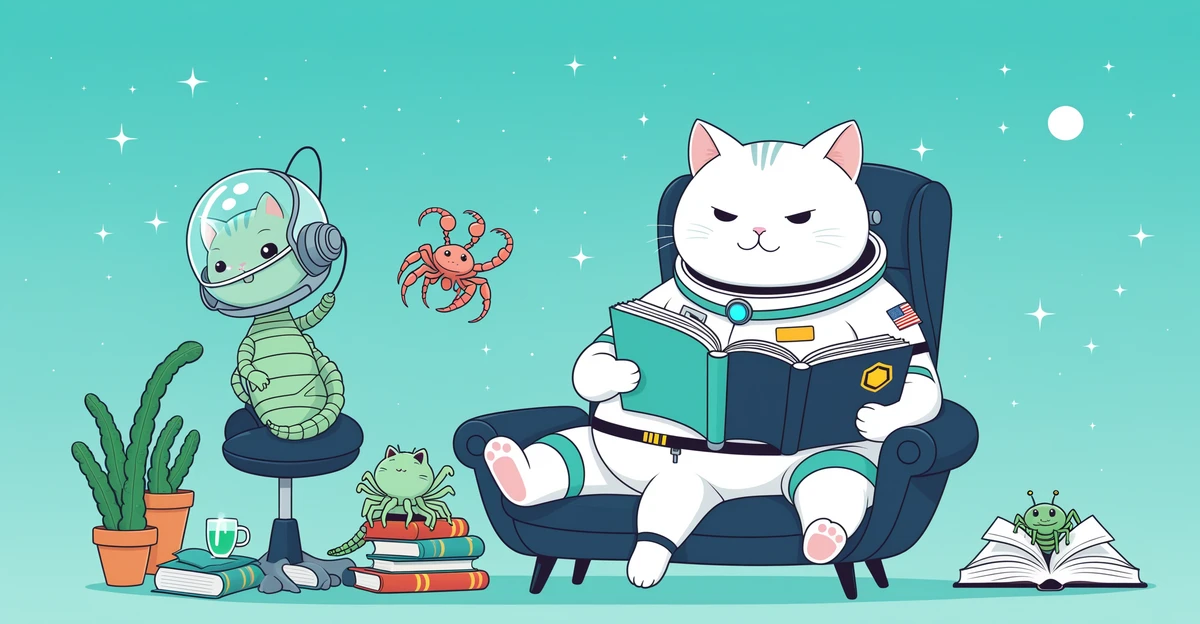
Picture a research vessel drifting toward an alien planet with a dark history. Onboard: a human scientist haunted by nightmares, a spider duo doing their whole spider-relationship thing, an octopus, and a captain who will punch you if you step into his personal space bubble. The captain is a mantis shrimp. He is six feet tall, wearing a uniform, and philosophically inclined when he’s not being terrifying.
This is Children of Strife, the fourth book in Adrian Tchaikovsky’s Children of Time series, and it came out today in the UK. If you have not read this series and you enjoy science fiction that actually makes you think about what consciousness, civilization, and communication mean — stop what you’re doing.
Why the Children of Time Series Is Unlike Anything Else
Most science fiction about alien intelligence imagines creatures that think roughly like humans, just with different skin tones and maybe some telepathy. Tchaikovsky does something more interesting and more unsettling: he asks what it would look like if spiders built a civilization. Or octopuses. Or, now, mantis shrimp.
The original Children of Time (2015) followed an ark ship of human survivors — Earth is gone or dying, there’s that — arriving at a terraformed planet that was supposed to receive them. The planet had been uplifted instead by a nanovirus that accidentally accelerated spider evolution. The Portia spiders had been building a civilization for centuries. Humans were not welcome.
The book’s genius is that you get chapters from both sides, and gradually you realize the spiders aren’t villains — they’re just alien. Their social structures, their communication (via web vibrations), their relationship with gender and hierarchy: all extrapolated logically from real spider biology. It’s the kind of worldbuilding that makes you look at a spider differently afterward.
Children of Ruin added octopuses and something horrifying involving a microscopic entity that replaces living tissue. Children of Memory was, by most accounts, the weaker entry — a planet that turned out to be a simulation, a bit more cerebral and detached. A wobble in an otherwise incredible run.
Children of Strife: Return to Form (With Bonus Mantis Shrimp)
The fourth book is, by early reviews, very much a return to what made the series great.
The setup: the research vessel Dissenter arrives at a planet with a particularly troubled history. Billionaire terraformer Gerry Hartmand — the guy who lost the bid to Avrana Kern in book one and never got over it — took his team off-grid thousands of years ago to create their own world. Things went very wrong. A technique developed by one of his scientists essentially turned the planet into a living computer, programmable at a biological level. The planet developed consciousness. An unstable, traumatized consciousness shaped by five deeply flawed people.
The Dissenter‘s crew has to figure out what happened. The crew includes Alis, a human scientist processing some difficult memories from the previous book, a spider pair named Portia and Fabian navigating their complicated relationship, and Captain Cato.
Captain Cato is a Stromatopod. An uplifted mantis shrimp. Aggressive, hierarchical, philosophical when he’s not feeling threatened, and carrying sixteen types of color receptors in his eyes (real mantis shrimp fact — they genuinely see in ways humans can’t fully comprehend). Tchaikovsky apparently had to invent an entirely new way of conveying mantis shrimp “speech,” since their communication through visual displays doesn’t map neatly onto language. The result is, according to reviews, a character who is simultaneously infuriating, protective, and oddly sympathetic.
“At times hilarious, at times blunt, sarcastic and manipulative but also clever, skilful and protective.” — Goodreads
The structure of the novel is ambitious: three parallel timelines spanning thousands of years — the original terraforming disaster, the post-disaster era, and the present-day investigation — that slowly converge. It’s the kind of architecture that either pays off magnificently or collapses under its own weight. Early word says it pays off.
What Makes Tchaikovsky Special
Adrian Tchaikovsky is extraordinarily prolific — he publishes three or four books a year across different genres — and that sometimes leads people to assume he’s a volume writer. He’s not. The Children of Time series in particular shows what happens when someone with a genuine background in zoology and a love of evolutionary biology writes science fiction.
New Scientist’s review put it well: while other famous SF writers mark themselves out with “Big Physics,” Tchaikovsky has made his name with “Big Biology.” The question he keeps asking is: what kind of society would this creature build, if it were as intelligent as us? It’s simple in principle and extraordinarily difficult in execution.
You end up with spiders who communicate via silk vibrations and have a matriarchal society where males are tolerated but never equal. Octopuses who experience color through skin receptors and have a fundamentally different relationship with individuality. Mantis shrimp who see colors humans cannot name and whose social dynamics involve a very clear hierarchy enforced by physical violence. All of it extrapolated from actual biology.
It’s also genuinely optimistic science fiction, which has become rare. The series is fundamentally about different kinds of minds learning to understand each other — not by becoming the same, but by building enough common ground to coexist. In 2026, that premise doesn’t feel quaint. It feels necessary.
Do You Need to Read the Previous Books?
The honest answer: you can technically start with Children of Strife. The reviews say newcomers can follow it. But you’d be skipping one of the best science fiction books of the last decade (book one), and a very solid follow-up (book two). The world-building accumulates in ways that make the fourth entry richer if you have the context.
If you’re impatient: start with Children of Time. It’s a standalone novel that happens to have sequels. You’ll be through it faster than you think — the alternating chapters between the human ark ship crew and the spider civilization are genuinely hard to put down.
Book three (Children of Memory) you can skim or skip if you bounce off it. Most readers found it the weakest. Book four apparently makes more sense with book two than book three anyway.
The Series at a Glance
- Children of Time (2015) — Spiders inherit a planet. Humans arrive uninvited. Genuinely brilliant.
- Children of Ruin (2019) — Octopuses on a water world. Also a microscopic body-horror nightmare. Excellent.
- Children of Memory (2022) — Colony simulation mystery. Fine, but the weakest entry.
- Children of Strife (March 2026) — Mantis shrimp captain, traumatized planet, three timelines. Return to form.
Children of Strife is published by Tor Books (US, March 17) and Pan Macmillan (UK, March 26 — today). Around 700 pages. Goodreads page here.
If you like science fiction that makes you think about what minds are, how communication works, and why cooperation between genuinely different intelligences is harder and more interesting than we usually admit — this series belongs on your shelf.
And if you just want to read about a philosophically inclined mantis shrimp captain who will absolutely fight you for entering his personal space: same answer.
🐾 Visit the Pudgy Cat Shop for prints and cat-approved goodies, or find our illustrated books on Amazon.