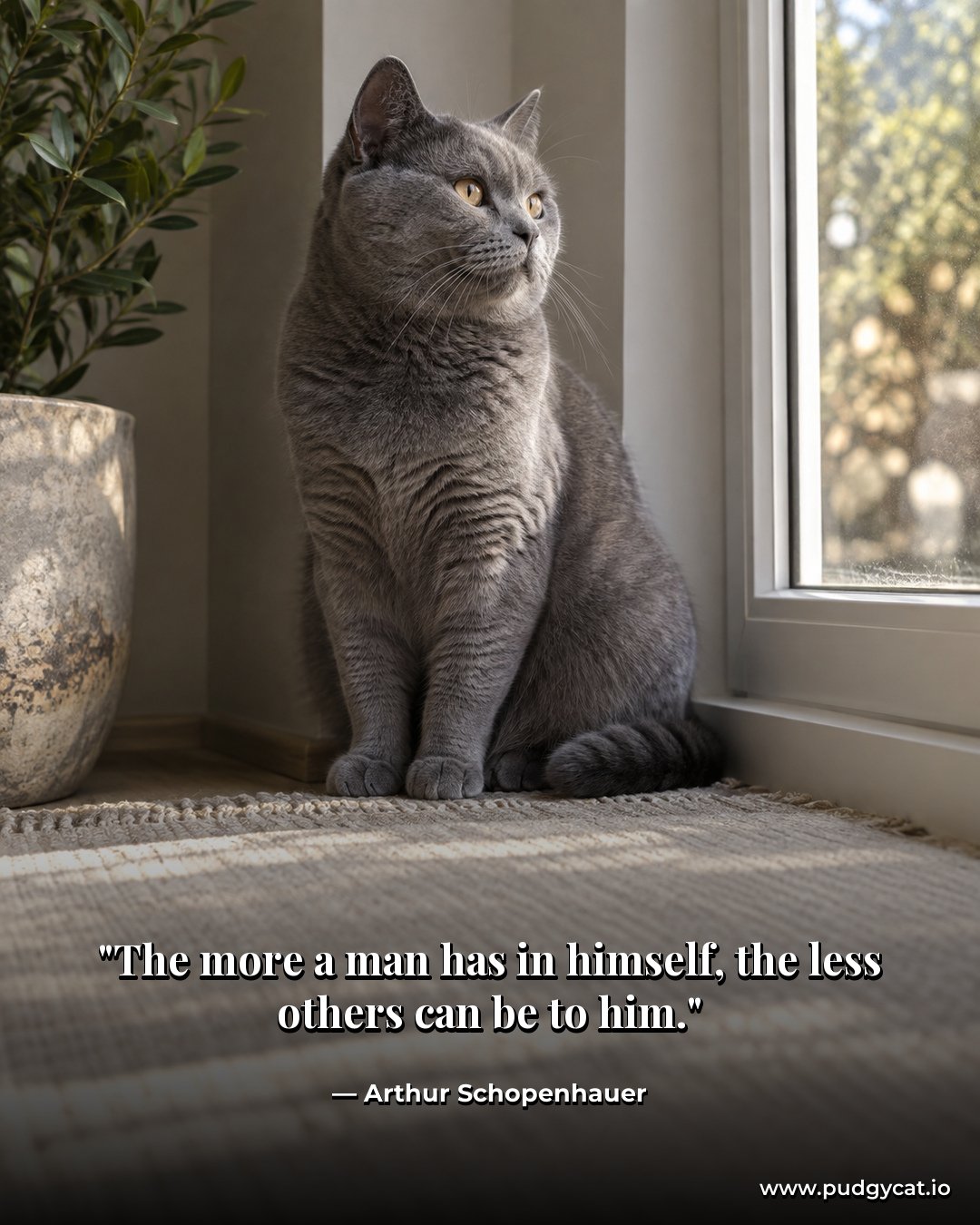
The more a man has in himself, the less others can be to him.
Arthur Schopenhauer
Source, Counsels and Maxims, Our Relation to Ourselves; English translation by T. Bailey Saunders
Why This Quote Matters
Arthur Schopenhauer makes this claim in Counsels and Maxims while considering a person's relation to themselves. It is an argument for inner resources: interests, thought, and the ability to occupy one's own attention. The sentence's severity can sound dismissive of other people, but its most usable question concerns how much of our satisfaction must be supplied from outside at any given moment.
Having something to return to within your own life can change the demands placed on company. A friend need not provide constant distraction; an evening need not become a failure because no invitation arrives. This should not turn self-sufficiency into a competition or deny the importance of support. Nobody is required to become an island. The point is to cultivate enough independent interest that relationships can be enjoyed for their particular qualities, rather than recruited to fill every available silence.
The blue-grey cat resting in a quiet alcove gives the idea a compact visual shape. Little is happening, yet the picture does not feel deprived of an event. That is an impression created by the scene, not evidence of the animal's inner life. For the human viewer, it offers a useful possibility: an unoccupied space in the schedule might become somewhere to dwell, instead of something that must immediately be repaired.
🐾 Visit the Pudgy Cat Shop for prints and cat-approved goodies, or find our illustrated books on Amazon.
More Cat Wisdom