Somewhere in a forest in Wisconsin, a bright yellow mushroom is doing something that no animal, plant, or virus has managed to do quite this effectively: it is quietly replacing an entire kingdom of organisms, one dead tree at a time.
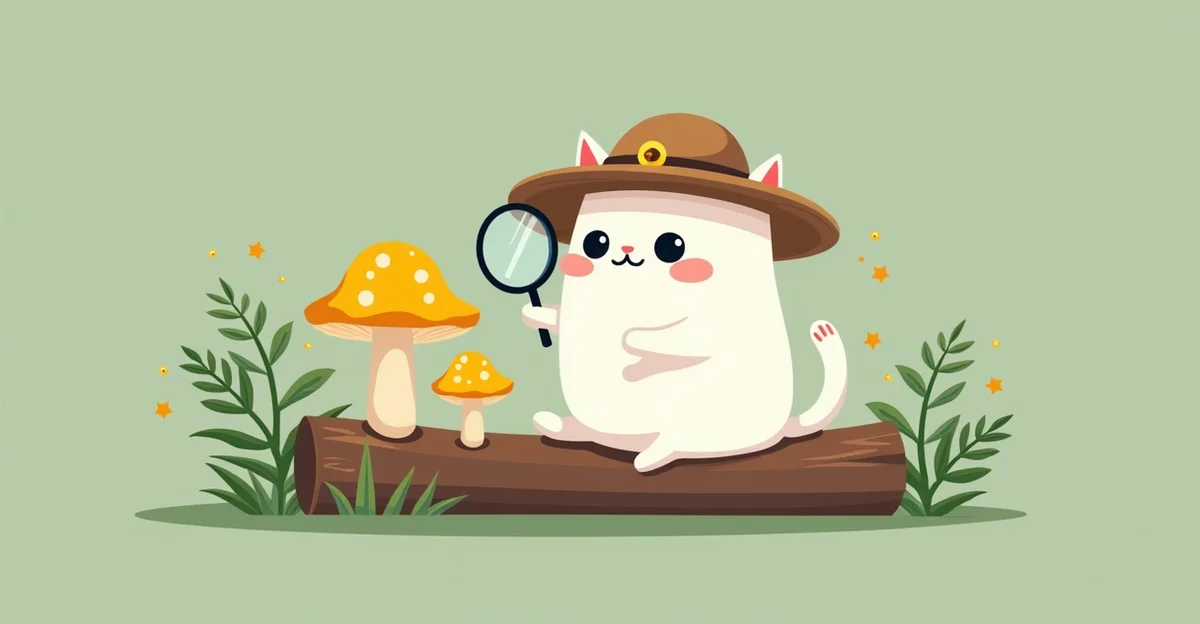
The golden oyster mushroom (Pleurotus citrinopileatus) was supposed to be lunch. Native to Asia, it was brought to North America in the early 2000s as a food crop. Easy to grow, high yield, beautiful neon-yellow caps. Home growers loved it. Commercial farms loved it even more. Then it escaped into the wild, and now scientists are scrambling to understand how much damage it has already done.
A Carnivorous Fungus With a Billion-Spore Habit
Golden oysters are not your average mushroom. For starters, they are one of the few carnivorous fungi on the planet, preying on nematode worms in the soil. They also happen to be absurdly prolific: a single gilled mushroom can release billions of spores into the air. Billions. From one mushroom.
For most of the year, the fungus is invisible, living as mycelium (thread-like strands) inside dead or dying hardwood trees. But come spring, it erupts. Huge clusters of yellow mushrooms cascade from logs and stumps, each one blasting microscopic spores into the wind. The mushroom equivalent of carpet bombing.
Nobody knows exactly how it escaped cultivation. It might have been a home grow kit left in a backyard. It might have been spores drifting from an outdoor log inoculated by an enthusiastic hobbyist. However it happened, the golden oyster is now in 25 U.S. states and at least one Canadian province, with sightings in Italy, Hungary, Serbia, Germany, Switzerland, and the south of England.
Half the Biodiversity, Gone
The real shock came in 2025, when mycologist Aishwarya Veerabahu at the University of Wisconsin-Madison and her team published research in Current Biology that nobody in the field was quite ready for.
The team drilled into dead trees across Wisconsin forests, extracting wood shavings and running DNA analysis on the fungal communities inside. Trees colonized by golden oysters had, on average, half the fungal biodiversity of trees without them. In some cases, even less.
“We found that trees colonized by golden oyster have, on average, about half the fungal biodiversity as trees without the golden oyster,” Veerabahu told the BBC. “That was a huge indicator that they’re likely outcompeting the native fungi that were there.”
Among the casualties: the mossy maze polypore, the elm oyster mushroom, and Nemania serpens, a fungus known for producing diverse chemical compounds that could have pharmaceutical applications. We are losing fungi we have not even finished studying yet.
Why This Matters More Than You Think
If your instinct is “who cares about mushrooms,” this is the part where that instinct gets corrected.
Fungi are not a decorative feature of forests. They are the infrastructure. The vast majority of plants on land depend on fungi for their nutrients through mycorrhizal networks (the “wood wide web” you may have heard about). Fungi break down dead wood and cycle carbon and nitrogen back into the soil. They create the cavities in trees that roughly 1,800 bird species need for nesting. No fungi, no holes. No holes, no birds.
As Matthew Wainhouse, a fungi specialist at Natural England, put it: “No fungi, no plants, which is a really wild thing.”
The golden oyster also chews through wood at an unusual rate, raising questions about carbon emissions from accelerated decay. In forests already stressed by climate change and habitat loss, losing half your fungal biodiversity is not a footnote. It is a structural failure.
It Is Not Alone
The golden oyster is the most visible invader, but it is part of a larger pattern. The death cap mushroom (Amanita phalloides), one of the most poisonous fungi on Earth, is spreading through California and Australia. Amanita muscaria, the iconic red-and-white spotted mushroom from fairy tales, is invasive in Colombia. In October 2025, Poland’s national forest agency sounded the alarm when the North American slender golden bolete was found in the UNESCO-protected Bialowieza Forest, home to Europe’s largest wild bison population.
Climate change is accelerating the problem. The “ping pong bat fungus” (Favolaschia calocera), originally from tropical Madagascar, has been showing up in Dorset, England. Rising temperatures are redrawing the map of where fungi can survive, and the most aggressive species are winning.
In March 2026, the International Union for Conservation of Nature (IUCN) added over 400 fungal species to its Red List of threatened species. The total is now above 1,300. In 2014, there were just three.
The Cloners Fighting Back
At the annual All Things Fungi Festival in Sussex, England, there is one mushroom species that is explicitly banned: the golden oyster. The festival instead focuses on something more constructive. Attendees learn to clone native fungi, preserving the genetics of species that might otherwise be steamrolled by more aggressive invaders.
Andy Knott, a former engineer turned mushroom farmer in Dorset, runs the cloning sessions. “A lot of people are growing non-native species of mushroom from China, America and elsewhere,” he says. “But why is no one preserving our native genetics?”
The technique is surprisingly low-tech. A sterile scalpel, some agar plates, a steady hand. The goal is to capture tissue from native species like the grey oyster and propagate it, creating genetic insurance policies for fungi that might be outcompeted in the wild within decades.
It is a familiar conservation playbook, but one that has almost never been applied to fungi. As Anne Pringle, professor of botany at the University of Wisconsin-Madison, points out: “When I started teaching mycology, fungi were plants, and you would teach them as if they were plants. Now that we know fungi are their own kingdom, I think it’s been a long process of also then thinking that maybe we should be thinking about them distinctly in terms of conservation.”
The irony is thick. The same biological resilience that makes certain organisms fascinating also makes them terrifying when they show up in the wrong place. The golden oyster is not malicious. It is just extremely good at being a mushroom. And that, it turns out, is the problem.
What You Can Actually Do
If you grow mushrooms at home (and millions of people do), the Royal Horticultural Society has a simple request: do not grow golden oysters outdoors. Their spores travel on the wind. Once they are in a local forest, they are not coming back out.
More broadly, the lesson is one we keep having to relearn. When we move species around the planet for our convenience, whether it is mining the deep sea or shipping mushroom kits to hobby growers, we rarely consider the ecosystems we are about to rewire. The golden oyster was not an act of negligence. It was an act of not thinking far enough ahead.
Fungi make up an estimated 2 to 5 million species globally. We have studied a fraction of them. We are now losing some of them to invaders before we even know what they do. That is not a mushroom problem. That is a “we have no idea what we’re messing with” problem.
And the golden oyster, bright and beautiful and absolutely relentless, does not care.
Sources: Veerabahu et al., Current Biology (2025) | BBC Future | The Conversation | IUCN Red List fungal additions
🐾 Visit the Pudgy Cat Shop for prints and cat-approved goodies, or find our illustrated books on Amazon.