
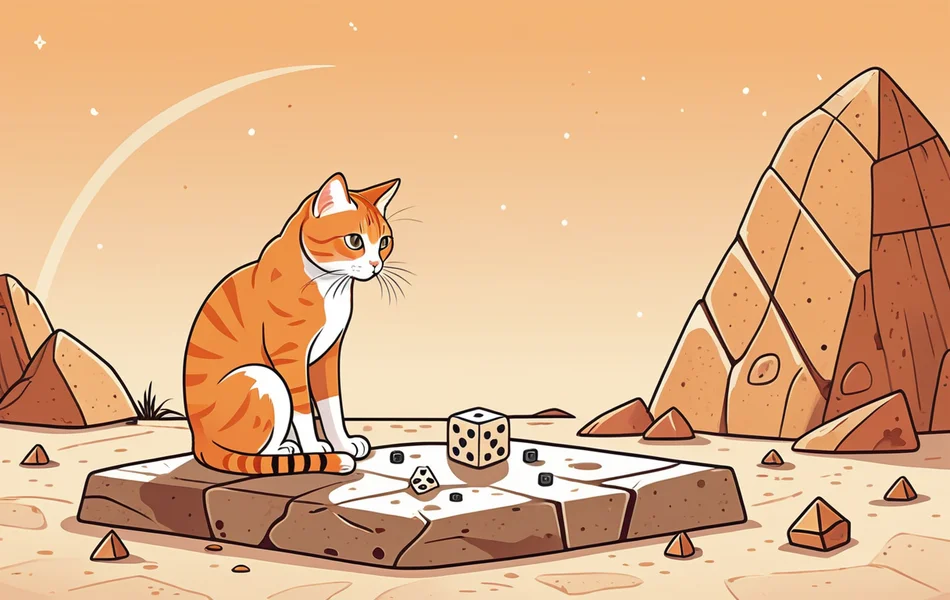
Somewhere in Wyoming, about 12,000 years ago, a group of hunter-gatherers sat around a fire and did something remarkably human. They gambled. Not with cards or chips or a roulette wheel, obviously. They used small, polished bones with lines carved on one side, tossing them the way you would toss a coin. Heads or tails, win or lose. The oldest casino in the world had no roof, no cocktail waitresses, and no dress code. Just people, bones, and the universal itch to test their luck.
A study published on April 2, 2026 in American Antiquity has officially rewritten the history of gambling. Researcher Robert J. Madden, a Ph.D. student at Colorado State University, tracked down over 600 dice artifacts from archaeological sites across North America. The oldest ones come from Folsom-period sites in Wyoming, Colorado, and New Mexico, dating back roughly 12,800 to 12,200 years. For context, the previous record holders were dice from Mesopotamia, made about 5,500 years ago. Madden just pushed the invention of dice back by more than 6,000 years. That is not a small correction. That is a complete rewrite.
Not Your Vegas Dice
Forget the six-sided cubes you picture when someone says “dice.” These ancient objects were flat, oval, or rectangular pieces of bone, worn smooth by years of handling. They had two faces: one marked with carved lines or surface treatments, the other left plain. Think of them as prehistoric coins. You tossed a handful onto a playing surface, counted how many landed on the “marked” side, and that was your roll. Archaeologists call them “binary lots,” which sounds less fun than what they actually were: the first gambling tools ever made by human hands.
What makes them unmistakable as dice (and not just random bone fragments) is a diagnostic checklist Madden built by studying 293 sets of historic Native American dice documented by ethnographer Stewart Culin back in 1907. Same shape, same size, same markings, same wear patterns. These were purpose-built objects, not scraps.
Ice Age Social Technology
Here is where it gets really interesting. Madden argues these dice were not just toys. They were social technology. Games of chance created neutral ground where people from different groups could interact without the tension that comes with first contact. You do not need to speak the same language to roll dice. The rules are simple enough that anyone can pick them up in minutes.
Think about what that means. Twelve thousand years ago, at the tail end of the last Ice Age, people were using games to form alliances, exchange goods, share information, and manage uncertainty. That is remarkably sophisticated social engineering, wrapped in something that looks like a simple pastime. We tend to think of social technologies as modern inventions, platforms and apps designed to connect people. But the first social technology might have been a handful of carved bones tossed onto a flat rock.
The Geography of Luck
The earliest dice come from three key sites. The Lindenmeier site in northern Colorado, one of the most important Folsom-period archaeological sites in North America. The Agate Basin site in eastern Wyoming. And Blackwater Draw in eastern New Mexico, a site already famous for being one of the oldest known human habitation areas on the continent.
These are not neighboring villages. They are spread across hundreds of miles of the western Great Plains. The fact that similar dice show up at all three locations, during the same time period, suggests that games of chance were not some isolated invention by one clever group. They were widespread. This was a cultural phenomenon.
And it did not stop there. Madden found dice artifacts from every major period of North American prehistory, from the Late Pleistocene all the way through European contact. Twelve thousand years of continuous gambling. That is a tradition that makes Las Vegas look like a pop-up shop.
Probability Before Math
There is something quietly profound about this discovery. These people were engaging with probability thousands of years before anyone wrote down the mathematics to describe it. They understood, on an intuitive level, that outcomes could be random, that risk could be managed, that luck was a force worth testing. The formal study of probability did not emerge until the 1600s, when Blaise Pascal and Pierre de Fermat started exchanging letters about gambling problems. But the instinct for it? That goes back to the Ice Age.
It is a reminder that mathematical thinking does not start with equations. It starts with curiosity. With the question: “What happens if I throw these bones?” The same impulse drives speedrunners who spend months testing the boundaries of game systems, or indie developers who bet years of their life on one idea. Humans have always been drawn to systems where the outcome is uncertain but the engagement is total.
Why This Matters Now
Gambling has a complicated reputation. It conjures images of neon-lit casinos, addiction hotlines, and that one friend who is always “about to hit it big.” But Madden’s research paints a different picture of its origins. Before gambling was an industry, it was an icebreaker. A diplomacy tool. A way to make strangers into trading partners without anyone having to draw a weapon.
The next time someone tells you that gambling is a vice, you can tell them it is actually one of humanity’s oldest social inventions. Older than agriculture. Older than pottery. Older than the wheel. People were rolling dice before they figured out how to grow wheat.
And honestly? If you had to survive an Ice Age with nothing but stone tools and animal hides, you would probably want something fun to do around the fire, too.
🐾 Visit the Pudgy Cat Shop for prints and cat-approved goodies, or find our illustrated books on Amazon.



Leave a Reply