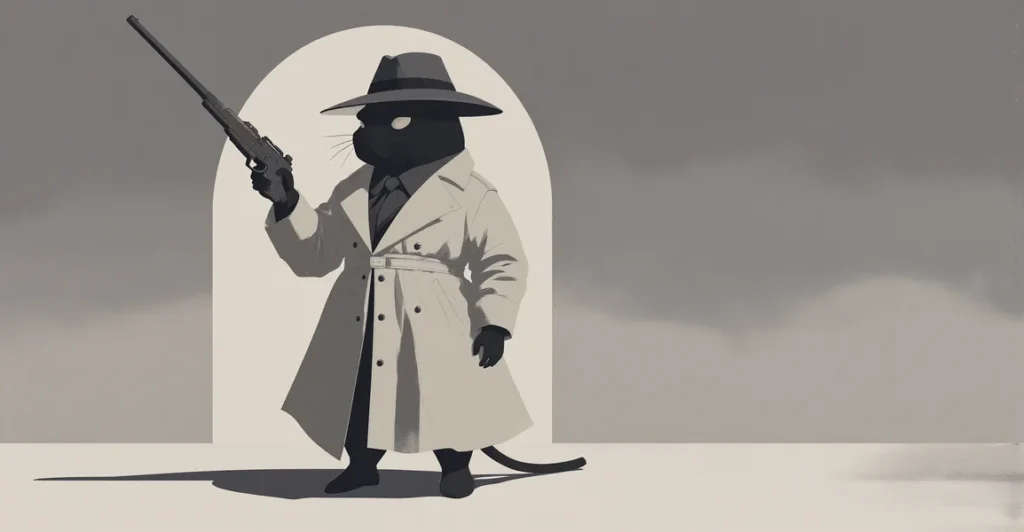
A cartoon mouse in a fedora is pointing a Tommy gun at you. The gun bends like a garden hose. The barrel wiggles. Someone has apparently loaded a cartoon reel into a DOOM engine, and we should probably hear them out.
MOUSE: P.I. For Hire arrives today, April 16, on PC, PlayStation 5, Xbox Series X|S, and Nintendo Switch 2, according to publisher PlaySide’s launch announcement. Developed by Fumi Games, it combines a first-person shooter with the black-and-white look of an old cartoon and a detective story. Think rubber limbs, hard-boiled dialogue, and an unusually well-armed rodent.
Rubber Hose Animation: A Very Flexible Inheritance
If you have played Cuphead or spent time around Bendy and the Ink Machine, you already recognize the family resemblance. Limbs bend without obvious elbows. Bodies squash and stretch. A character’s skeleton seems to be an optional subscription.
The look reaches back to animation of the 1920s and 1930s, including early Mickey Mouse. The Walt Disney Family Museum’s history of Mickey’s design describes those flowing limbs and follows their gradual replacement by a more naturalistic approach. It was an evolution, not a switch somebody flipped halfway through the 1930s.
That distinction matters. Old cartoon styles did not simply disappear until a videogame studio rediscovered them in a dusty cupboard. They remained available to watch, imitate, and remix. Games give the visual language another job: those expressive shapes now have to respond to a player.
What MOUSE Is Promising
You play Jack Pepper, a war veteran turned private investigator in Mouseburg. In the developer deep dive presented by Xbox in October 2025, the shooting sits alongside gathering clues, talking to characters, and bringing evidence back to Jack’s office. The hub also gives the detective somewhere to return between excursions.
That is a useful distinction from the elevator pitch. A mouse holding a gun is a striking image; a world that gives him something to investigate is a game concept. The presentation shows weapon upgrades and alternate attacks as well as detective work. How well those pieces hold together over a full playthrough is a separate question from how good the trailer looks.
The visual trick is more interesting than putting a filter over a conventional shooter. In Fumi’s account of the production for Unity, two-dimensional characters, weapons, and interactive objects occupy three-dimensional environments. Lighting and animation help direct attention in a world that cannot rely on bright color coding.
In other words, the cartoon style affects how the developers communicate with the player. A bouncing object can invite attention; a quieter background can let it stand out. The look is doing work, even when the object doing that work appears to be made of licorice.
Why an Old Style Still Feels Fresh
Part of the appeal, to my eye, is contrast. Photorealistic games can be beautiful, but an exaggerated silhouette offers a different pleasure. You do not need another layer of simulated skin to make a character memorable. Sometimes you need a hat, a pair of gloves, and a complete disregard for anatomy.
This is one of the recurring pleasures of distinctive indie game design: a strong visual decision can give a project an identity before you know much about its systems. That does not guarantee a good game, and it does not mean every player prefers stylization. It does explain why this particular mouse is hard to confuse with a space marine.
There is also nostalgia without a personal memory attached. You can be drawn to an old visual language without having lived through its original moment. Cartoons reach people through reruns, family viewing, clips, and later works that borrow their shapes. Familiarity travels further than a birth certificate.
And part of it, honestly, is that the aesthetic is funny. A weapon that appears nervous about being fired already has a personality. The joke arrives before anybody writes a punchline.
Hand-Drawn Does Not Mean Technically Simple
Cuphead made a particularly vivid case for bringing traditional animation methods into games. Studio MDHR’s account of its process describes hand-drawn and inked animation combined with painted backgrounds and a modern game engine. The old-fashioned appearance was a production choice, not an absence of technical work.
MOUSE applies a related idea to a different space. Fumi’s Unity account describes an animation pipeline built to handle large numbers of sprites and the extra views needed when a player moves around characters. A flat-looking image can have a considerable amount of machinery behind it.
That is why the interesting question is not whether an old style has suddenly become fashionable enough to count. It is what a developer does with it. Cuphead’s boss encounters, Bendy’s unsettling cartoon imagery, and MOUSE’s detective-shooter pitch are different uses of a shared visual inheritance.
Should It Go on Your List?
If cartoon noir and first-person shooting are already your sort of thing, the launch material gives you a good reason to take a closer look. If you mainly loved Cuphead for its specific combat or cooperative play, do not assume a similar drawing style means a similar experience.
Watch a stretch of gameplay, check the requirements or the version for your platform, and decide whether the shooting and investigation appeal as much as the artwork. A launch-day style discussion is not a substitute for testing performance or finishing the campaign.
A hand-drawn mouse. A jazz-inflected noir world. A gun with the structural integrity of cooked spaghetti. The ingredients are ridiculous in precisely the way a memorable cartoon should be. Now the interesting part is seeing what players make of the game behind them.
🐾 Curiosity looks good on you. Explore the Goodies, or find our illustrated books on Amazon.