A Kyoto software company shipped a mobile game in October 2014 with a target of about 50,000 downloads in six months and no English translation. By July 2015 it had already passed five million downloads. The Neko Atsume idle game loop asks almost nothing of you, and that was the point: you put food and toys in a small yard, you close the app, and the cats arrive while you are somewhere else. The reward for playing is generated by not playing. That inversion turned a side project into a genre landmark and pulled a whole category of Japanese mobile design into international view.
Table of Contents
- How the Neko Atsume Idle Game Loop Actually Works
- Where the Idle Game Genre Came From Before Neko Atsume
- Why the Neko Atsume Idle Game Rewards Absence
- What Research Says About Idle Games and Waiting
- The Boom: Clones, a Dog Version, and a Cat Inside Android
- From Phone Screen to Cinema, VR, and a Sequel
- Why the Cat, and Why Japan
- Frequently Asked Questions
How the Neko Atsume Idle Game Loop Actually Works
Hit-Point, a small software company based in Kyoto, released Neko Atsume on iOS and Android on 20 October 2014. The project was led by Yutaka Takasaki, who built it in the gaps between other projects. The illustrations came from designer Ippei Morita, and the music from Ryo Shintani. The English release, titled Neko Atsume: Kitty Collector, followed on 30 October 2015, a full year after the Japanese original.
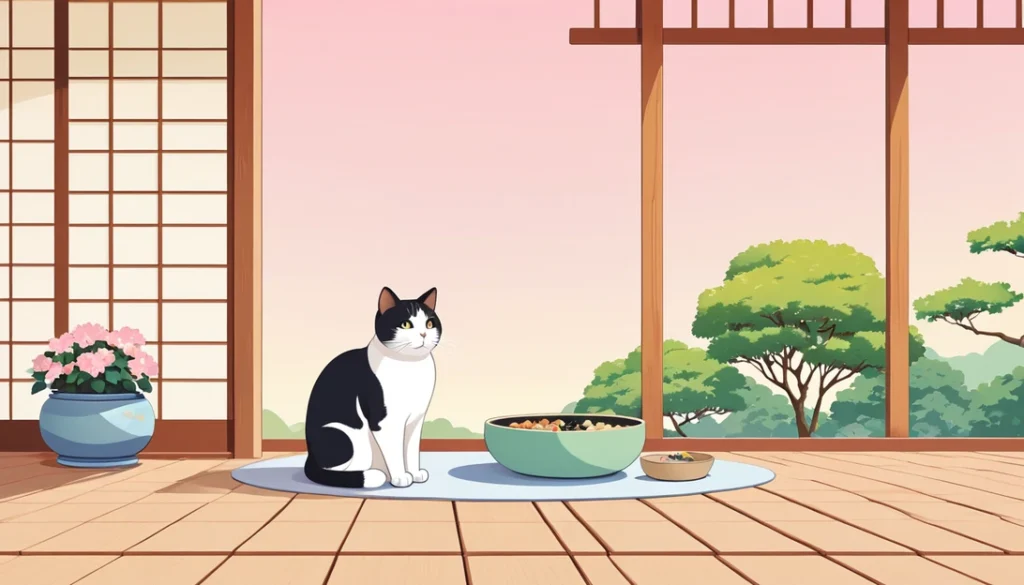
The mechanics fit in a sentence. You have a yard. You buy food and toys with two currencies, silver and gold niboshi, the dried sardines used for stock in Japanese cooking. You place your items, you leave. When you come back, some cats have visited, eaten, played, and left you more niboshi. You photograph them, you log them in a book, you buy better toys, you leave again.
There is no conventional game-over screen. Food does run out, so you refill it and invite the next round of visitors; you are not trying to keep a vulnerable virtual pet alive. The catbook records ordinary visitors and rarer cats with particular tastes in food or toys. You can also remodel the yard, turning the same small space into a different setting. The original developer interview compared the idea to cat-observation manga. Takasaki explained that the visitors were not your household pets, without defining them as strays either. They are characters who happen to drop by.
The 50,000 Download Target
In a March 2015 interview with Weekly ASCII, Takasaki said the team had hoped for 50,000 downloads in six months. The interview already reported 1.5 million. A SoftBank announcement on 15 July 2015 put the total above five million. The cats had substantially overperformed their job description.
The early developer interview described word of mouth and shared screenshots as major drivers, rather than a big promotional campaign. Players posted the cats that turned up in their yards, other people asked what the app was, and the loop repeated. This is the same organic spread that built the early feline internet, a mechanism we traced in our history of cat blogs and the feline web between 1995 and 2010, except compressed into a few months and running on mobile screenshots instead of blog rolls.
Where the Idle Game Genre Came From Before Neko Atsume
Idle games did not begin with cats. They began with a joke about role playing games. Progress Quest, released in 2002 by Eric Fredricksen, is an early landmark of the type. Its official manual cheerfully explains how the adventure proceeds by itself. It parodied the automated combat and stat grinding of MMORPGs by removing the player entirely. You created a character, and then you watched. The character levelled up, killed things, collected loot, and you contributed nothing beyond the initial setup.
In 2010 the game designer and academic Ian Bogost built Cow Clicker, a satire of the Facebook social games then dominating the platform. You clicked a cow. Then you waited six hours before you could click it again. In his own account of the project, Bogost describes it as both a critique and a game people actually played. The joke acquired an audience willing to click sincerely, which was funnier and bleaker than the satire itself.
The Joke That Refused to Stay a Joke
The genre stopped being a punchline in 2013 with Cookie Clicker by the French developer Julien Thiennot, who works under the name Orteil. You click a cookie, you buy a grandmother who bakes cookies for you, and the numbers escalate until they need scientific notation. Orteil has called his own output non-games. In early 2014 he released Idle Game Maker, a tool that let anyone build the same structure.
Two design ideas arrived quickly after that and still define the category. AdVenture Capitalist pushed offline earnings, crediting progress for time spent away, rather than requiring the full simulation to keep running while the app was closed. Clicker Heroes, by Playsaurus, popularised prestige, the mechanic where you voluntarily reset your progress in exchange for a permanent multiplier. Others, such as Candy Box! and Universal Paperclips, did something rarer for the genre and gave the player an actual ending.
Why the Neko Atsume Idle Game Rewards Absence
Here is the useful contrast with a game such as AdVenture Capitalist: one welcomes you back with an earnings total, the other with visitors. It is a difference between designs, not a strict border between Japanese and Western games. Both approaches can make leaving and returning part of the fun.
Neko Atsume gives you a scene instead. You open the app and there is a cat in a cardboard box, a cat wedged into a bowl too small for it, a cat asleep on a cushion you bought three days ago on a hunch. The variable is not how much you earned. It is who came. The Japanese term for this family of games, hōchi games, translates roughly as neglect or leave-alone games, and that framing is more honest about what is happening than the English word idle. You are not idling. You are leaving something set up and hoping.
This is also, and not by accident, an accurate model of how cats work. You cannot summon one. You can only make a place worth visiting and then get out of the way. Games that put you inside the animal have to solve a much harder problem, the one we picked apart in our look at cat simulator games and the design trouble of playing an animal with no hands. Neko Atsume sidesteps it completely by refusing to let you be the cat, or even to touch one properly. You are the landlord. The cats are the tenants, and they do not sign anything.
What Research Says About Idle Games and Waiting
Researchers examined the pattern in “Playing to Wait: A Taxonomy of Idle Games”, presented at CHI in 2018 by Sultan A. Alharthi and colleagues. They analysed 66 idle games and compared them with 10 non-idle games, considering mechanics, rewards, interaction, progression and interfaces. This was a taxonomy of game design, not a controlled experiment proving how every player feels.
Their central observation is that idle games move the player from playing to planning. The interesting decisions happen before you put the phone down, not while you hold it. They also noted the genre’s unusual economics of attention: it consumes computer cycles and clock time rather than your hands and eyes, although checking in, planning and anticipating rewards can still compete for your attention.
Waiting also has a less cuddly side. Justin Buergi’s 2024 paper “Idle Games: A Cozy Genre Turned Exploitative” discusses how monetisation can exploit impatience. The original Neko Atsume allows optional gold-fish purchases, and its early developer interview described a relaxed commercial approach. That makes an interesting contrast; it does not place every edition of the game outside monetisation concerns.
The Boom: Clones, a Dog Version, and a Cat Inside Android
Success at that scale on mobile guarantees imitation. The Japanese developer Chronus produced Boku to Wanko, the same game with dogs, and Boku to Nyanko, which was Boku to Wanko with the cats put back. The underlying invitation-and-return loop is easy to recognise across these games, even when the animals change.
The strangest tribute came from Google. In 2016, Android 7.0 Nougat shipped with a hidden easter egg: tap the version number repeatedly and you get a cat collecting game in the notification shade, where you put out food, wait, and name whichever cats show up. An operating system used by more than a billion people hid a cat-collecting diversion in its settings menu, with the Neko implementation preserved in Android’s source code, which is a level of cultural penetration most mobile games never reach.
The industry noticed too. Neko Atsume won in the game-design category at the CEDEC Awards ceremony on 27 August 2015, and GameSpot placed it among its top five mobile games of 2015. In February 2016 the pet supply company Petio released physical versions of the in-game toys for real cats, closing the loop: a game about virtual cats producing objects for actual ones.
From Phone Screen to Cinema, VR, and a Sequel
On 8 April 2017 Japan got a live action film, Neko Atsume no Ie, which translates as The House of Cat Collection, directed by Masatoshi Kurakata and distributed by AMG Entertainment. The plot is about a novelist with writer’s block who starts caring for the cats that appear around his house. Adapting a game with no story into a feature film sounds impossible until you notice the game was never about the cats arriving. It was about the person waiting. The Japan Society archive records its JAPAN CUTS screening in New York on 16 July 2017.
A PlayStation VR version arrived in Japan on 31 May 2018 and internationally in August 2021, which is an odd product: a game built on absence, ported to a device you strap to your face. Hit-Point then announced Neko Atsume 2 on 22 February 2024 for a summer window, slipped to autumn, and released it on 20 October 2024, exactly ten years after the original.
The sequel keeps the familiar visual identity but adds Going Out, which lets you visit other players’ yards, and the optional Cat’s Club subscription with helper cats and Myneko. Its official site describes the paid model and the separate Myneko space. Goodies can also wear down and be repaired, a system referenced in Hit-Point’s June 2025 update notes. Adding upkeep to such a relaxed loop is a design choice worth discussing, even without pretending every player reacts the same way.
Why the Cat, and Why Japan
A cat is the correct animal for a game about waiting, and Japan had several centuries of practice making that argument. The beckoning figurine in shop windows, whose real and much-disputed origins we untangled in our piece on the history of the maneki-neko, is already a statue of an invitation rather than a possession. The literary tradition runs the same way, from Soseki’s narrator onward, as we covered in the cat in Japanese literature from Soseki to Murakami: the cat watches, comments, and leaves.
The country also has physical places built on the same principle. The fishing settlements documented in our guide to Japan’s cat islands are, functionally, offline versions of the game: humans set out food, cats decide. The commercial version, the cat cafe, went in the opposite direction and turned the waiting into a paid hourly experience, a story we followed in how a Taiwanese idea became a global institution.
Cats already had other prominent roles in Japanese mobile gaming. PONOS launched Nyanko Daisensou, known in English as The Battle Cats, on the Japanese iOS store in November 2012. It passed 17 million downloads by February 2015 and 55 million by November 2020. It is a tower defence game rather than an idle one, and the cats are deliberately ugly, but the point holds: the audience for feline games was there, but a crowded field of cats did not guarantee a hit. For the longer arc, our history of cats in video games from Cait Sith to Stray covers the ground from 1983 forward.
Frequently Asked Questions
Was Neko Atsume the first idle game?
No. Progress Quest from 2002 is an early example, and Cow Clicker in 2010 and Cookie Clicker in 2013 established the genre in the West. Neko Atsume, released in 2014, matters for a different reason: it replaced escalating numbers with a scene you want to look at.
How many downloads did Neko Atsume get?
SoftBank’s July 2015 announcement reported more than five million downloads, well beyond the original target of 50,000 in six months. These are historical download figures, not a count of current active players.
Is there a Neko Atsume movie?
Yes. Neko Atsume no Ie, a live action film directed by Masatoshi Kurakata about a blocked novelist and the cats around his house, opened in Japan on 8 April 2017 and screened at the Japan Cuts festival in New York that July.
What is the difference between Neko Atsume and Neko Atsume 2?
Neko Atsume 2, released on 20 October 2024, keeps the familiar cat-collecting loop while adding visits to other players’ yards, the optional Cat’s Club subscription and goodies that can wear down and be repaired. The original game and the sequel are separate apps.
Do I need to keep Neko Atsume open?
No. You can put out food and toys, leave and check back later. The original game’s FAQ explains that it supports offline play and uses your device’s clock. The important design choice is progress without continuous attention, rather than a requirement to watch an empty yard until somebody turns up.
The Cat Comes Back
The most influential idea in Neko Atsume was not the cats. It was making the player’s absence the input. Everything after it, the clones, the easter egg buried in Android, the film, the headset version, the sequel ten years to the day later, grew out of one small Kyoto studio deciding that a game could be a place you prepare rather than a thing you do. The cats are why anyone stayed. The design is why anyone still talks about it. Put out the food, close the app, and something will show up or it will not. Both outcomes are the game.