Walk into a ramen shop in Osaka, a bakery in Lima, or a nail salon in Manchester, and there is a good chance a small ceramic cat is sitting by the register with one paw in the air. The maneki-neko is one of the most widely exported objects in Japanese material culture, with a history that mixes pottery, local legends, and hopes for good fortune. It is beckoning rather than waving goodbye, but the meaning of its colors and raised paw is less standardized than a souvenir-shop chart might suggest.
Here is what the records show, where the legends come from, and how the beckoning cat became familiar far beyond Japan.
Table of Contents
- What “Maneki-neko” Actually Means
- The Maneki-neko Is Much Younger Than It Looks
- Origin Stories Around the Beckoning Cat
- Why It Looks Like the Cat Is Waving at You
- How to Read a Maneki-neko
- How Aichi Prefecture Became the Lucky Cat Factory
- The Cat Goes Global
- Frequently Asked Questions
What “Maneki-neko” Actually Means
The word splits cleanly. Maneki is the nominalized stem of maneku, the verb for inviting someone by beckoning. Neko is cat. Put together, 招き猫 means beckoning cat, and that is the whole of it. The name describes the gesture; its association with good fortune belongs to the wider tradition surrounding the figurine.
Lucky cat, welcoming cat, money cat, fortune cat, and waving cat all circulate in English. Some names emphasize a hoped-for blessing, while others describe what the figure seems to be doing. “Beckoning cat” keeps the invitation in view.
Lafcadio Hearn described a beckoning kitten in Glimpses of Unfamiliar Japan (1894). That is an early English-language encounter with the object, not a reliable birthday for the tradition. A writer introducing an unfamiliar charm to readers is recording its circulation, not necessarily witnessing its invention.
The Maneki-neko Is Much Younger Than It Looks
The familiar figurine belongs to the late Edo period rather than remote antiquity. SFO Museum’s exhibition history places early production at the Imado kilns in the mid-nineteenth century. Older stories can be attached to a later object, so the age of a temple legend and the age of surviving figurines are different questions.
A particularly useful visual record is Hiroshige’s Jōrurimachi hanka no zu. The Rijksmuseum dates its market scene to 1852 and identifies a beckoning-cat seller among the stalls. It shows the figure in commercial circulation by that date. A market scene is a firmer foothold than an exact invention story supplied long afterward.
Real cats also had practical value around stored food and other goods vulnerable to rodents. It is easy to see why a useful animal could become associated with protection and prosperity. That connection helps the symbolism make sense, but does not establish a single step-by-step path from one farming charm to every shop-counter figurine.
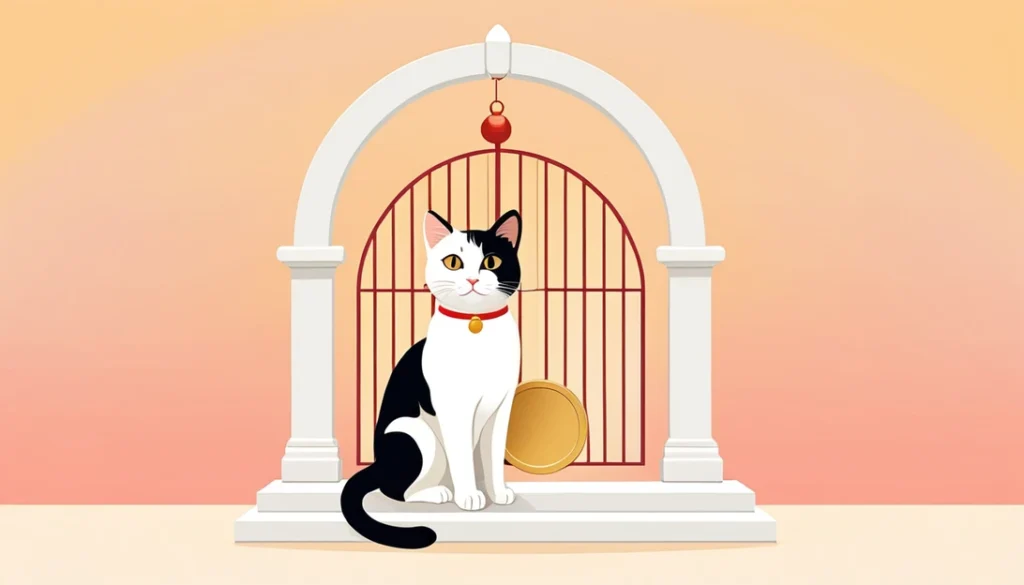
Different makers gave the cats different bodies, decorations, and materials. Collars, bibs, bells, and coins became parts of the visual vocabulary. Their coexistence is more useful to notice than a tidy story in which all cats wore one accessory until every workshop switched to another.
Edo and its pottery traditions are central to this history, but production spread beyond the city. The object can belong simultaneously to a household, a business, a temple tradition, and a ceramics workshop. Calling it only a merchant’s charm would miss some of the reasons people keep it.
Origin Stories Around the Beckoning Cat
There is no universally accepted inventor or birthplace. Several Tokyo traditions connect a helpful cat to a particular community. These are stories people tell about the charm, rather than four independently documented manufacturing patents.
Gotokuji: The Lord Who Dodged Lightning
In Gotokuji’s own telling, a cat beckons Ii Naotaka, lord of Hikone, into the temple as he returns from falconry. A thunderstorm follows, and he enjoys shelter and conversation with the temple master. Other retellings add a dramatic lightning-struck tree. The temple’s account emphasizes the fortunate invitation.
Gotokuji dates its rebuilding with Naotaka’s support to 1633. It later enshrined the auspicious cat at Shofuku-den. That date belongs to the temple’s history; it does not, by itself, date the first commercial beckoning-cat figurine.
Gotokuji’s white cats raise the right paw and carry no coin. The temple explains the figure as inviting connections with people, whose value depends on how someone responds with gratitude. Many visitors return figures as offerings after a wish is fulfilled. It is a more specific teaching than “right paw equals money,” and a good reason to read the local explanation before translating every cat into a shopping list.
Imado Shrine: The Woman Who Sold a Dream
A legend associated with Imado tells a poorer story. An elderly woman, too broke to keep feeding her cat, gave it up. The cat came to her in a dream and told her to make figures in its likeness. She shaped them from local Imado ware and sold them near Asakusa Shrine. They sold well. She stopped being poor.
This story gives the charm an appealing commercial origin: the cat helps a woman by suggesting something she can make and sell. The connection with Imado pottery fits the object’s material history, but the dream remains part of the legend. A plausible setting does not convert every event in a folk tale into a documented biography.
Jishoin, Yoshiwara, and the Cats Nobody Agrees On
Another tradition connects Jishoin with a cat that aided Ōta Dōkan during fighting. Shinjuku’s municipal listing identifies the temple with the beckoning-cat origin tradition. As with Gotokuji, a story about a helpful animal should be distinguished from evidence for the age of the figurines.
The Yoshiwara version is the grimmest. A courtesan named Usugumo kept a cat that followed her everywhere and pulled at her clothing. Someone killed it, assuming possession. The severed head is said to have flown at a snake coiled to strike her. The cat had been warning her the entire time. Figures were carved in its memory.
These stories give the cat different roles: rescuer, guide, protector, and unlikely business adviser. Their variety is part of the object’s appeal. It does not prove when each tale developed or that four social classes independently invented their own versions. For another tradition with changing local meanings, see our account of black cat superstitions.
Why It Looks Like the Cat Is Waving at You
This is the most common misreading, and it comes down to a gesture mismatch. The standard Japanese beckoning motion holds the hand up, palm facing down, fingers folding down and back toward the wrist. That is “come here.”
The Western version is the opposite: palm up, fingers curling toward yourself. So some European or American viewers read palm-down-and-folding as a wave hello, a wave goodbye, or even a shooing motion. The cat is doing none of these. It is saying come in, and it has been saying it politely for over a century and a half to people who keep hearing something else.
A motorized arm makes the ambiguity especially easy to see. To one viewer it beckons; to another it waves. The gesture travels with the object, but its interpretation depends on what a person has learned to recognize. It is a small cultural translation problem with an unusually cheerful face.
How to Read a Maneki-neko
Details can carry intended meanings, but there is no single universal key. A maker’s explanation or a temple’s tradition is more useful than assuming every cat with the same color or paw means exactly the same thing.
The Paw
A common commercial reading associates the left paw with customers and the right with money or good fortune. Seto’s makers describe that convention. Gotokuji provides a useful counterexample to treating it as a universal rule: its right-pawed cats invite human connections. Both-pawed figures also exist. The best choice is the meaning and design you actually like, rather than fear of ordering the wrong department of luck.
The Colors
Color associations vary between makers and traditions. Common examples include:
- White: often associated with happiness or general good fortune.
- Black: often linked to protection or warding off evil.
- Gold: commonly associated with money and prosperity.
The familiar calico pattern gives many figures white, orange, and black markings. Tokoname’s tourism guide describes it as the traditional popular design, while other workshops use different patterns and silhouettes. Look closely at a collection and the patches become another part of the design: the same basic cat can look solemn, mischievous, or ready to supervise your accounts.
Accessories give makers further room to vary the message. A collar, bell, decorative bib, or large oval coin can make a cat look domestic, ceremonial, or extravagantly prosperous. A huge denomination is best read as auspicious exaggeration, not a financial statement. The ceramic cat is allowed to have unrealistic savings goals.
How Aichi Prefecture Became the Lucky Cat Factory
Established pottery workshops helped the figurines reach more buyers. Plaster molds made repeatable forms possible, while painting and glazing allowed variation. Seto’s makers describe adapting European mold techniques to their ceramic figures. A production method can spread an object without erasing the choices of the people decorating it.
Seto and Tokoname became important centers with recognizable styles. Tokoname’s official tourism history dates its lucky-cat production to the late 1930s and describes it as Japan’s leading producer by 1950. The town’s established ceramic industry gave artisans the skills to make a new line of objects.
Tokoname’s familiar version has a plump body and large eyes and ears. It is one influential regional style, not the face of every maneki-neko. Comparing a rounded Tokoname cat with a more slender Seto figure makes the workshop history visible. A shelf of lucky cats is also a shelf of design decisions.
The Cat Goes Global
Japanese manufacturers were exporting the figurines during the Meiji period, according to SFO Museum. Their later familiarity in Chinese restaurants and shops helps explain why some viewers assume a Chinese origin. The cat’s international story includes trade, migration, collecting, and decoration rather than one fully mapped route followed by every figurine.
The legends also feed modern mascots. Hikone’s official profile of Hikonyan combines the cat said to have helped Ii Naotaka with the Ii forces’ red helmet. Created in 2006 for the castle’s 400th-anniversary celebrations, it shows how an old story can acquire a new face. The helpful cat has become a welcoming character for an entire city.
Celebrations, collections, and exhibitions give the object a life beyond individual shop counters. SFO Museum’s 2018 exhibition brought together examples from different Japanese pottery traditions. Looking at several styles together reveals how much variety can fit inside the simple idea of a cat raising a paw.
The maneki-neko travels easily because it can be both a recognizable invitation and a personally meaningful object. One owner hopes for customers, another values a temple visit, and another simply likes the cat. Those uses can coexist. The figure does not lose its whole history the moment someone puts it on a desk instead of beside a cash register.
Frequently Asked Questions
Is the maneki-neko Japanese or Chinese?
Japanese. The figurine’s history is associated with Japanese pottery and late-Edo culture. Its wide use in Chinese restaurants and shops can lead to confusion about its origin, but international popularity does not change where the tradition developed.
How old is the maneki-neko?
The familiar figurine is documented in the nineteenth century, including Hiroshige’s 1852 market scene. Older origin legends are part of its cultural history, but they do not establish an exact manufacturing date. A surviving record gives a point by which an object existed, not necessarily its first day.
Which paw should I choose?
The common commercial distinction is left for customers and right for money or good fortune, but local meanings vary. Check the maker’s or temple’s explanation if the symbolism matters to you. You can also choose a cat because you enjoy looking at it.
Why do the cats at Gotokuji have empty paws?
Gotokuji explains its figure as inviting opportunities for human connection, rather than handing over fortune directly. The outcome depends on how those connections are valued. Its coinless design expresses that teaching.
Where does the calico tradition come from?
Calico markings are a familiar traditional design, with workshop styles sometimes modeled on Japanese bobtail cats. Stories about the luck of rare male calicos circulate too, but they do not establish a single origin for every tricolor figurine.
The Short Version
The maneki-neko brings together nineteenth-century pottery, older legends, regional styles, and hopes for good fortune. A market print can show that cats were being sold; a temple can explain what its own cat means. Neither gives every figurine one compulsory interpretation. The gesture is still an invitation, though, and much of the world has been politely waving back.