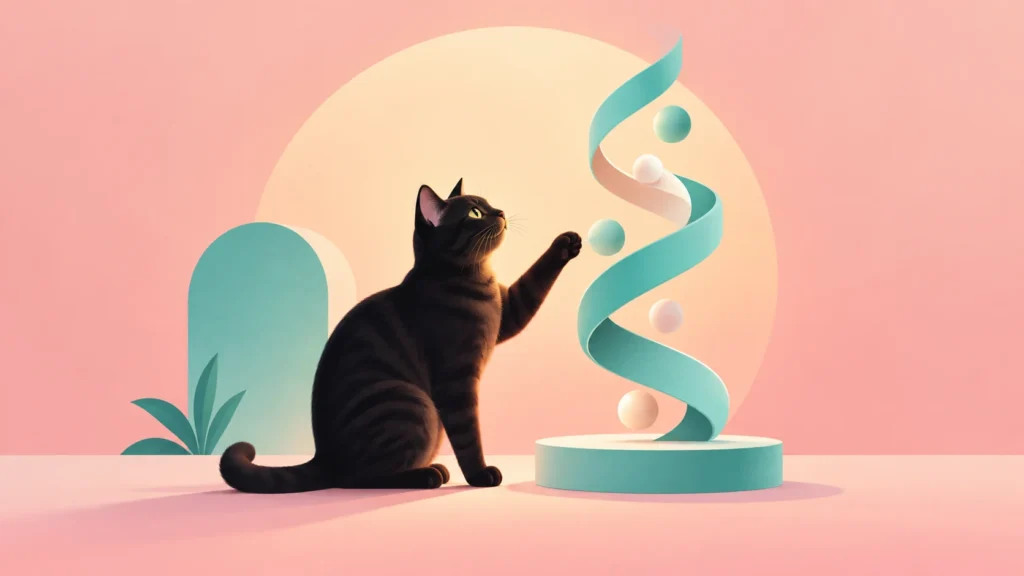
A black coat looks like a simple result: dark fur, everywhere. Underneath that appearance is a system controlling pigment production, distribution and pattern. One small genetic change can affect the result, but it is not a complete instruction manual for the animal.
The frequently mentioned “two missing letters” belong to a particular variant of the ASIP gene in domestic cats. They help explain non-agouti colouring, not every possible black coat across the cat family.
What the agouti switch does
The UC Davis Veterinary Genetics Laboratory explains that agouti signalling helps regulate switching between pigment types during hair growth. The non-agouti variant involves a two-base-pair deletion that disrupts the protein’s function.
In the laboratory’s notation, cats with two copies of the recessive variant are non-agouti, while one functional copy can produce agouti colouring. Other colour genes still affect the visible coat. The laboratory specifically notes the interaction with orange colouring, an important reason not to treat one test as a complete colour prediction.
Colour and pattern are not the same question
It helps to separate the pigment a hair contains from the arrangement of markings across the body. These processes interact, but they are not identical. A phrase such as “the black gene” compresses several biological questions into one convenient label.
That compression becomes misleading when it suggests that a single result explains every shade, every marking and every exception. A genetic test answers the question it was designed to test. A photograph supplies a visible appearance under particular lighting. Neither automatically replaces the other.
Different cats can reach a dark coat by different routes
A 2003 study of melanism in the cat family investigated ASIP and MC1R and identified different deletions associated with dark coloration in three felid species. Similar-looking coats therefore need not have the same underlying mutation.
This is a useful example of why resemblance alone cannot establish a shared genetic mechanism. A domestic black cat and a dark wild cat may invite the same visual description while raising different inheritance questions.
What a coat cannot tell you
A colour result is not a personality test. It does not establish that an individual is friendlier, more independent or more difficult to live with. Nor does a dark coat, by itself, demonstrate special disease resistance. Those claims need their own evidence.
The genetics is interesting without assigning a temperament to a pigment. It explains how a small change can alter a visible trait while reminding us how much remains outside that single explanation.
For the cultural stories people have attached to the same colour, read our history of black cat superstitions.