
 English
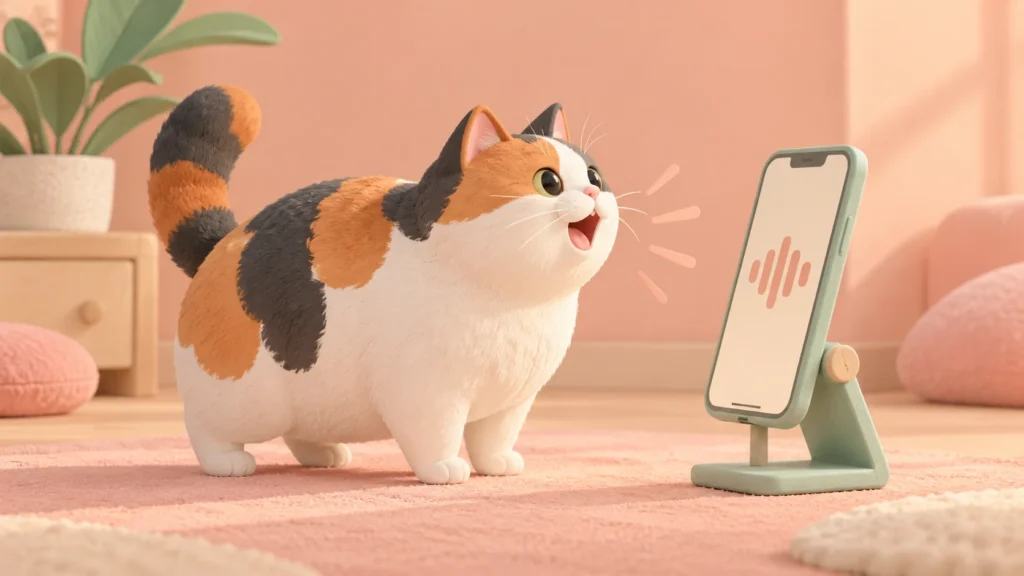
Your cat meows at the phone. A phrase appears on the screen. It is hard to resist the feeling that a small language barrier has finally fallen.
The interesting question comes a moment later: how did the app decide what the sound meant?
MeowTalk describes its system as using artificial intelligence to interpret feline vocalisations. Its results are presented through categories of intent. Those are the company's descriptions of its product; an appealing phrase on a screen does not itself establish what a particular cat intended.
Recognising a context
There is real research behind the broader idea of classifying meows. In a 2019 study by Ntalampiras and colleagues, researchers analysed recordings made in three situations: waiting for food, being brushed and isolation in an unfamiliar environment.
Their system could distinguish these recording contexts with high accuracy within the study's evaluation. That is an interesting result. Sounds can contain information associated with the circumstances in which they were produced.
But the labels came from situations the researchers already knew. A model choosing among three supplied categories has a narrower task than discovering the meaning of any meow from any cat.
The study is separate from an independent test of MeowTalk. Its results should not be borrowed as an accuracy score for the commercial app.
A label is an interpretation
Imagine recording your cat beside a closed kitchen door. The sound, the location and the time of day all matter to your own interpretation. You may know that food is behind the door, or that another member of the household has just gone through it.
A label such as hunger compresses those possibilities. It can be a useful prompt to look more closely, but the neatness of the word may conceal how much remains uncertain.
An accuracy percentage is only informative when you know what was tested: which cats, which recordings, which labels and whether unfamiliar animals were kept separate from training examples.
Consider an ordinary example: the app labels a recording as a request for food, but the cat is beside a closed door and has just eaten. The label gives you a suggestion; the surroundings provide evidence that may point somewhere else.
You do not need to decide that the software is always right or always useless. Keep the observation separate from the interpretation. A note of the time, setting and what happened afterwards is more informative than collecting a series of amusing labels with no context attached to them.
Keep watching the cat
If you try an app, compare the output with the situation rather than encouraging repeated meowing to get a funnier answer. Record ordinary behaviour without creating distress. Consider microphone access and the service's current privacy settings before sharing recordings.
A sudden change in vocalisation deserves attention to the animal and, where appropriate, veterinary advice. An app's reassuring phrase cannot rule out discomfort.
The same distinction matters in AI systems that assess feline pain: a computational output has to be judged against a clearly defined task and suitable evidence.
The entertaining part of MeowTalk is the apparent conversation. The more useful part may be the extra minute you spend noticing where your cat is looking, what just happened and what it does next.