
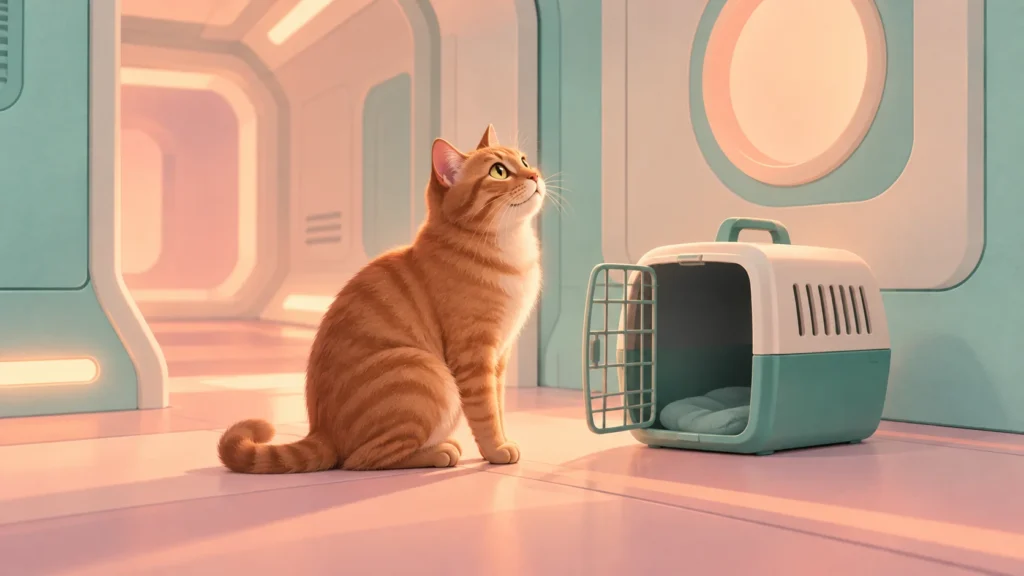
There is a ginger cat aboard the Nostromo. Amid equipment, narrow passages and people doing a difficult job, that detail makes the ship feel inhabited before it feels haunted.
Jones, usually called Jonesy, occupies very little of Alien‘s running time. Yet the cat changes how its spaces and silences work. A movement might be harmless. A person might have someone to address. A place built for industrial labour might also contain an ordinary attachment.
This article discusses situations and suspense in Ridley Scott’s 1979 film.
A familiar creature in an unfamiliar workplace
The BFI’s discussion of cats on film identifies Jones as the Nostromo’s feline crew member and notes his nominal role in controlling rodents. It also points to critic Anne Billson’s account of the different narrative functions he performs.
A ship’s cat is a wonderfully economical detail. It suggests routines that existed before the story began: feeding, finding a sleeping place, being underfoot. The audience does not need an explanation of every one of those habits to recognise them.
That familiarity is valuable in a film full of things its characters do not understand. Jonesy is a living creature they can recognise, even when they cannot control where he goes. The contrast helps make the unknown threat feel more alien.
A harmless explanation can create suspense
Horror depends partly on uncertain interpretation. A sound is heard; its source has not yet been identified. An animal gives a filmmaker a plausible answer that is innocent, mobile and not especially interested in following human plans.
The effect is not simply a joke interrupting a frightening scene. A harmless explanation can release one moment of tension while leaving the larger danger intact. Viewers have learned that a sound may have more than one possible cause.
This is one reason a cat works differently from an inert object falling off a shelf. It can keep moving, disappear again and demand attention elsewhere. Ordinary animal behaviour supplies uncertainty without needing a second monster.
Companionship gives the danger a scale
Jonesy also gives Ripley a familiar presence to address. Speech directed towards a companion can reveal attention and feeling without becoming a formal explanation for the audience. The animal’s silence leaves room for the human performance.
A small creature makes vulnerability concrete. Vast machinery and corporate priorities are difficult to hold emotionally; an animal that needs to be found and kept safe is immediately legible. That does not make the cat more important than the people. It gives the film another register in which danger can be felt.
The ordinary responsibilities of care become particularly striking when the surrounding situation has become extraordinary. A cat cannot be briefed on the emergency. Someone still has to take its needs into account.
Let Jonesy remain a cat
The character works without a supernatural explanation or a hidden strategy. Reading every look as secret knowledge can be entertaining, but the film does not need the animal to understand the plot for his presence to matter.
That restraint offers a useful contrast with Cat People‘s use of feline fear and suggestion. In Alien, the familiar cat and the unfamiliar creature occupy different parts of the audience’s imagination.
On a rewatch, notice what changes when Jonesy enters a scene: where attention moves, which sounds become ambiguous and how a human voice changes when it addresses him. The cat has no speech to explain his importance. The film’s handling of him does the work.