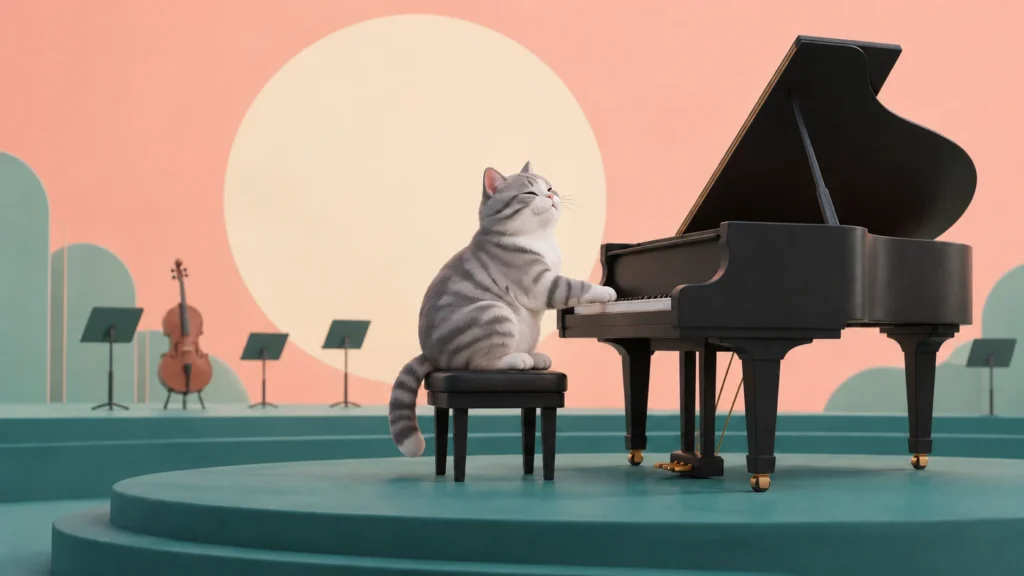
A grey tabby sits at a piano and presses the keys. On its own, the recording has the loose rhythm of a cat investigating something that makes an interesting noise. Add an orchestra that listens for those scattered notes, and the scene changes.
Nora the Piano Cat became the soloist in CATcerto, a piece by Lithuanian composer Mindaugas Piečaitis. Her contribution arrived on video. The musicians had a score.
From a Philadelphia home to a concert screen
According to the account maintained by Nora’s family, she was adopted by musicians and artists Betsy Alexander and Burnell Yow! after being rescued in New Jersey. She began playing at their piano as a young cat, and footage shared online in 2007 brought her a much larger audience.
Nora died in February 2024. The recordings remain, including the clips that caught a composer’s attention years before. Keeping that timeline clear matters: a newly encountered video can feel like a current event even when its performer has been part of internet history for a long time.
It is easy to see why a composer might linger over this particular footage. Each press produces a real piano sound, but the spacing follows the cat’s activity. Anyone trying to accompany it has to decide what to preserve, what to organise and where other instruments can enter.
How the composer built around her
On his CATcerto project page, Piečaitis describes contacting Nora’s owners in 2009, gathering footage and arranging her recorded playing into a continuous video. He then wrote the orchestral accompaniment around it. The work premiered in Klaipėda in June that year.
That order of events is part of the fun. The animal’s movements supplied material that a human musician shaped into a performable piece. Nora did not need to follow a conductor or understand the structure of a concerto for her sounds to become part of one.
The publisher’s catalogue identifies the work as a piece for chamber orchestra and video. On stage, the screen supplies the feline performer while the live players bring the accompaniment into the room.
What to listen for
The original performance shared by Piečaitis is the best place to meet the idea. On a first viewing, the temptation is to watch Nora throughout. On a second, try attending to the instruments around her and the spaces between her notes.
Listen for how an isolated sound changes when another instrument follows it. Notice when the accompaniment makes a pause feel expected. These are useful listening questions without requiring any claim that the cat intended the musical relationship you hear.
The distinction also makes an enjoyable comparison with Keyboard Cat, whose recorded performance acquired a new purpose through editing and reuse. The human arrangement determines much of what an audience understands, even while the animal holds its attention.
If our article about cats and classical music sent you looking for something to play, this is a particularly direct follow-up. You can hear the source of the idea as you watch it. Somewhere in the careful relationship between a recorded paw and a live ensemble, a small domestic interruption becomes a concert.