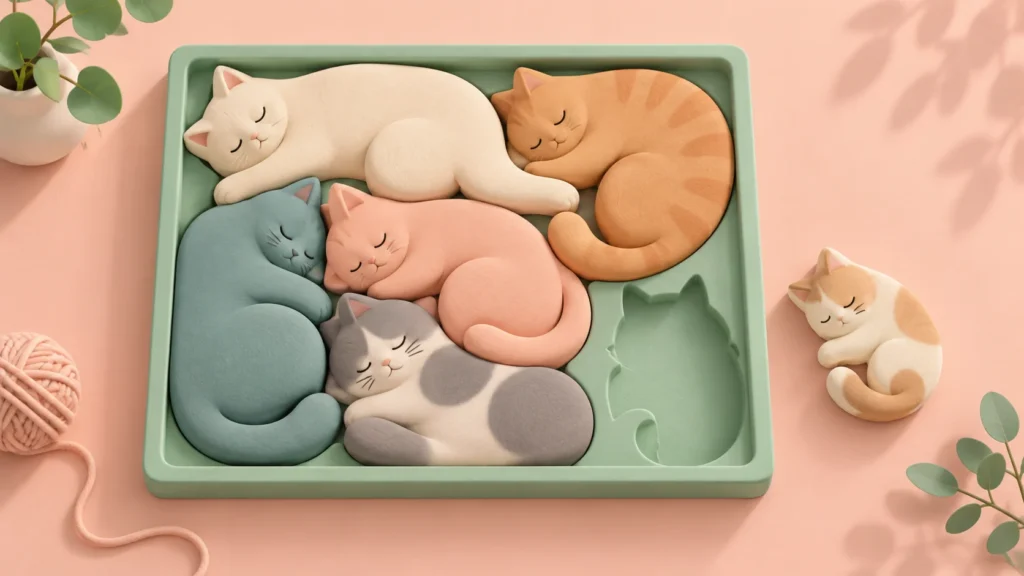
A cat can occupy a box that appears much too small for it, then somehow take up an entire sofa. Cats Organized Neatly turns that household puzzle into a literal one: here are the cats, here is the available space, and somehow everyone has to fit.
There is an immediate pleasure in the premise. The problem is visible before you have learned anything about a fictional world or memorised a long set of controls. You can look at the empty grid and start thinking about the shapes.
What you are arranging
Released in 2020 by DU&I, the game offers 80 handcrafted levels and 30 hand-drawn cats, according to its official Steam page. You place and rotate the feline pieces to fit them inside a grid. The developer describes controls built around the left and right mouse buttons, accompanied by quiet, café-like music.
The drawings give personality to what is fundamentally a spatial problem. A long cat or an awkwardly shaped one has a practical consequence: it takes up a particular arrangement of spaces. Cuteness and the puzzle therefore share the same object. The cat you want to admire is also the piece preventing the others from fitting.
Why a nearly full board can be misleading
A packing puzzle invites a familiar mistake. You put the most obvious piece in the most obvious place, build around it and discover a tiny gap at the end. Almost everything looks right. Unfortunately, the remaining shape is excellent at demonstrating the difference between almost and finished.
That is where this kind of puzzle becomes interesting. A placement can be locally convincing while making the rest of the board impossible. The satisfying moment comes when changing an early assumption allows several later pieces to make sense together.
If you tend to get stuck with placement puzzles, try attending to the empty space. Instead of asking where a favourite piece could go, ask which remaining piece could possibly fill a narrow recess or an isolated corner. This is a general approach to packing problems, rather than a solution to a specific level.
Rotating a piece can also be easier to reason about before it reaches the board. Look at its outline and imagine the gaps it would leave on each side. An attempted arrangement becomes useful even when it fails, provided you notice what made it fail.
Choosing the right kind of cat game
If the appeal of a cat game is watching little visitors develop routines, Neko Atsume offers a different kind of attention. If you like weighing several scoring possibilities across a tabletop, our look at Calico explores that pleasure. A compact packing puzzle is a better match for the moment when you want one clearly bounded problem in front of you.
This is an introduction to the game’s published design, rather than a claim that we have tested every level. The store’s screenshots and trailer are useful for judging whether its visual style and central task appeal to you. Check the current platform requirements there too, since an old operating-system entry does not necessarily describe what the store client now supports.
The title makes a promise that real cats would probably dispute. In a puzzle, though, there is room for optimism: somewhere among those rotations and rearrangements is a board with no awkward gap left over.