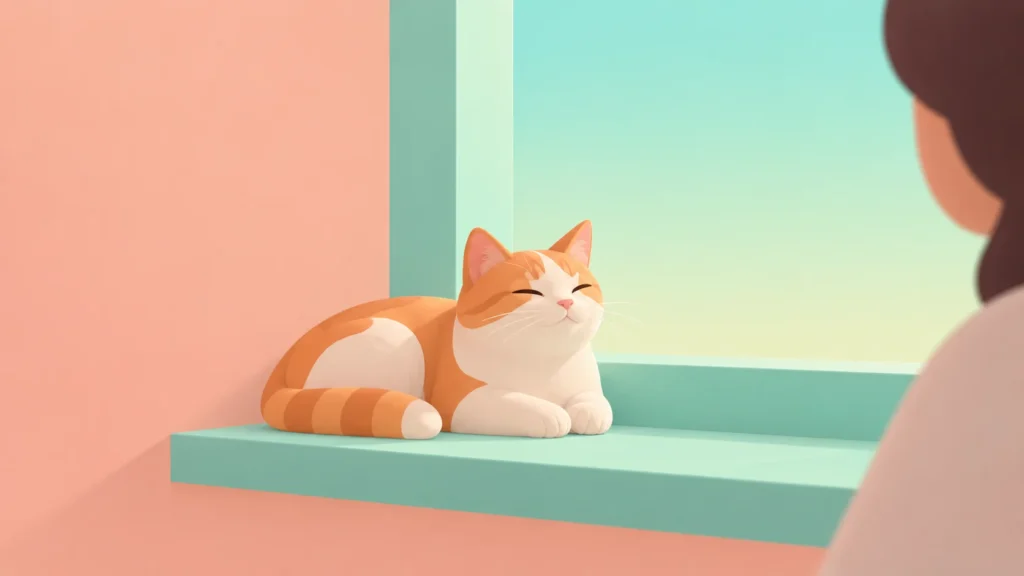
Your cat looks across the room, lets its eyelids droop and closes them for a moment. You do the same. Then you wait, feeling slightly foolish, while the cat resumes looking out of the window. Did that little exchange mean anything?
Slow blinking has attracted researchers as well as cat owners. There is evidence that cats respond to it, although the familiar description of a blink as a feline kiss gets ahead of what an experiment can establish.
What the experiments found
In a 2020 study in Scientific Reports, researchers examined two kinds of interaction. First, they compared cats’ eye movements when their owners slow blinked with a condition in which the owners did not interact with them. The cats produced more eye narrowing and half blinks during the slow-blink exchanges.
A second experiment involved an unfamiliar researcher. Cats were more likely to approach an offered hand after the researcher had slow blinked than after a neutral expression. That adds a useful behavioural observation: the response involved willingness to approach, as well as movement of the eyelids.
The findings support a role for slow blinking in positive communication between people and cats. They do not provide a dictionary in which every eye movement has one fixed translation. Nor do they tell us exactly what an individual cat is feeling during a particular encounter.
The rest of the cat still matters
A relaxed cat on its usual sleeping chair gives you a different starting point from a cat crouched beside an unfamiliar carrier. Looking at the eyes alone throws away much of that information.
Cats Protection’s body-language guidance recommends considering the animal’s whole posture. A loose body and relaxed ears belong to a different picture from a tense body, ears pulled back and an attempt to withdraw. The same person can be welcome company at one moment and rather too close at another.
There is also a distinction between a brief social exchange and an eye that stays narrowed. Persistent squinting, a change in how an eye looks or other signs of discomfort deserve veterinary attention. A charming interpretation should never stop us noticing a physical problem.
Trying it without turning it into a test
Choose a quiet moment when your cat has already settled nearby. Keep some distance, soften your gaze and close your eyes slowly for a moment. Then look away and give the cat room to decide what happens next. There is no need to bring your face close, hold the cat or repeat the gesture until you get the response you wanted.
In its discussion of slow blinking, Cats Protection cautions that the evidence is limited and that eye narrowing can occur in stressful situations too. A cat that does not blink back has not failed a trust test. It may be distracted, resting or simply uninterested in this particular conversation.
That is a useful habit to carry into other encounters. Our article on cats recognising their names also separates a detectable response from the response a person hopes to receive. Attention does not have to end with a cat walking over.
If your cat blinks, stays comfortably beside you and eventually goes back to watching the birds, you can enjoy the company without assigning a sentence to it. The window may still be the more interesting part of the room.