Gary and Shaggy had unusually long limbs as kittens. Later, veterinary examinations found problems involving their eyes and the aorta, the major blood vessel leaving the heart. Taken together, those observations led researchers to investigate a condition much better documented in people.
A study published in September 2026 reports the first combined clinical and molecular characterisation of Marfan syndrome in domestic cats. The two brothers helped connect a visible medical pattern with a specific genetic change.
How the case became a research study
Cornell University’s account, published on September 22, describes a collaboration between the cats’ owners, veterinary specialists and genetic researchers. The work involved Cornell and colleagues at other institutions, including Ghent University.
The important starting point was a combination of findings, rather than body shape alone. The cats had displaced lenses in both eyes and enlargement at the root of the aorta, alongside their long limbs. Those features pointed towards a disorder affecting connective tissue.
A case like this asks researchers to connect several levels of evidence. The examination identifies what is happening in the animal. Genetic analysis asks whether a change in the inherited instructions can help explain it. Further work then tests what that change actually does.
Why one gene can affect several organs
The gene involved is FBN1. The US National Library of Medicine’s explanation describes its role in making fibrillin-1, a protein that helps form networks of fine fibres outside cells. These networks support tissues and contribute to the assembly of elastic fibres.
That helps explain why an apparently varied set of problems can belong together. Blood vessels need appropriate strength and elasticity; the lens of the eye needs supporting structures. Connective tissue is involved in both places, as well as elsewhere in the body.
Different changes in the same gene can have different consequences. A gene’s name is therefore the beginning of an explanation, rather than a complete diagnosis or a prediction of severity.
The unusual finding in Gary and Shaggy
The Scientific Reports paper identified two copies of a variant near a splice site in FBN1. Splicing is part of the processing that turns a gene’s initial RNA message into instructions a cell can use.
In material examined from an affected cat, the variant caused a section of the message to be skipped in many transcripts. Some normally processed messages remained. The authors describe the variant as hypomorphic, meaning it reduces function rather than eliminating it completely.
This residual activity helps explain an otherwise puzzling result: the cats carried two altered copies yet survived into adulthood. The variant was also absent from a comparison group of more than 1,000 cats, supporting its rarity within that dataset.
What two cases can tell us
The report gives veterinary researchers a documented example to compare with future cases. It cannot establish how common the condition is across the domestic-cat population, and it does not announce a new treatment.
It would also be a mistake to turn the story into a visual checklist for owners. Long legs in a photograph are not the evidence assembled in this investigation. Questions about an individual cat’s health belong with its veterinary team.
Like the work discussed in our article on recognising feline pain, this research becomes more useful when the observation and the conclusion remain clearly connected. Gary and Shaggy’s case adds a carefully investigated example, with a molecular explanation that other researchers can examine.
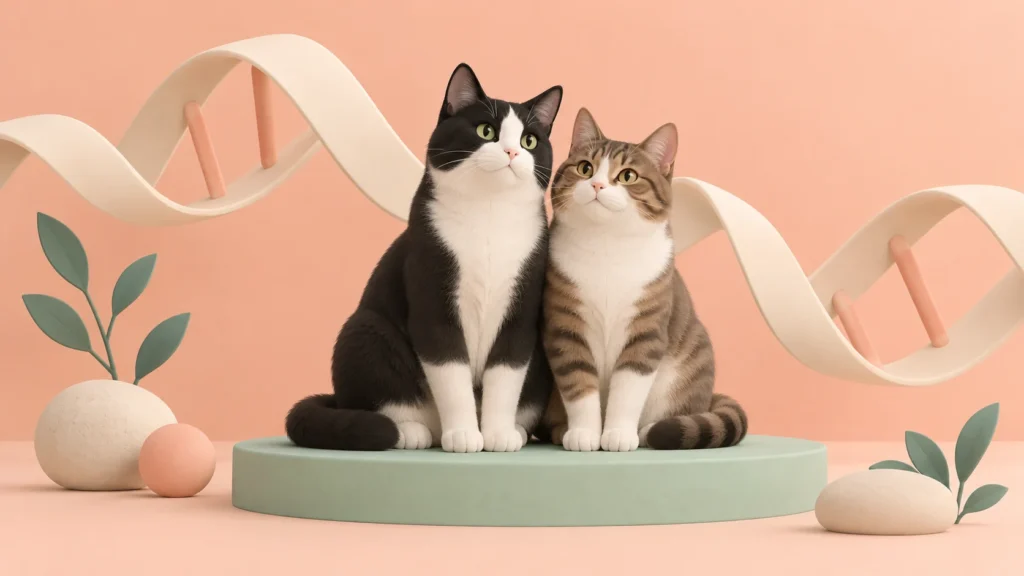
The featured image is an editorial illustration, not a photograph of Gary and Shaggy.