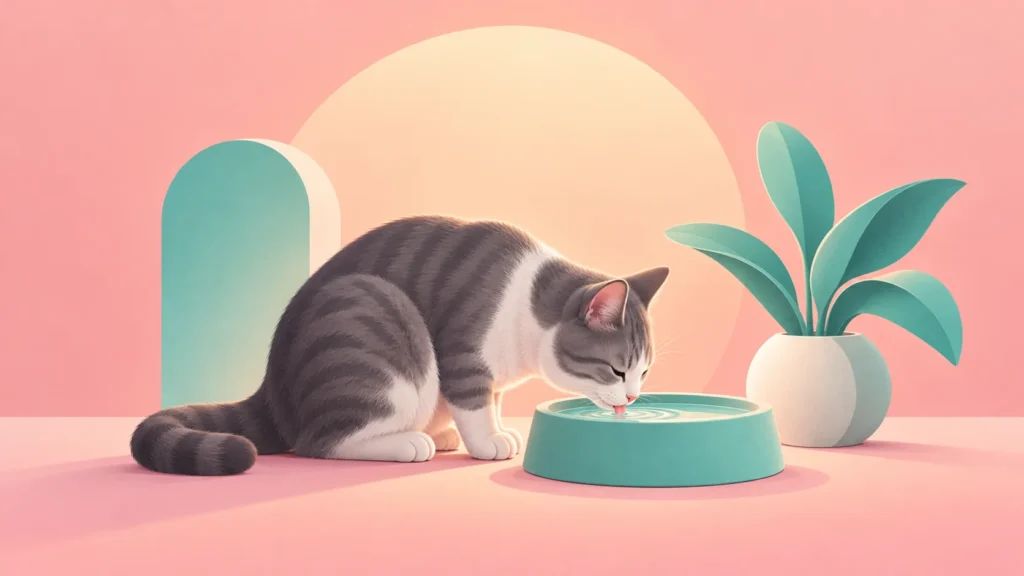
A cat at a water bowl looks busy without appearing to do very much. The tongue flicks, the surface trembles and the water level slowly drops. At ordinary speed, it is hard to see what actually travels from bowl to mouth.
Slow the movement down and something stranger appears: a narrow column of liquid briefly connects the tongue to the water below. The cat catches part of that column before it collapses. A drink is being assembled and dismantled several times a second.
The tongue touches, then lifts
In their 2010 study in Science, Pedro Reis, Sunghwan Jung, Jeffrey Aristoff and Roman Stocker examined this sequence using high-speed recordings and a physical model. The familiar bowl-side performance became a problem they could measure.
The tip curls backwards. Its upper surface contacts the liquid, then withdraws rapidly. Water adhering to that surface starts moving upwards with it. More liquid follows, creating the temporary column.
Thinking of the tongue as a little spoon can therefore lead you astray. The decisive event is the withdrawal and the moving liquid it produces. The mouth closes on the rising column; the rest returns to the bowl.
A race between upward motion and gravity
MIT’s account of the research describes the balance between inertia and gravity. Inertia keeps moving water moving. Gravity pulls it down. For a brief interval after the tongue lifts, the upward motion wins enough ground for the cat to collect a mouthful.
Wait too long and the column breaks. Close too early and the available column is smaller. The timing is part of what makes the movement effective.
It is tempting to say that a cat “calculates” the perfect instant. That is a cheerful metaphor, not a finding about feline arithmetic. The researchers calculated a model of the motion. The cat continued drinking without submitting any working.
Why the researchers built a substitute tongue
A camera can show that two events happen together. A physical model lets researchers change part of the process and examine what follows. The team used a mechanical substitute moving over liquid to investigate the column under controlled conditions.
This matters because a living cat is an uncooperative laboratory instrument. It chooses when to drink, shifts position and eventually walks away. A repeatable model can isolate the movement that an animal performs within a much messier scene.
The study also compared domestic cats with larger felines. Domestic cats lapped at roughly four times a second; larger tongues were associated with slower lapping. The interesting claim is a relationship between size and motion, not a universal metronome that every pet must follow.
Watch the gap above the bowl
On your next quiet observation, look at the space between mouth and surface. The useful action happens there, rather than only inside the water. A slow-motion recording may make it easier to follow, provided the cat can drink undisturbed.
This is also a good reason to separate a mechanism from advice. A study of how liquid moves does not establish the best bowl, a daily drinking target or the cause of a change in thirst. Those are different questions. Nor does a research image featuring milk make milk a recommended drink for cats.
Our article on the righting reflex follows another familiar movement that becomes more interesting when taken apart. In both cases, the pleasure is in noticing a sequence that happens too quickly for a casual glance. Your cat has probably completed several more examples while you were reading.