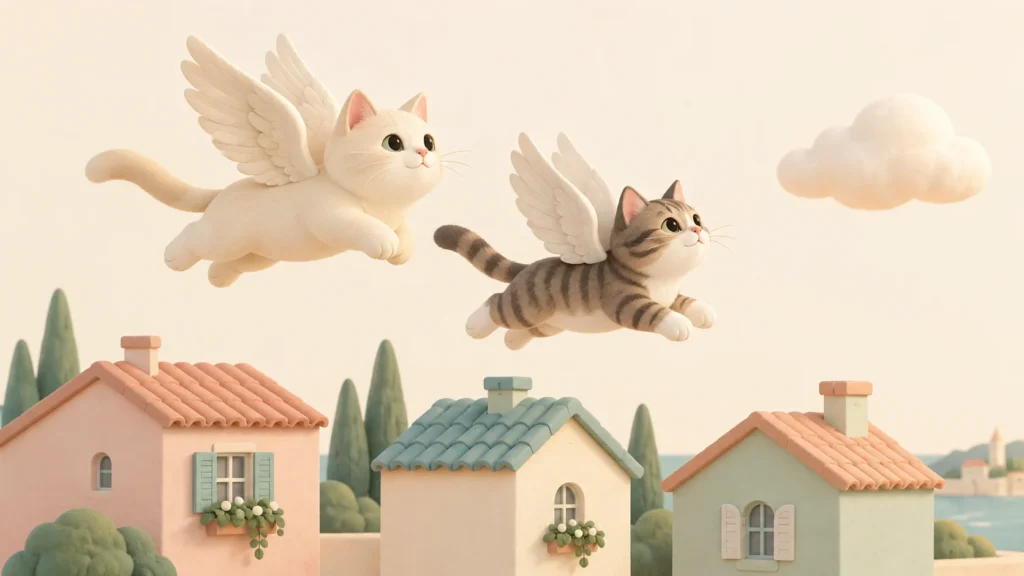
Mrs. Jane Tabby has four kittens, and all four have wings. She worries about them much as any mother might worry about children preparing to leave home. Flight offers a way out of their dangerous city neighbourhood, but it cannot tell them where to land.
That small, practical problem gives Ursula K. Le Guin’s Catwings its appeal. An impossible animal still needs somewhere safe to sleep. Even with feathers, a kitten has a great deal to learn.
A different corner of Le Guin’s imagination
Le Guin’s official bibliography dates the first book to 1988 and credits the illustrations to S. D. Schindler. Readers who arrive from her science fiction or Earthsea stories will find a much smaller canvas here: a family of cats, a departure and the question of whether unfamiliar surroundings can become home.
The series comprises four books: Catwings, Catwings Return, Wonderful Alexander and the Catwings and Jane on Her Own. These are short children’s stories, with pictures that matter to the reading experience. They are particularly inviting if you want to share a book with a younger reader without beginning a long fantasy series.
There is something funny about trying to imagine the household arrangements. Four ordinary kittens already require vigilance. Four that can reach places without using the furniture would make keeping track of everyone a considerably different job.
The wings do not settle everything
The publisher’s description and opening excerpt introduce Thelma, Roger, James and Harriet. Their mother sends them away from the city in the hope of a safer life. The countryside brings its own difficulties.
That premise gives a reader more to think about than the novelty of flying cats. An ability that solves one problem can leave another untouched. Getting away from danger does not automatically produce trust, food or a place where you belong.
For a conversation after reading, try asking which parts of the journey the wings actually make easier. Then ask what the kittens still need from other creatures. A child can answer through the pictures or through a favourite incident; there is no need to turn a bedtime story into an examination.
Another enjoyable question is where a winged cat would choose to rest in your own home. It brings the fantasy back to familiar territory. The highest shelf might win, although the warmest patch of floor would remain a serious contender.
Reading the pictures as well as the words
Schindler’s drawings deserve time of their own. Look at how the kittens occupy the space around them, and how their new anatomy sits alongside recognisably feline bodies. A useful way to share an illustrated book is to pause before turning the page and let the other reader point out what you missed.
The contrast with Wanda Gág’s Millions of Cats makes a pleasant pairing. One begins with an extraordinary number of cats; the other gives a small family an extraordinary ability. Both invite a reader to take an impossible situation seriously enough to care about its consequences.
You can start with the first Catwings and see whether its particular mixture of tenderness and uncertainty suits you. The kittens do not need a complicated explanation for their wings before their journey can matter. They need a safe landing.