
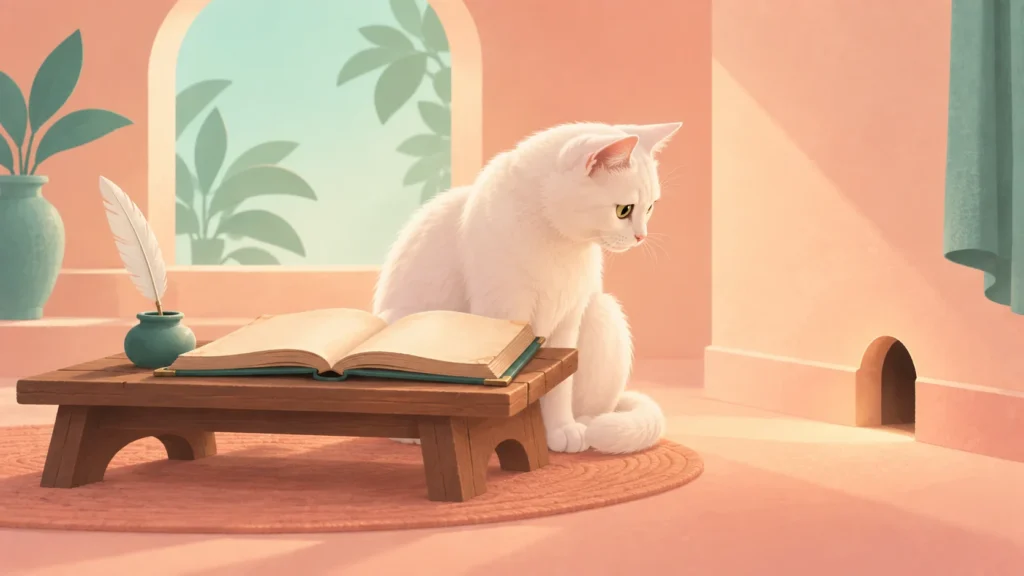
One occupant of the room is trying to solve a difficult passage. The other is waiting for a mouse. Neither considers the other’s job especially urgent. Somehow, the arrangement works.
That shared room is the world of Pangur Bán, an Old Irish poem by an anonymous medieval writer. The cat has survived in literary memory more securely than the name of the person who wrote about him. Many present-day cats would consider that a reasonable distribution of credit.
A small poem with a long journey
University College Cork’s CELT edition presents the poem as Messe ocus Pangur bán, with the English subtitle The Scholar and His Cat. Its catalogue places its creation around 800 to 850 and identifies the manuscript source as the Codex Sancti Pauli.
The text consists of eight short stanzas. Its scale suits its subject: a person’s work, an animal’s attention and the satisfaction each finds in a successful search. There is no grand adventure waiting outside the door.
For a modern reader, that smallness is part of the surprise. A medieval voice need not arrive carrying a battle, a royal genealogy or a warning about the end of the world. Sometimes it arrives with a cat and a task that is taking longer than expected.
Two kinds of concentration
The central comparison is between hunting prey and pursuing understanding. Pangur watches for a mouse. The scholar works through difficult knowledge. Each has a field of attention, a method and moments of success.
What makes the comparison appealing is its generosity. The cat is allowed to be good at being a cat. He does not have to read, deliver wisdom in human speech or abandon his interests to become a useful symbol.
There is humour in the parallel, but also recognition. Anyone who has worked beside a sleeping or watchful animal knows the peculiar companionship of sharing a space without sharing a project. Company does not always require conversation.
Read it as a relationship, not a slogan
It would be easy to reduce the poem to a reassuring message about productivity. Yet the two workers do not compete, swap jobs or measure their achievements on one scale. The delight comes from their separate purposes fitting comfortably within one room.
That makes the poem a useful counterweight to stories in which an animal exists only to improve a person’s character. Here the cat already has a complete occupation. The scholar’s insight is to notice the resemblance without erasing the difference.
Our account of cats in the Middle Ages explores why sweeping stories about medieval attitudes can mislead. This poem offers a more intimate kind of evidence: one literary voice imagining daily life with a feline companion. It cannot stand for every household or every century.
Which Pangur will you meet in English?
English versions vary in rhythm, diction and emphasis. Some sound conversational, others more formally lyrical. A translation is a writer’s set of choices, so the version that first reaches you will shape the room you picture.
Reading two versions side by side can be more rewarding than searching for a single definitive quotation. Notice whether the scholar sounds amused, peaceful or intensely absorbed. Notice how much independence the translator gives the cat.
For a different literary approach, T. S. Eliot’s practical cats build a whole social world of feline personalities. Pangur needs much less furniture. A page, a watchful animal and two kinds of patient attention are enough to keep this particular room inhabited more than a thousand years later.