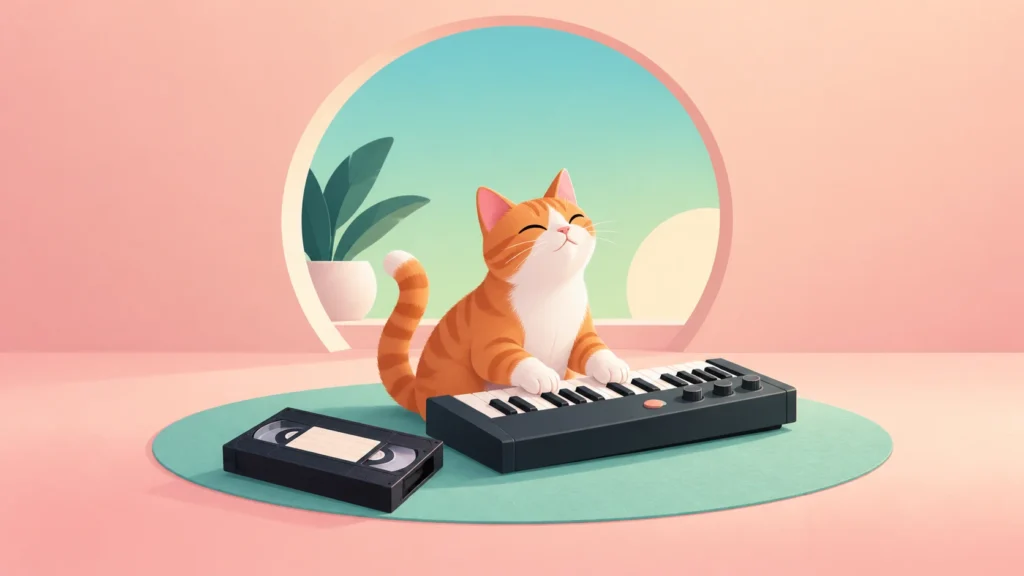
A cat in a blue shirt appears to play a cheerful keyboard tune. The clip is funny on its own, but its larger internet career depended on a second idea: put it after something goes wrong, and let the music dismiss the scene.
Keyboard Cat shows how a recording can acquire a new job long after it was made. The date of filming, the date of an upload and the moment a format becomes widely reused are different events.
A home-made performance from 1984
Charlie Schmidt’s own upload identifies the footage as an original 1984 clip. The performer was Fatso. In a 2009 interview with Love Meow, Schmidt discussed the cat and the making of the video.
This was a staged comic performance, not a demonstration that a cat had learned to play a keyboard independently. The shirt and framing help make the illusion legible. The audience does not have to believe in a trained feline pianist to enjoy the image.
The edit supplies a new meaning
Know Your Meme’s chronology records Brad O’Farrell’s February 2009 mashup placing the cat after footage of a man falling down an escalator. The “play him off” framing gave the old performance a reusable role.
The music becomes a kind of exit cue. Instead of commenting in words, the edit acts as if an unseen stage manager has decided the preceding performance is over. That structure can survive even when the setup changes completely.
Why a short ending travels well
A reusable ending asks less of an editor than an entire new sketch. The setup can come from one source and the payoff from another. Recognition supplies part of the pleasure: viewers know what the cat is about to do before the tune has finished.
The contrast matters too. A mishap may be chaotic or embarrassing, while the keyboard performance carries on with apparent composure. The cat does not respond to the event; the edit makes its indifference feel like a response.
The animal and the character are not interchangeable
Schmidt later made Keyboard Cat videos with other cats. The recurring character can continue, but that does not make every clip footage of the same animal. The creator’s attribution is a better guide than assuming a familiar costume establishes identity.
The same care applies to dates. A later upload of an old tape is evidence of that upload, not proof that the material was filmed then or that it was the first time anyone saw it online.
Keyboard Cat’s history is ultimately about reuse: a performance becomes an ending, and an ending becomes a format people can recognise across unrelated situations. Explore more of those transformations in our Internet Culture archive.