
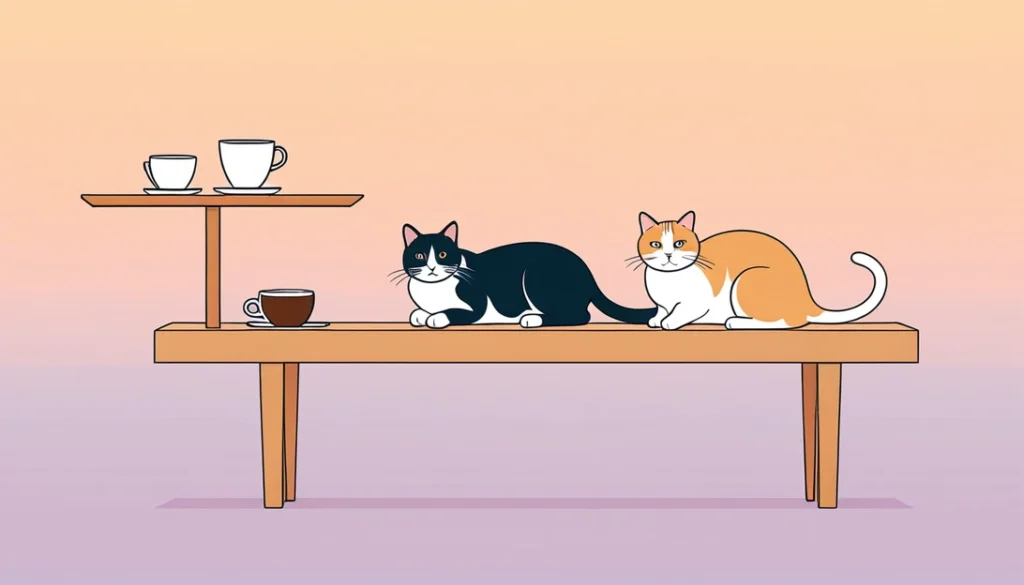
In 1998, a small place opened near Zhishan Station in the Shilin District of Taipei, put some cats in the room, and started serving drinks to strangers who wanted to sit with them. It was called Cat Flower Garden. Twenty four years later, in June 2022, Guinness World Records certified it as the oldest cat cafe still in existence. Much of the history that came after, the hundreds of Japanese rooms full of sleeping tabbies, the Bethnal Green waiting lists, the American adoption lounges with separate ventilation systems, looks back to that Taipei starting point. Cat cafes are now a global category of business with licensing regimes, welfare research, and a trade press. One room offered a simple possibility: spending time with cats without having one at home.
Table of Contents
- It Started in Taipei, and the Original Is Still Open
- How Japan Made Cat Cafes Familiar
- The 8 PM Rule: How Japan Regulated Cat Cafes
- The Long Walk West: Saint Petersburg, Vienna, London
- North America Rewrote the Business Model
- Why Many Cat Cafes Separate Cats and Catering
- What the Research Says About the Cats Themselves
- Frequently Asked Questions
- Where the Idea Stands Now
It Started in Taipei, and the Original Is Still Open
Cat Flower Garden, sometimes written as Kitten Garden and now trading under a name that includes the dogs too, opened in Taipei in 1998. The Guinness World Records entry, achieved on 9 June 2022, describes the animal roster at the time of verification: twelve cats, two dogs, and one bird. The cats are allowed to approach customers and jump on the tables. There are snacks for them on the menu alongside the human food, and cat books scattered around the room.
The concept is aggressively simple, which helps explain its appeal. You are not only paying for coffee. You are paying for proximity to an animal that has no obligation to like you. The connection with Japan is more than a tidy origin story: Tokyo’s Neko no Mise explicitly names Cat Flower Garden as its inspiration. A living room with cats was an idea worth adapting.
How Japan Made Cat Cafes Familiar
Japan’s first cat cafe, Neko no Jikan, opened in Osaka in 2004. Neko no Mise followed in Machida, Tokyo, in 2005. Their names roughly mean “Cat’s Time” and “Cat’s Shop,” neither of which suggests that the human customer will be in charge. The format became a recognisable part of Japanese city life while continuing to develop in Taiwan and elsewhere.
The Apartment Problem
For somebody whose apartment does not permit pets, a room shared with cats offers an obvious attraction. Limited space, rental conditions, working hours, and the long commitment of adoption can all make keeping an animal difficult. Neko no Mise describes the experience as sharing a living room with cats moving at their own pace. You can enjoy that company without mistaking a timed visit for the responsibilities of ownership.
That makes the cafe something more specific than a coffee shop with an unusual decorating scheme. It sells access to an experience a visitor may not have at home. Some customers are considering a cat of their own; others simply like being near animals. There is no need to assign the same story of urban loneliness to everybody holding a mug.
There is a particular charm to paying for an hour in which the main attraction may ignore you. The cat gets to remain a cat, and the visitor has to adjust expectations accordingly. Even a familiar sound deserves some context: our article on what purring does explains why a purr is not a universal certificate of contentment.
The 8 PM Rule: How Japan Regulated Cat Cafes
Scale brought scrutiny. In 2012, Japan introduced restrictions on the public display of dogs and cats by animal businesses during the night, generally from 8pm to 8am. Cat cafes were caught by rules also affecting pet shops. The Environment Ministry’s discussion of the measures records a temporary exception for adult cats able to move freely to a resting area, allowing display until 10pm while the effects were examined.
The 2016 regulatory discussion set out important conditions for the extended hours: cats at least one year old, free access to somewhere they could rest, and no more than twelve hours of display per day. It also addressed health-conscious treatment of older cats, using eleven years as a guide. Research reviewed by the ministry had not found a significant stress difference between the closing-time groups under the studied conditions. That is narrower than saying late opening is harmless for every cat in every cafe.
That is a remarkable thing to exist: a regulatory discussion about a cat’s maximum public-facing shift. The detail that matters most is the exit option. Staying open later is a different proposition if the animal can leave the interaction rather than remain available for every customer’s attention.
The Long Walk West: Saint Petersburg, Vienna, London
Saint Petersburg’s Cats Republic dates its opening to 2011 and describes itself as Europe’s first cat cafe. Vienna’s Cafe Neko followed in 2012, while other cities developed their own versions. London would attract substantial attention, but the European story had already begun elsewhere.
Lady Dinah’s Opened Twice
Lauren Pears used crowdfunding to establish Lady Dinah’s Cat Emporium, which opened in Bethnal Green in 2014. Booking a visit became an event in itself. Its appeal was not difficult to understand: a distinctly British cafe experience, with cats deciding how much of the hospitality they personally intended to provide.
The Bethnal Green business closed in 2025 amid financial pressures. Manager Freyja Hides-Westwood led a fundraising effort, and an additional investor helped make a new location possible. Reporting on the reopening places it on April 11, 2026 at 29–30 King William Walk in Greenwich. The new chapter followed community support as well as the practical work of rebuilding the business.
The closure and return reveal how many costs sit behind the pleasant room: rent, staffing, food service, veterinary care, and suitable accommodation for the cats. Affection helps bring customers back, but it does not cancel the bills. In this case supporters helped finance a return. Attachment had become a practical resource, rather than merely a feeling expressed in the comments.
North America Rewrote the Business Model
A prominent early American example was a marketing pop-up. Purina ONE announced a New York cat cafe for April 24–27, 2014, working with North Shore Animal League America. The cats were available for adoption. It was a temporary promotion, but it made an adoption-focused version of the idea highly visible.
Montreal’s Le Cafe des Chats opened in August 2014, among North America’s first permanent venues. In Oakland, Cat Town opened its cafe on October 25, 2014, widely recognised as the first permanent example in the United States. The opening-day report described a rescue project with a coffee counter attached, rather than a conventional cafe acquiring pets as decoration.
Cat Town and the Numbers That Justify the Model
Cat Town began as a rescue organisation in 2011. Its tenth-anniversary account describes helping cats who struggle in conventional shelter accommodation, including those needing patient socialisation. For a dated measure of the work, its 2023 adoption report records 463 adoptions, exceeding the previous annual record of 458 in 2015. Those are outcomes from the organisation’s wider rescue work, not proof that serving coffee alone changes a city’s shelter statistics.
The idea is easy to grasp. A frightened cat in a kennel may show visitors very little of its usual personality. A more suitable room can give it space to relax and people time to get acquainted. That does not guarantee an adoption or suit every individual, but it gives the meeting another chance. The distinction is between resident-cat venues and adoption-focused ones, rather than an absolute division between Asian and Western cafes.
Why Many Cat Cafes Separate Cats and Catering
Many cat cafes place the food counter and cat lounge in separate spaces. The arrangement can help with hygiene, controlled entry, and preventing escapes. Its exact form depends on the premises and the local rules; there is no worldwide two-room blueprint that every cafe must follow.
In the United States, the FDA Food Code is a model offered for adoption by jurisdictions, not one automatically binding national cafe licence. Section 6-501.115 generally excludes live animals from food-establishment premises, subject to specified exceptions. Local authorities determine which rules apply and how a proposed operation must separate its activities. That is why an operator needs a local answer rather than a floor plan copied from another city.
Some venues simplify their food offering; others have more substantial catering in an appropriately separated operation. Separate ventilation and particular wall or doorway arrangements may matter to an individual approval, but should not be presented as universal FDA requirements. The surprising amount of planning behind a sleepy cat and a cup of coffee is part of this business’s story.
What the Research Says About the Cats Themselves
A 2025 study in Animals observed 27 adoptable cats at one Stockholm cafe, in changing groups of eight or nine, for 227 hours over 70 days. This was a study of one setting, not a global verdict on the format.
The cats used both the customer lounge and a private cat room. Higher customer occupancy was associated with greater use of elevated or private space. Their responses to people varied, underlining the importance of being able to approach or withdraw.
The authors recommend vertical structures, hiding places, and areas customers cannot enter. They also caution that the setting, pandemic-related changes, and limits in observation reliability restrict generalisation. A shelf is useful, but the study does not show that layout alone guarantees welfare. Anyone familiar with cats investigating high surfaces will recognise part of the appeal.
Frequently Asked Questions
Where was the first cat cafe?
Taipei, Taiwan, in 1998. Cat Flower Garden in the Shilin District holds the Guinness World Record for oldest cat cafe still in existence, verified on 9 June 2022. Japan’s first, Neko no Jikan in Osaka, did not open until 2004.
Do you have to buy anything to visit a cat cafe?
Usually there is an admission charge, a timed session, a minimum purchase, or some combination. Prices and arrangements differ between venues. Check what your booking includes; the cat’s willingness to sit on your lap is unlikely to appear among the guarantees.
Are the cats in cat cafes adoptable?
It depends on the venue. Some keep resident cats, while others work with rescue groups to find permanent homes. A cat being a rescue does not automatically mean it is available for adoption. Check the cafe’s own policy rather than assuming the answer from its country.
Is it stressful for the cats?
It can be, and individual responses differ. The Stockholm study supports giving cats ways to withdraw from visitors, but cannot certify every cafe as safe or stressful. Suitable care, space, handling rules, and respect for animals avoiding contact all matter.
Why do cat cafes have a separate room for the cats?
Often to keep food service and animal interaction appropriately separated, alongside controlling entry and escapes. The required arrangement depends on local food and animal-business rules. Two rooms and independent ventilation are not a universal legal formula.
Where the Idea Stands Now
The format is no longer a curiosity with only one interpretation. The original Taipei room, Japan’s resident-cat spaces, and adoption projects such as Cat Town demonstrate several ways to combine hospitality and animal care. Counting every venue is less useful to a visitor than understanding what a particular cafe does for the cats living there.
What is striking is how far the thing has drifted from its origin without breaking. A Taipei room for people with small apartments became a Japanese urban stress valve with rules governing display hours, then a British crowdfunding cause, then an American setting for rescue work and adoption. Same cats, same room, several different needs being addressed. The cat, characteristically, contributed nothing to any of it and takes all the credit. For more on that talent, see the long history of humans reading meaning into cats and what happened when the internet got hold of them. And for a city that skipped the cafe stage entirely and just handed the cats the streets, there is Istanbul.
The idea that started in Shilin in 1998 turned out to be portable in a way almost nothing else in hospitality is. Put cats in a room, charge for the time, and the surrounding culture decides what the room is for. In Tokyo it is relief from a housing market. In Oakland it is an adoption pipeline. In Greenwich it is a community asset supporters helped finance. The cats sleep through all of it, which is the only correct response and arguably why the model works: nobody performs, nobody owes anybody anything, and the animal on the shelf is under no obligation to come down.