
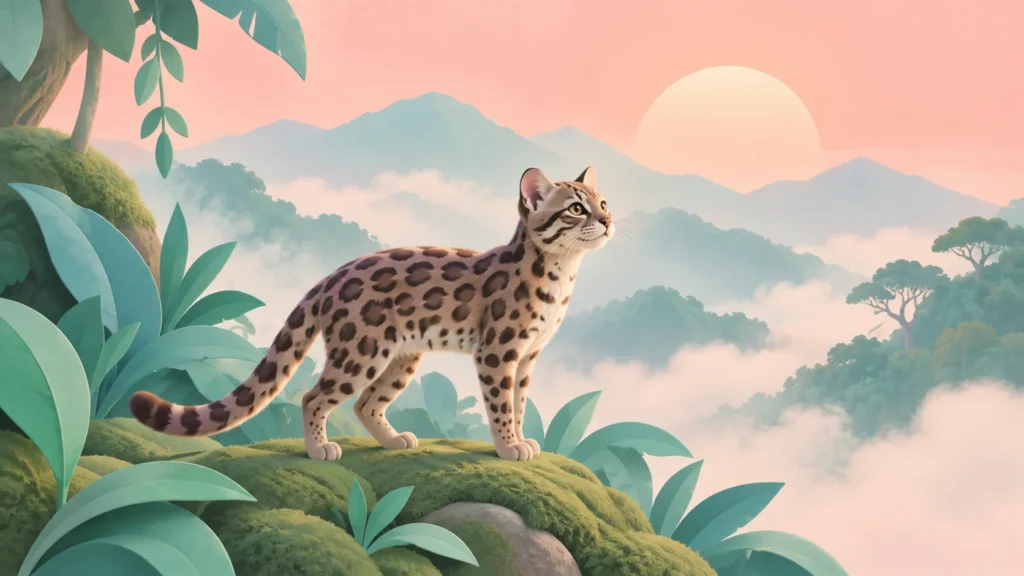
A small cat with irregular spots has just made the world’s feline family tree more interesting. Scientists have described Leopardus tilcayo, a wild species from the Yungas forests of Bolivia. It looks familiar enough to make you pause: how can a cat be new to science when people already know what to call it?
That is part of the story. Tilcayo is a local name, now carried into the scientific one. The discovery concerns the animal’s identity and evolutionary history. It is not a newly bred domestic cat, and it did not suddenly appear in the forest this week.
What was announced?
The description appears in a study published in Current Biology on 17 September 2026. The researchers investigated the difficult family history of South American tiger cats, small spotted members of the genus Leopardus. These are not miniature members of the tiger species.
The study supports five distinct species within that complex, including the newly named tilcayo. It also describes a Peruvian subspecies, Leopardus tigrinus antisuyo. Those two announcements are easy to merge in a quick headline, but they concern different animals and different taxonomic ranks.
New species descriptions and the restoration of older species names are also different events. That distinction matters when reading the widely reported claim that this is the first new living cat species formally described in more than a century. It does not mean that feline classification stood still throughout that period.
A forest cat with a familiar local name
National Geographic’s photographs and announcement show a small, lightly coloured wild cat with large, uneven markings. Its home is the Yungas cloud forest, where steep terrain and dense vegetation make an elusive animal difficult to study.
The announcement includes photographs of an individual at Senda Verde, a sanctuary in Bolivia. It describes this animal as the only known individual in protective care. That phrase should not be shortened to “the last tilcayo”: a statement about animals in care is not a census of the wild population.
The same caution applies to the appealing photographs. They show a wild animal, not a potential household companion. A sanctuary is a place of care, not evidence that a species has become domesticated.
How DNA changed the identification
According to the participating university PUCRS, the team compared complete genomes from 38 animals, including eight historical museum specimens. Museum material helped bring rarely encountered populations into the comparison.
This combination of modern samples and preserved specimens is called museomics. It lets researchers ask a broader question than whether two cats look alike. Similar coats can occur in lineages with separate evolutionary histories; genetic evidence can help reveal the boundaries that appearance leaves uncertain.
PUCRS identifies the sanctuary male, known as Tigrino, as the holotype: the reference specimen attached to the formal description. A holotype anchors a name. It does not, by itself, tell researchers everything about the behaviour, distribution or variation of the species.
What remains to be learned
A name is a beginning for conservation work. Researchers still need a clearer picture of where tilcayos live and how their populations are doing. It would be premature to turn the discovery into a precise population estimate, a complete range map or a settled extinction-risk category.
Separating previously grouped cats also changes the conservation question. A broad distribution attributed to one species can conceal several much smaller distributions. Protecting the group then requires understanding the places and pressures affecting each member.
For another example of why a familiar-looking cat can conceal a complicated biological story, see our explanation of feline taste and its genetic basis. Here, the striking result is larger than a coat pattern: an animal already known in its home region now has a clearer place in the scientific record.