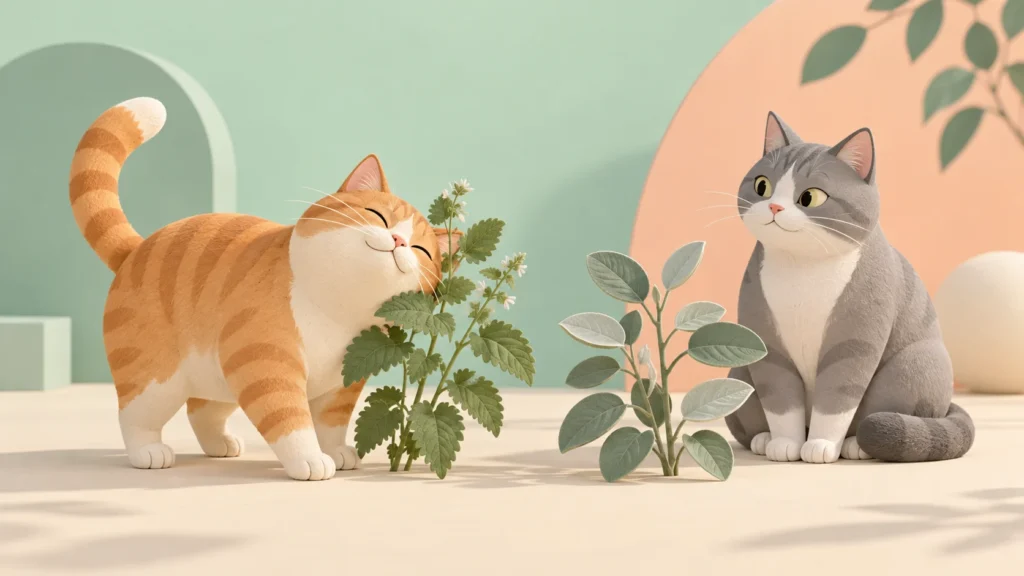
One cat rolls against a catnip toy as though it has discovered the best object in the house. Another gives it a brief sniff and leaves. Both reactions are familiar, and the uninterested cat has not necessarily missed the instructions.
Catnip is only one of the plants researchers have studied for this response. Silvervine has helped reveal how much variation there is between cats, and why the rubbing itself deserves a closer look.
Different plants, different responses
A 2017 study of 100 domestic cats compared catnip with silvervine, Tatarian honeysuckle and valerian. About two-thirds responded to catnip, while 80% responded to silvervine. Six showed no response to any of the four materials.
Those are findings from that study group, rather than a promise about every cat. They do show why one disappointing catnip toy tells you very little about whether a particular animal might respond to another plant.
The behaviours the researchers watched included sniffing, licking, rubbing and rolling. Describing these actions is more precise than assuming we can translate them directly into a human experience of intoxication. A cat cannot report how the sensation feels.
The chemistry reaches beyond a smell
Research published in Science Advances in 2021 investigated nepetalactol, a compound in silvervine. The work linked the characteristic response with the cats’ endogenous opioid system. It also found that rubbing transferred the compound to the fur and helped repel mosquitoes in the experimental tests.
This gives the rolling a possible function beyond being an amusing response to a plant. Contact matters: the cat can end up carrying some of the chemical material on its coat. The behaviour and the substance work together.
The mosquito result is a research finding under particular conditions. It does not make a plant-filled toy a substitute for veterinary parasite prevention. It also does not establish that a cat deliberately understands mosquito repellency when it rubs its face against a leaf.
Why chewing the leaves matters
A 2022 study in iScience looked at the effect of damaging silvervine and catnip leaves. Licking and chewing increased the release of iridoids, the group of compounds involved in these responses. Damaged silvervine also produced a changed mixture that elicited a stronger response.
That is a useful detail to notice. The plant is not simply releasing a fixed smell while the cat happens to roll beside it. The cat’s own handling can change what is released. A little bout of chewing can alter the chemical encounter that follows.
Leaf experiments should not be read as tests of every commercial powder, stick or scented product. Preparations differ, and results obtained with identified plant material cannot automatically be assigned to anything sold with a similar name.
The cat gets a vote
For everyday enrichment, the absence of a dramatic response is useful information too. There is little point arranging a cat’s leisure around something it ignores. Watching which activities it returns to will tell you more than comparing it with an especially enthusiastic video cat.
Our guide to food puzzles explores another way of offering choices and adjusting an activity to the animal in front of you. A plant response is one possible interest among many.
The research makes those familiar rolling cats more interesting to watch. There is variation between individuals, chemistry in the leaves and a physical exchange between plant and fur. The cat walking away belongs in that picture as well.