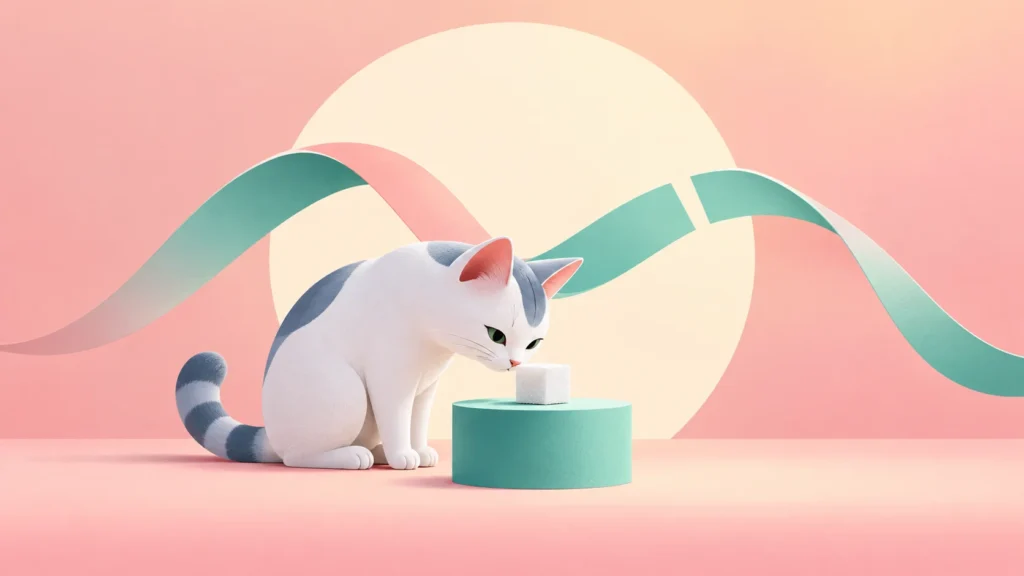
A dessert can smell interesting to a cat without tasting sweet. Cats lack the functional receptor that normally detects sweetness in mammals. The explanation lies in genetics, but it does not mean their entire sense of taste is missing.
The missing half of a sweet receptor
The familiar mammalian sweet receptor combines two proteins, T1R2 and T1R3. In a 2005 study, Xia Li and colleagues found that feline Tas1r2 was an unexpressed pseudogene. Its sequence included a deletion of 247 base pairs and premature stop codons.
The researchers also found the same deletion in the domestic cats, tiger and cheetah they tested. Together with the expression tests and earlier behavioral evidence, this provides a molecular explanation for feline indifference to sweet compounds.
The comparison suggests an inherited loss predating the separation of those sampled lineages. It does not directly date the mutation, and the study did not sequence every living cat species. “An ancient shared change” is more defensible than assigning it an exact age from a family tree.
Why a meat-based diet is relevant
A 2012 study of carnivorous mammals found independent losses of functional sweet-receptor genes in several other species. Some mammals had also lost genes associated with other taste receptors.
The authors linked these patterns to feeding ecology. If a sensory function becomes less useful, natural selection may be less effective at preserving it. That is different from an animal deliberately giving up a sense, or a diet automatically producing the same mutation in every species.
The pattern also does not justify saying that all carnivores have identical taste systems. Evolution works through particular lineages, mutations and circumstances. A broad dietary category is the beginning of an explanation, not the whole mechanism.
Umami works differently in cats
In research published in 2023, Scott McGrane and colleagues characterized the cat’s umami receptor and tested taste preferences. In their receptor experiments, nucleotides activated the receptor, while several amino acids enhanced the response when combined with a nucleotide.
The team proposed that tuna’s combination of inosine monophosphate and free histidine could help explain its appeal to cats. That was a proposed contribution to palatability, not proof that one molecular pairing explains every cat’s food choices.
There is another useful distinction here: a receptor studied in a laboratory system is not the same thing as the behavior of a whole animal. The paper used complementary methods because those levels of evidence answer related but different questions.
Bitter taste has not disappeared
A 2015 functional study identified twelve intact feline bitter-receptor genes and demonstrated responses from at least seven receptors under the tested conditions. Cats therefore have a functioning bitter-detection system despite their specialization as carnivores.
The evolutionary reasons for retaining those receptors remain a research question. Bitter detection should not be described as an infallible safety test: “bitter” and “poisonous” are not interchangeable categories.
What an interest in dessert can—and cannot—tell you
If a cat investigates a sweet human food, the observation alone does not reveal which feature attracted it. Smell, texture and other ingredients are possible factors. It is too strong to announce that one individual cat definitely wants the fat or protein without testing that explanation.
Likewise, an inability to taste sweetness says nothing by itself about whether a food is suitable for a cat. This is an explanation of sensory biology, not a feeding recommendation or a reason to test sugar substitutes on a pet.
The lesson is more interesting than “cats have no taste.” Their sensory equipment differs from ours in specific, measurable ways. Our article on feline vision explores another part of that sensory world. What seems like indifference at the dinner table can reflect a signal that their taste system does not detect.
Visit the Pudgy Cat Shop for cat-inspired goodies, or find our illustrated books on Amazon.