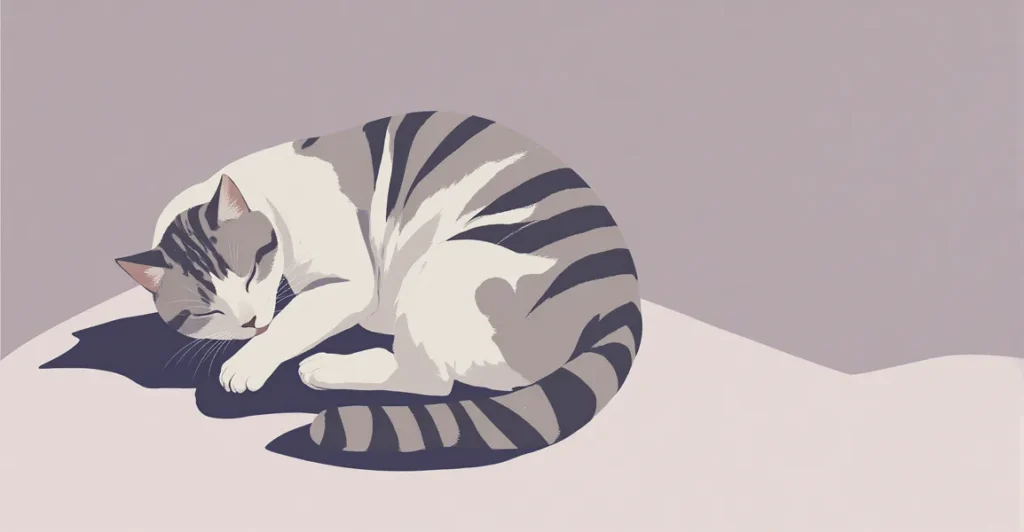
Minimalist illustration of a sleeping cat purring with visible vibration rings, why do cats purr

Why Do Cats Purr? The Science Behind the Rumble, Explained

Why do cats purr? The short answer is that purring is part vocalization, part self-soothing, and part low-frequency vibration therapy that may actually help bones and tissue heal. The longer answer involves vocal cord anatomy that scientists only fully mapped in 2023, a frequency band of 25 to 150 Hz that overlaps with therapeutic ultrasound research, and a sneaky little trick cats use to make humans feed them faster. This guide breaks down the mechanics, the meanings, and the science behind the most familiar sound in any cat household, written by a cat who has spent considerable time studying the matter from the inside.

Table of Contents

How and Why Do Cats Purr: The Anatomy Inside the Throat

For about fifty years, the textbook answer to why do cats purr focused on muscle action. The 1970s theory said the laryngeal muscles contract and relax roughly 30 times per second, opening and closing the glottis and producing the steady rumble on both inhale and exhale. It was a clean explanation that fit the data scientists had at the time, and it sat in veterinary curricula for decades.

Then in 2023, a research group at the University of Vienna led by voice scientist Christian Herbst dissected the larynges of eight domestic cats and found something the older model missed: thick fibrous pads embedded inside the vocal folds. These pads, about four millimeters across, add fatty connective tissue that lowers the vibration frequency dramatically. When Herbst’s team passed air through the larynges of post-mortem cats, the tissue produced low frequency oscillations between 25 and 30 Hz without any active muscle control. The brain signals the larynx to enter the purr posture, then the tissue does the rest passively, almost like a reed in a clarinet.

This matters because it explains a long-standing puzzle. Cats can keep purring through inhale, exhale, and even short pauses, with almost no audible interruption. Active muscle theory struggled with that continuity. Passive tissue resonance, driven by airflow over loaded vocal folds, handles it without contradiction. The implication is that purring is closer to snoring or speaking with a low growl than to actively tapping out a rhythm.

Why Do Cats Purr? The Five Main Reasons

Once the mechanics are clear, the obvious question is what triggers the purr. Vets and ethologists generally group the causes into five overlapping motivations, and a single purring session can involve more than one at the same time.

1. Contentment

This is the cliche, and the cliche is correct as far as it goes. A cat on your lap, eyes half-closed, kneading the blanket and rumbling away, is signaling that the environment is safe and the company is acceptable. This is the same kind of low-arousal pleasure response that drives a dog’s tail thump.

2. Communication With Other Cats

Mother cats purr to their kittens from the first hours of life. Kittens are born blind and deaf to airborne sound, but they can feel the vibration of a purring mother through her abdomen. The purr functions as a homing beacon that says here I am, you are safe, come nurse. Adult cats also purr at familiar housemates during low-stress contact, which seems to reinforce social bonds the way grooming does.

3. Self-Soothing Under Stress

Cats often purr in places they obviously do not want to be, like a vet exam table or the inside of a carrier. Behaviorists interpret this as a self-calming mechanism comparable to humming or rocking in humans under stress. The cat is regulating its own arousal state rather than expressing pleasure.

4. Pain and Illness

This one trips up new cat owners. A sick or injured cat may purr loudly. The behavior overlaps with self-soothing, but it is also where the healing-frequency hypothesis enters the picture, since the same vibrations that comfort the cat may be doing something measurable to its body.

5. Solicitation

The most cunning category. When a cat wants something specific from a human, usually food, it sometimes mixes a high-frequency cry into its purr. The result is a sound humans find difficult to ignore, because the embedded frequency sits in the same range as an infant’s distress cry. More on this trick in its own section below.

The Purr Frequency and the Healing Hypothesis

The purr sits in a narrow acoustic band between 25 and 150 Hz, with dominant peaks at 25 and 50 Hz in most domestic cats. This frequency range is interesting because it overlaps almost exactly with frequencies physiotherapists and orthopedic researchers have used for decades to stimulate bone density and accelerate fracture healing.

A 2001 paper by bioacoustician Elizabeth von Muggenthaler, titled The Felid Purr: A Healing Mechanism?, sparked the modern healing hypothesis. Her team measured purr frequencies across 44 felid species, from house cats to cheetahs and ocelots, and found the same narrow band again and again. She paired that finding with existing rehabilitation research showing that mechanical vibrations in the 25 to 100 Hz range improve bone density, joint mobility, and soft-tissue repair in mammals. The argument was straightforward: cats spend a large fraction of their lives at rest, so a low-cost vibrational maintenance system bolted onto the breathing apparatus would be evolutionarily advantageous.

The specific frequency bands map roughly to specific effects in clinical research:

  • 25 Hz to 50 Hz: linked to bone density and fracture healing in low-magnitude high-frequency vibration studies.
  • 100 Hz: associated with reduced pain perception and increased joint mobility.
  • 120 Hz: implicated in tendon repair and reduced inflammation in tissue research.

The hypothesis is still officially that, a hypothesis, because controlled studies on cats purring at injured cats are not exactly easy to set up. But the correlation is strong enough that NASA studied vibration plates partly because the natural model of low-frequency, low-amplitude, restful vibration in domestic cats hinted at the underlying mechanism. If you have ever wondered why a cat that just fell off a bookshelf is purring two minutes later, the healing hypothesis is the leading explanation. For a related quirk of feline behavior that also has a deeper rationale than it looks, see our piece on why cats knock things off tables.

The Solicitation Purr: How Cats Manipulate Humans

In 2009, animal behaviorist Karen McComb at the University of Sussex published a study that gave cat owners a small jolt of validation. McComb’s team recorded purrs from ten domestic cats during two contexts: regular contented purring on the couch, and the breakfast-time purr aimed at a sleepy owner who had not yet stood up to operate the can opener.

The two types of purr looked similar on a casual listen, but spectrograms told a different story. The solicitation purr contained an embedded high-frequency component, around 220 to 520 Hz, sitting on top of the low-frequency rumble. That high-frequency band overlaps with the acoustic range of a human infant’s cry. McComb played both purr types to human listeners, including people who had never lived with cats, and asked them to rate urgency and pleasantness. The solicitation purrs were consistently rated as more urgent and more unpleasant.

The simplest interpretation is that cats learned, individually or evolutionarily, to exploit a mammalian hardwired response to high-frequency distress cries. Cats that mastered the trick got fed faster. Cats that did not, ate later. Selection pressure took it from there. This is one of the cleanest examples of feline domestication shaping vocalization for human ears, and it pairs nicely with our deep-dive on why cats chirp at birds, another vocalization that does not appear in adult-to-adult cat communication in the wild.

Kittens, Mothers, and the First Purr

Kittens start purring at roughly two to three days old, before their ears or eyes are functional. The trigger is contact with the mother’s belly during nursing. Because the kitten cannot yet see or hear, the vibration is the dominant channel of communication, transmitted through skin and skeleton rather than through air. The mother purrs back, and the result is a tactile conversation that helps the kitten locate the nipple, stay close, and regulate its breathing.

This early life function explains why purring is so reflexively associated with safety and food. A kitten that purrs while nursing is more likely to nurse calmly, get more milk, and avoid being trampled by littermates. A kitten that gets that bonding signal also imprints purring as a comfort behavior it will use for the rest of its life. The same reflex, scaled up, is what makes adult cats purr when a trusted human picks them up gently, or behaves in ways that map vaguely onto a parental archetype. Cat behavior, like a lot of why cats knead behavior, traces back to the first month of life.

Can a Cat’s Purr Heal Humans Too?

The research on humans is more cautious than the marketing copy on the average pet blog. There is no rigorous double-blind study showing that a purring cat closes wounds or knits broken bones in humans. What does exist is a body of correlational research on cat ownership and human health outcomes.

A 2008 study at the University of Minnesota’s Stroke Institute, drawing from a cohort of more than 4,000 Americans tracked over a decade, found that cat owners had a 30 to 40 percent lower risk of death from heart attack compared with non-cat-owners, even after adjusting for known cardiovascular risk factors. The mechanism is not proven, but the leading hypothesis points to stress reduction, lower resting heart rate, and lower blood pressure associated with regular interaction with a calm pet.

Petting a purring cat triggers the release of oxytocin and reduces cortisol in human subjects, an effect measurable within minutes. The rhythmic low-frequency sound also functions as a kind of analog white noise, which improves sleep onset in many people. None of this rises to the level of a medical treatment, but as an unintentional side benefit of living with a small predator who naps fifteen hours a day, it is a respectable bonus.

For a broader look at how analog routines and tactile habits affect humans in surprisingly measurable ways, our piece on how to remember what you read covers some of the cognitive-rest research that overlaps with the same nervous-system territory.

When Purring Is a Warning Sign

Because cats purr for reasons that include pain, stress, and end-of-life self-comfort, a purring cat is not automatically a healthy cat. Vets watch for context, not the purr in isolation.

Signs that a purr should prompt a vet visit:

  • Purring combined with hiding, refusal to eat, or hunched posture for more than 24 hours.
  • A purr that sounds wet, raspy, or interrupted by coughing, which can indicate respiratory distress.
  • Purring during palpation of a specific body part the cat normally tolerates being touched.
  • A previously non-purring cat that suddenly starts purring constantly, especially in older animals.
  • Purring with rapid breathing, dilated pupils, and avoidance of usual sleeping spots.

None of these is automatic emergency, but they shift the prior from contented cat toward stressed or unwell cat. The rule of thumb veterinarians give: judge the whole cat, not the soundtrack. Cats have been quietly studied as health indicators in their own right, a small chapter in the larger history of how humans have read meaning into cats for thousands of years.

Do Big Cats Purr?

Not all felines purr in the same way, and the split lines up cleanly with anatomy. Cats with a fully ossified hyoid bone, like cheetahs, cougars, lynxes, bobcats, ocelots, and domestic cats, can produce the continuous low-frequency purr on both inhale and exhale. Cats with a flexible ligament instead of bone in part of the hyoid, the so-called roaring cats, can roar but cannot sustain a continuous purr. That group includes lions, tigers, jaguars, and leopards.

Snow leopards are the famous exception. They cannot roar despite belonging to the Panthera genus, and they produce a kind of chuff or short rumble but not a true sustained purr. Cheetahs, on the other hand, despite being among the largest cats that can purr, produce one of the loudest purrs measured in any species, reportedly audible from several meters away during contented rest. If you ever wondered why a cheetah at a wildlife sanctuary sounds like an idling motorcycle when it stretches out, that is the anatomy talking.

FAQ

Why do cats purr when you pet them?

Petting triggers a relaxation response associated with grooming behavior the cat experienced as a kitten. The cat’s nervous system interprets the contact as low-threat social bonding, and the purr is part of the automatic comfort response. In some cases the purr is also a reciprocal signal back to the human, the cat version of saying this is acceptable, please continue.

Why do cats purr loudly when they are dying?

End-of-life purring is most likely a combination of self-soothing under physical distress and the same low-frequency vibration the cat uses for routine self-maintenance. It is not a sign that the cat is fine. Vets sometimes describe it as the cat trying to use its only available comfort tool.

Can cats control their purr?

The brain decides when to enter the purr state, so initiation is voluntary in the same sense that breathing is voluntary. The actual sound is produced passively by airflow over the vocal-fold pads once the larynx is in position. Cats can stop purring on demand, often abruptly when they hear something interesting, but they do not consciously adjust pitch the way humans control speech.

Why does my cat purr but not let me touch it?

The purr is probably self-soothing rather than an invitation. Some cats purr when they are overstimulated and ambivalent, signaling that the environment is borderline-okay but not yet fully trusted. Respect the boundary and let the cat close the distance on its own schedule.

Do cats purr in their sleep?

Yes, both during light sleep and occasionally during deep REM sleep. The mechanism is the same passive tissue resonance, sustained by the breathing rhythm. A cat that purrs steadily while asleep is generally a cat that fell asleep contented and stayed that way.

Conclusion

Why do cats purr? Because their vocal cords carry fatty pads that resonate at exactly the frequency that calms a kitten, soothes the cat itself, possibly accelerates tissue repair, and conveniently happens to operate human heart rate and blood pressure in a useful direction. It is a single piece of anatomy doing several jobs at once, refined over roughly forty million years of feline evolution. The next time a cat curls up on your chest and starts rumbling, you can either enjoy the side effects, or take it as a polite reminder that your housemate is using you as furniture and a low-frequency vibration platform at the same time. Either reading is correct.


🐾 Visit the Pudgy Cat Shop for prints and cat-approved goodies, or find our illustrated books on Amazon.

Stay Curious, Stay Engaged!
Get our best stories delivered weekly. No spam, no fluff.
Share this story

Leave a Reply

Your email address will not be published. Required fields are marked *