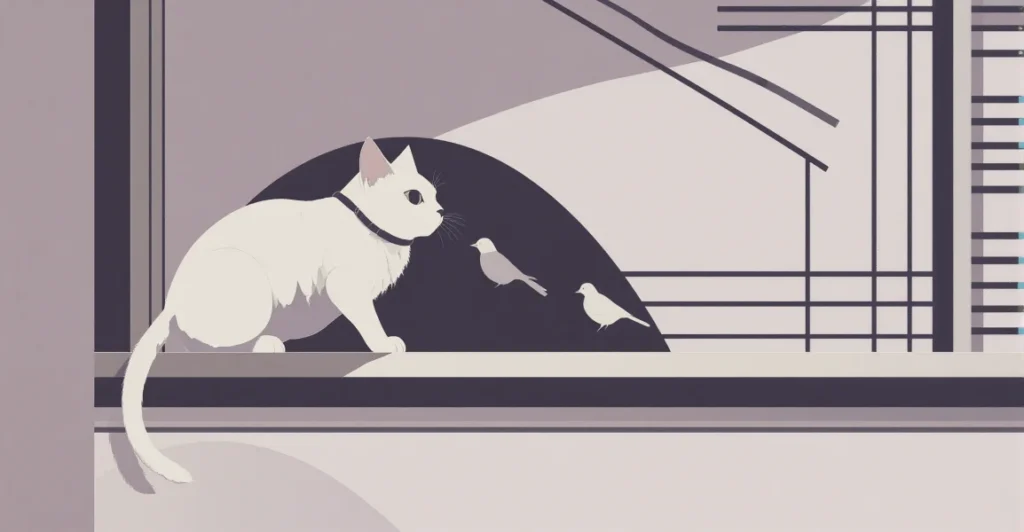
A cat spots a bird outside the window. Its stare fixes, its jaw begins to move, and a small machine-gun assortment of clicks and squeaks emerges. Why do cats chirp at birds? The honest answer is that the behavior is well recognized, but its exact function remains uncertain. Excitement and frustration are plausible explanations. Prey mimicry is a more intriguing possibility, and the familiar “rehearsing the killing bite” story is a hypothesis rather than a demonstrated neurological mechanism.
That uncertainty does not make the window performance less entertaining. It just means we should distinguish what we can see and hear from the subtitles we would like to give it. The cat has not approved our translation.
Table of Contents
- Chirping and chattering
- Excitement and hunting interest
- The frustration explanation
- Could it be mimicry?
- The killing-bite hypothesis
- What an owner can do
- Frequently asked questions
Chirping and Chattering Are Not Quite the Same Sound
Owners use chirp, chatter, twitter, and trill in overlapping ways. Broadly, chattering describes the rapid jaw movement and clicking sound, while a chirp includes a short voiced sound. A cat may combine several sounds during the same episode, which helps explain why descriptions vary.
There is actual acoustic research here. In a 2013 phonetic pilot study, Susanne Schötz analyzed 257 vocalizations from three related domestic cats watching birds. She described several sound types and found variation both between cats and within an individual cat’s calls. It was a small descriptive study, not a universal specification for how long every chirp lasts.
The distinction matters. Recording the noise can establish features of the sound; it does not by itself establish what the animal intends or feels. A microphone is very useful equipment, but it does not come with a feline thought decoder.
Excitement and Hunting Interest
The context is the strongest everyday clue. The cat is looking intently at a bird, insect, or other small moving target. Its posture and attention suggest interest in that target. Excitement is therefore a reasonable interpretation, and Cats Protection includes it among the possible explanations.
That does not establish a particular chain of adrenaline release, heart-rate spikes, and vocal reflexes. Nor does it mean all short cat calls are prey-directed. A sound’s context matters as much as the convenient name we give it. The same human word can cover noises that do different jobs.
The Frustration Explanation
A window creates an obvious mismatch: something interesting is visible, but inaccessible. Frustration may be part of the response. It is a plausible reading of the situation, not something we can measure simply by counting jaw clicks.
Calling it frustration also should not lead straight to “therefore open the window.” The sound does not create an obligation to provide live prey. A house cat can be interested in the outside world while staying safely separated from it. The bird did not volunteer to help settle a behavioral debate.
One episode may be brief and easily interrupted; another cat may remain intensely focused. Watching the whole sequence gives you more information than deciding that the sound always means the same thing.
Could the Cat Be Imitating Its Prey?
The most memorable comparison comes from a wild relative. Researchers observed a margay in the Brazilian Amazon producing sounds resembling pied tamarin calls in 2005. The Wildlife Conservation Society described the observation in 2010. Monkeys approached, but an alarm call helped thwart the attack.
It is a fascinating report of apparent prey mimicry. It is not a controlled demonstration that domestic cats imitate birds when they chatter at windows. Moving from one wild-cat observation to a general explanation for every household tabby is a much larger step than the story alone supports.
The possibility is worth discussing because it suggests a question that could be investigated. Calling a hypothesis interesting is different from calling it settled. Your cat can retain its air of espionage without being awarded a proven talent for avian impersonation.
The Killing-Bite Hypothesis
Another explanation links the jaw movement to the bite used during hunting. Cats Protection describes this as an unlikely theory. The visible movement is real; the claim that a specific bite circuit is firing without prey is not established by that appearance alone.
Two movements looking similar is a starting point for a question, not proof that they have the same function. Describing chattering as a “motor rehearsal” may sound satisfyingly precise, but precision in the wording cannot substitute for evidence. It is all right to leave this part unresolved.
What an Owner Can Do
Familiar, brief chattering during birdwatching is usually not a problem. If it is new, increases markedly, or comes with other changes in behavior or health, speak to a vet. The sound alone is neither a clean bill of health nor a diagnosis.
Cats Protection suggests play as an outlet and reducing the view of wildlife if the situation appears to frustrate the cat. A supervised fishing-rod toy gives the cat something to stalk and catch without involving the sparrow. Choose activity your cat engages with comfortably, and give it room to disengage.
You can also make a simple record of what happens: the target, the duration, the cat’s posture, and whether it returns to ordinary activity afterward. A short video can help explain an unfamiliar episode to a vet. That is more useful than deciding the cat must be complimenting your home, planning a kill, or demanding a very specific toy.
Frequently Asked Questions
Do all cats chatter?
No. Some owners hear it regularly and others hardly at all. Not making the sound is not, by itself, a problem. Cats do not owe us the full sound-effects package.
Why does my cat make a little trill at me?
A greeting-like trill can occur in a different setting from prey watching. Everyday labels overlap, so look at what the cat is doing rather than assuming that every short sound means a hunting response.
Does chattering prove that a cat is stressed?
No. Excitement and frustration are among the possible interpretations, and context matters. A change from your cat’s usual behavior is more informative than the noise in isolation.
Should I punish the behavior?
No. Treat it as something to observe and understand. If the situation seems unhelpful, offer an alternative activity or reduce the visual trigger. For persistent concerns, get advice suited to the individual cat.
Are wild-cat chirps the same thing?
Similar-sounding calls occur in other felids, but similarities in the name or sound do not establish identical functions. The margay observation is one example with a particular context, not a translation key for the entire family.
The cat at the window gives us a small, funny glimpse of an animal attending intensely to its world. We know more about the sound than we do about its precise purpose. That leaves room for curiosity, a little restraint in the explanation, and perhaps a toy the cat can actually catch. For more animal oddities, browse Curiosities.