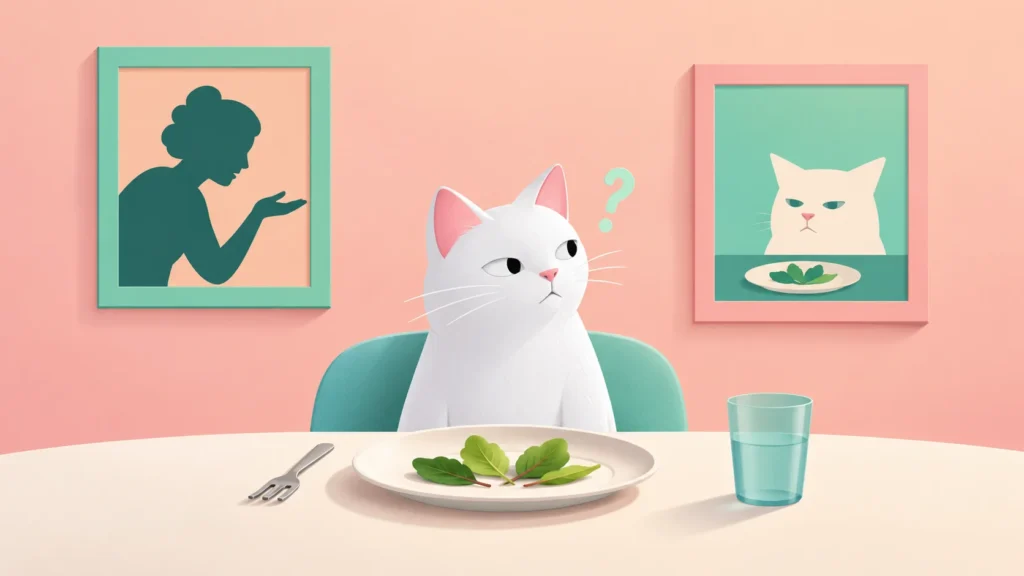
A woman points across a restaurant table. A white cat sits behind a plate of vegetables. Put the photographs together and they appear to document a magnificent argument. They do not: the joke depends on editing two unrelated situations into a conversation.
That gap between what a picture records and what a caption makes it mean is the engine of Woman Yelling at a Cat. Neither half needs to know the other exists for the audience to invent a relationship.
Two pictures, two different lives
The woman is Taylor Armstrong, shown with Kyle Richards in footage from The Real Housewives of Beverly Hills. The cat is Smudge. In a firsthand interview with TIME, owner Miranda Stillabower described his habit of occupying a chair at dinner. The familiar photograph came from that domestic setting, rather than a television confrontation.
Smudge’s expression does much of the comic work, but calling it outrage or contempt is our interpretation. A still photograph cannot tell us exactly what a cat thought. The plate, chair and angle give viewers enough material to cast him as a diner with a grievance.
The television scene was not a harmless argument about salad
In her 2025 interview with Know Your Meme, Armstrong explained that the original scene involved fear connected to abuse in her marriage. She was not performing a joke for a future internet audience.
She also described being able to find humour in the meme years later, after therapy and work speaking about domestic violence. Both things can be true: the source moment was distressing, and she subsequently found a different relationship with its public afterlife. Her account should take priority over guesses about how a famous reaction image must feel to its subject.
Why the pairing is so adaptable
There is a useful imbalance between the panels. The human image supplies movement and intensity; the cat image supplies stillness. A caption can turn that contrast into an accusation and a reply, an elaborate complaint and a literal misunderstanding, or two incompatible definitions of the same word.
The format also leaves room for the reader to finish the joke. We imagine tone, timing and a line of dialogue that nobody actually spoke. Unlike a complete video sketch, the image does not fix every part of the exchange. Replacing a few words can give the same faces a new dispute.
A caption is not the original event
Reaction images are efficient because they shed context. That efficiency is also their limitation. They can make a stranger’s experience look like a stock emotion, and they can turn an animal into a character whose intentions are entirely invented.
Knowing the two histories does not require us to pretend the composite never became funny. It lets us recognise what is funny about the edit without mistaking it for a documentary scene. For more on how pictures acquire new meanings, explore our Internet Culture archive.