In 2004, a surprisingly reliable way to find a picture of a cat online was to read a political blog on a Friday. Cat sites already existed, but Friday catblogging made them a weekly ritual that serious writers used to break up posts about election polling. The surrounding feline web grew into carnivals, community hubs, book deals and a reported two-million-dollar acquisition. Some sites later closed, others changed shape, and a few communities kept going. Nobody had stopped liking cats.
This is the story of that feline web: its text-heavy beginnings in the 1990s, its independent-blog boom in the 2000s, and what happened when social feeds became another place to put the cat. There is no single villain. Even Google Reader, whose departure hurt, did not personally confiscate anyone’s tabby.
Table of Contents
- Before Cat Blogs, There Were Cat Newsgroups
- Friday Catblogging and the Weekly Ritual
- The Golden Age of Cat Blogs, 2004 to 2007
- The Cat Blogosphere and the Community Behind the Pictures
- Cheezburger and the Year Cats Became a Business
- How Social Feeds Changed Cat Blogging
- Frequently Asked Questions
- Conclusion
Before Cat Blogs, There Were Cat Newsgroups
Cat discussion was thriving online before the cat-blog boom. On Usenet, rec.pets.cats and its successor groups collected questions about litter boxes, illness and new arrivals. A surviving 1990s FAQ announcement points readers to collections of advice and related resources. These were communities built around conversation, with the FAQ doing some of the work a pinned introductory post does today.
Mailing lists provided another home for discussions among owners, breeders and enthusiasts. Their practical exchanges are part of this history too: the feline internet was answering worried humans long before it became famous for funny captions.
These spaces were often text-heavy. Images were possible, but bandwidth, software and hosting made exchanging photographs less frictionless than posting a sentence. The balance shifted as personal websites and blogs made pictures easier to share. Our history of internet forums follows the broader communities around that change. Cats had an audience; now they were getting more screen time.
Friday Catblogging and the Weekly Ritual
One influential route ran through Kevin Drum’s Calpundit. In 2003 and 2004 he helped popularize Friday catblogging: photographs of his own cats, including Inkblot, between the political arguments. In a 2014 interview, he described the friendly response those posts received. The cats gave readers something to agree about. Mostly.
Drum took Political Animal to the Washington Monthly in 2004, moved to Mother Jones in 2008 and left it in 2021. When he died in March 2025, The New Republic marked his death with a Friday-catblogging tribute. The ritual had become part of his public identity. It worked because it was a deliberate break in register, a reminder that the person behind the argument had a life, and cats, beyond it.
The Carnival That Turned a Habit Into a Network
Laurence Simon, author of This Blog Is Full Of Crap, helped turn the scattered habit into a network with Carnival of the Cats in 2004. Participating blogs took turns hosting a roundup of feline posts. A visitor arriving for one familiar cat could leave knowing several more, along with the humans who supplied the photographs.
The surviving links show how long that voluntary network lasted. A December 2010 post at Lost in the Cheese Aisle directs readers to Carnival number 352 at Mind of Mog, with its own cat Hakuna leading the parade. That is evidence of a long-running institution, even without assuming that every scheduled edition appeared without interruption. Keeping a cat-photo roundup alive for years is a respectable feat of administration.
The Golden Age of Cat Blogs, 2004 to 2007
Carnivals were one route through a growing collection of single-topic sites, rather than the beginning of all of them. MyCatHatesYou dates to 2000 in Know Your Meme’s early-cat-site chronology, a format that looks obvious now and looked eccentric then, in the same way the Hamster Dance looked eccentric until it did not.
The Infinite Cat Project and Stuff on My Cat
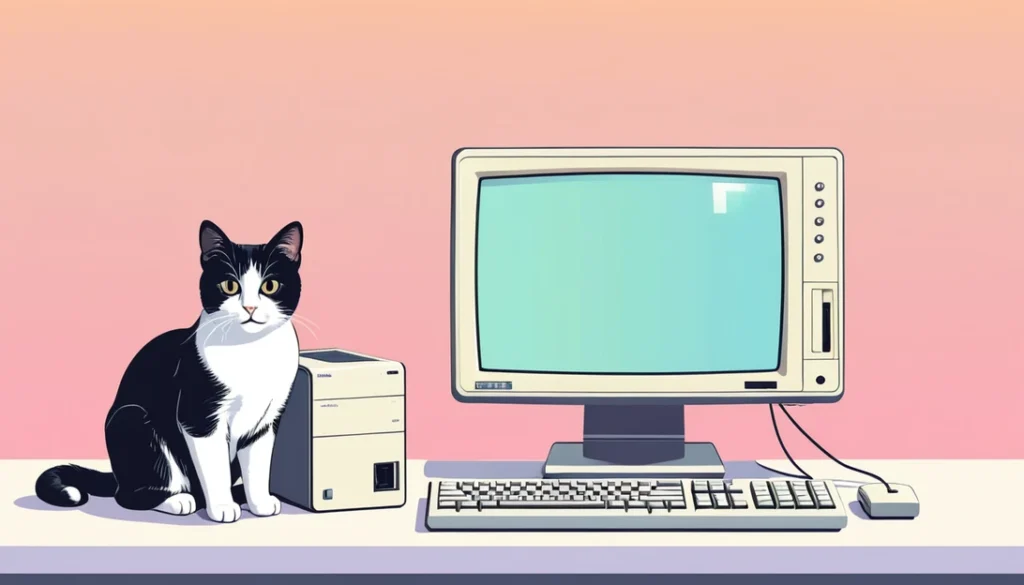
In 2004, Mike Stanfill launched the Infinite Cat Project: a chain of photographs in which a cat looks at a monitor displaying an earlier cat. A contemporary report from August 2004 describes its origin in a forum exchange and the invitation to keep the recursion going. It is a pure artifact of the era: easier photo-sharing, willing volunteers and absolutely nothing better to do. A cat looking at a cat looking at a cat is, technically, an expanding audience.
Stuff on My Cat, built by Mario Garza around his patient sleeping cat Love, started with office supplies and spare computer parts balanced on a napping animal. The joke grew into a Chronicle Books collection published in 2006. Web attention had become a physical object you could place on a shelf. Preferably the shelf, rather than the cat.
Cute Overload and the Rules of Cuteness
Cute Overload, created by Megan Frost in 2005, made its captions and shared vocabulary part of the attraction. Its Rules of Cuteness were an evolving list, not a fixed seven-point formula. Tiny paws and implausibly cute poses became material for a running conversation between editors and readers. This was affectionate overanalysis, which is an excellent use of a small animal photograph.
Recognition included the blog-category People’s Voice honour at the 2006 Webby Awards. Cute Overload continued until January 2016. Its closure was a real ending for a particular community, but it should not stand in for the disappearance of every animal blog.
Running in parallel, Catster took a different approach. Launched in 2004 by Ted Rheingold and Steven Reading, it gave cats profiles, friends and diaries: a social network where the users were cats and the typing was done by staff. Catster’s own history records its combination with Cat Fancy in 2015 and Pangolia’s acquisition in 2023, the year its print edition ended. The website’s survival shows why a neat rise-and-fall story needs room for transformations.
The Cat Blogosphere and the Community Behind the Pictures
The part of this history that gets left out of most retrospectives is that cat blogs were a social network before social networks, with all the obligations that implies. According to the Cat Blogosphere’s own account, on 27 April 2006 Robyn Harton, known in the community as Mom Robyn of HotMBC, published the first post on the Cat Blogosphere, writing in the voice of her cat Sanjee. The site became the central news hub for hundreds of pet bloggers: announcements, events, jokes, and, more than anything, news about sick animals and sick humans.
It moved from Blogspot to WordPress on 1 January 2007 and passed through a chain of volunteer editors, ML Sherwood, Sue Strong, Morgen Pittman in January 2013 and Paula Gregg from April 2018 until her death on 2 May 2022. Terry Frum later took over with a team. Memorials for the community’s pets remain part of its work. Harton credited earlier bloggers as the inspiration, among them Psychokitty Max, Timothy Dickens, Laurence Simon and Jay Dyke’s comic strip The Mows.
The carnival format spread sideways too. Weekend Cat Blogging, created by Clare at the Australian food blog Eat Stuff, brought food bloggers into the ritual: cook something, photograph the cat who supervised. Farmgirl Fare’s July 2005 archive already lists editions six, seven and eight, credits Clare and invites readers to submit their links. The dated posts show the network in action, down to the instructions for joining. It was a recommendation system operated by people who knew one another’s cats.
Cheezburger and the Year Cats Became a Business
On 11 January 2007, Eric Nakagawa and Kari Unebasami launched I Can Has Cheezburger around a captioned cat image. A 2008 interview with its founders recounts how Kari had sent Eric funny cat pictures after his bad day at work. An investor group led by Ben Huh bought the site in September 2007, for a reported $2 million. Huh then expanded the operation into a network and publishing business. In a 2009 interview, he put the site’s audience at acquisition at about 500,000 page views a day. That is his stated metric, not a count of half a million different people.
Structurally it was still a blog. Reverse chronology, permalinks, comments, an RSS feed. But its appeal could travel one image at a time: arrive from a link, scroll, laugh, send it on. This did not mean there was no community. Huh explicitly described buying into one, and readers supplied much of the material. The relationship was less dependent on following one household’s Friday ritual. The captioned-image format it industrialized had its own separate technical history, which we cover in the piece on image macros and Impact font, and its imageboard ancestry runs through sites like 4chan and oddities like Longcat. The economic lesson was that captioned cat pictures could support a larger publishing operation. The personal blogger was no longer the only model.
How Social Feeds Changed Cat Blogging
In March 2008, Ethan Zuckerman presented the cute cat theory of digital activism at ETech. His playful contrast put scientific papers at the beginning of the web and cute-cat sharing at the heart of its participatory phase. The serious argument concerned censorship: blocking a widely used service to silence activists can also inconvenience ordinary users and make the censorship more visible. It was an argument about the political cost of blocking mainstream platforms, not a promise that activists using them would be safe.
Mainstream platforms offered another route to an audience. A cat photograph could circulate through followers and shared posts without its owner arranging a carnival slot or maintaining a separate site. The work did not disappear, and the hosting was not charity: platform owners set the rules. But publishing a picture through an account could feel considerably easier than maintaining the whole little cat newspaper yourself.
Google Reader’s closure became a symbol of the change. In its announcement dated 13 March 2013, Google cited declining usage and scheduled the reader’s retirement for 1 July. For people following many small blogs, losing a familiar reading tool was a disruption. It was not the end of RSS: other readers and feeds remained available, and Google’s announcement included a way to export subscription data. Reader’s closure alone cannot tell us how many cat blogs closed, or why each owner stopped.
The cats found more homes on YouTube, Tumblr, Instagram and other services, alongside the independent sites that continued. Some personal relationships survived the move; others became harder to maintain as a feed mixed friends, strangers and popular clips. That is a change in the conditions of publishing, not proof that authorship vanished overnight. Our history of cat memes follows the feline images through those changing formats.
Frequently Asked Questions
What was the first cat blog?
There is no clean answer, because definitions and surviving archives differ. MyCatHatesYou, dating to 2000, is an early single-topic example. Cat discussion online goes back further, through Usenet groups and mailing lists in the 1990s.
What was Friday catblogging?
A convention popularized by political blogger Kevin Drum at Calpundit in 2003 and 2004: end the week by posting photos of your cats instead of analysis. It spread across the political blogosphere and was collected weekly by Laurence Simon’s Carnival of the Cats, whose surviving references include its 352nd edition in December 2010.
Did cat blogs disappear?
Some closed and others moved or changed format. Social feeds offered alternative distribution, while Google Reader’s 2013 closure disrupted one familiar way of following blogs. RSS itself survived, as did independent cat communities. There is no single explanation for every site’s fate.
Is anything from the cat blog era still online?
Yes. The Cat Blogosphere continued under a succession of volunteer editors, including Terry Frum and a team. Catster survives as a website after ending its print edition in 2023. Other sites, such as Cute Overload, closed. The history includes continuity as well as loss.
What is the cute cat theory?
Ethan Zuckerman’s 2008 argument that censoring an ordinary, widely used platform can create more public friction than blocking a little-known activist tool. Cute cat pictures were his memorable example of everyday use. The theory does not guarantee the safety of an individual activist.
Conclusion
Cat blogs were about cats and the people who cared about them. They gave small, reciprocal networks a wonderfully undemanding reason to meet. Carnivals ran for years on volunteer effort; strangers wrote memorial posts and meant them. Some of those connections faded, some moved, and some are still visible in independent communities and surviving archives. A feed can recommend a funny cat. Knowing why this particular cat matters takes a little longer. For the wider picture, see our history of internet memes.