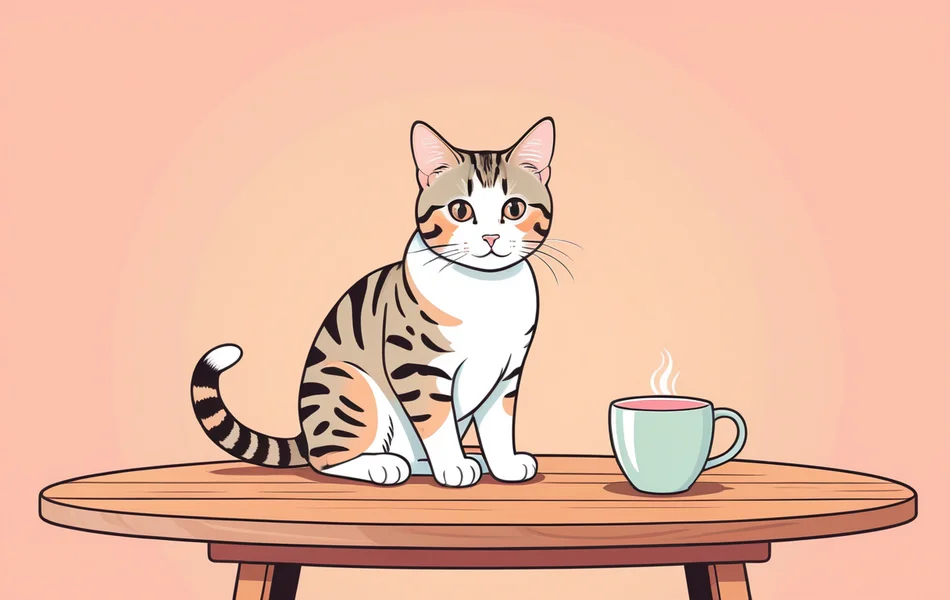
A glass sits near the edge of a table. Your cat approaches, raises a paw, and conducts a brief meeting with gravity. Why do cats knock things off tables? Play, exploration, and learned ways of getting a response can all be involved. The same swipe does not tell us exactly what every cat is thinking.
There is useful research on feline expectations, and practical veterinary guidance on enrichment and learning. Neither requires us to imagine that the cat has priced your favorite mug on a resale site.
Table of Contents
- Play and the Hunting Toolkit
- What the Physics Experiment Actually Tested
- When the Swipe Gets a Response
- Making Room for Activity
- The Table Is Part of the Environment
- How to Reduce the Damage
- When to Ask Your Vet
- FAQ
Play and the Hunting Toolkit
Stalking, chasing, and batting are useful parts of a cat’s play repertoire. The 2013 AAFP/ISFM Environmental Needs Guidelines include opportunities for play and predatory behavior among the foundations of a healthy feline environment.
A small object that moves when touched can offer something interesting to investigate. A pen rolls, a light toy skitters, and a bottle cap takes an entertainingly unpredictable route. That makes play a plausible explanation for some table-top experiments, without requiring the cat to believe that every object is prey.
The important distinction is between noticing what your cat does and inventing a precise thought behind it. “She keeps batting objects that roll” is an observation. “She is calculating the coefficient of friction” is an excellent caption.
What the Physics Experiment Actually Tested
A 2016 study in Animal Cognition, led by Saho Takagi, tested cats with a shaken container and an object that either appeared or did not appear when the container was turned over. Some combinations of sound and outcome matched expectations; others did not.
The cats looked longer at the mismatched outcomes. The researchers interpreted the result as evidence that cats could use sound to infer the presence of an unseen object and predict its appearance.
That is interesting on its own. The experiment did not test cats pushing cups off tables, understanding the price of crockery, or deliberately breaking things. Calling your cat a tiny physicist is still allowed. Awarding it a degree on the strength of this study would be premature.
When the Swipe Gets a Response
The Feline Veterinary Medical Association’s behavior guidance specifically mentions knocking objects off shelves or dressers as one way cats may wake caregivers. Getting up and feeding the cat can inadvertently reward the behavior.
Consider the sequence in your own home. Does the noise regularly produce breakfast? Does a paw near a pen bring you straight over? Those patterns are useful clues, though eye contact alone cannot establish a motive.
The household may have accidentally installed a very expensive doorbell. Its button is anything on the nightstand.
Making Room for Activity
Rather than diagnosing boredom from a checklist, look at what your cat can actually do during the day. Are there opportunities to play, explore, rest undisturbed, and spend time with you? The environmental guidelines emphasize meeting those needs, including safe places and appropriate resources.
Offer play that suits the individual cat and let the cat set the pace. Short, regular opportunities can be easier to fit into a household routine than one occasional marathon. There is no universal daily activity quota or one-week success percentage for preventing the swipe.
For equipment, Cornell’s safe-toy guidance warns about pieces and strands that can detach and be swallowed. Check toys for damage, and supervise anything that presents that risk. A toy is meant to give the cat something enjoyable to do, not create a new item on the vet’s extraction schedule.
The Table Is Part of the Environment
A table also provides height, a view, and access to whatever you are doing. The FelineVMA guidance notes that counters can attract cats because of food, proximity to their person, or a lack of suitable perches. It recommends providing an appealing alternative and rewarding its use.
A nearby permitted perch can therefore be more useful than repeatedly objecting to the chosen one. You are giving the cat somewhere to participate in household life. The supervisory position remains; the glasses can move out of the job description.
How to Reduce the Damage
Start with the objects
Move breakables, hot drinks, medications, and other hazards away from accessible edges. Secure unstable items or put them behind a closed door. This is the quickest change because it does not depend on the cat learning anything first.
If something breaks, keep the cat away and clean it up promptly. Do not leave sharp fragments or a dangerous spill in place as part of a training exercise.
Teach the alternative
Reward calm use of the chosen perch or an appropriate play area. Schedule attention and play before the familiar trouble spot in your routine, where possible. Try to avoid making the fall itself the reliable signal for a reward.
Skip the punishment
Cornell’s guidance on destructive behavior warns that yelling, spraying water, and startling a cat can teach fear of the person rather than the desired behavior. Management and suitable alternatives make a better starting point.
Keep a brief note of when incidents happen and what changes help. Treat it as a way to spot patterns, not a countdown to guaranteed obedience. Cats are generally poor subscribers to seven-day transformation plans.
When to Ask Your Vet
A new or marked behavioral change deserves attention, particularly with changes in appetite, movement, vocalization, or social behavior. Do not assume that apparent clumsiness or agitation is simply a new habit.
Cornell’s guidance on aggression explains that medical problems and pain can affect behavior. If your cat seems distressed or aggressive, give it space and seek veterinary advice. Knocking over an object cannot diagnose a specific illness.
FAQ
Is my cat doing it to annoy me?
The timing can certainly feel personal. It is more useful to look at play opportunities, the setting, and the response the action gets than to treat it as a quarrel.
Should I ignore it?
Always deal with hazards. For a harmless repeated behavior, focus on preventing the setup and rewarding an alternative, rather than making every fallen pen the start of an exciting interaction.
Does the cat know my mug will break?
The container experiment cannot answer that. It studied expectations about hidden objects, not a cat’s understanding of fragile household possessions.
Will more toys solve it?
They may help provide an alternative activity, but the pattern and the individual cat matter. If the behavior persists or changes suddenly, your vet can help assess what is going on.
The practical aim is a home with fewer hazards and more acceptable things to do. Your cat can remain head of gravity research. It just needs a less expensive laboratory.
Another cat mystery
The difference between an observation and a guessed motive also matters when a cat stays still after hearing its name. For a quieter household mystery, kneading a blanket offers another example of a familiar movement with more than one possible explanation.