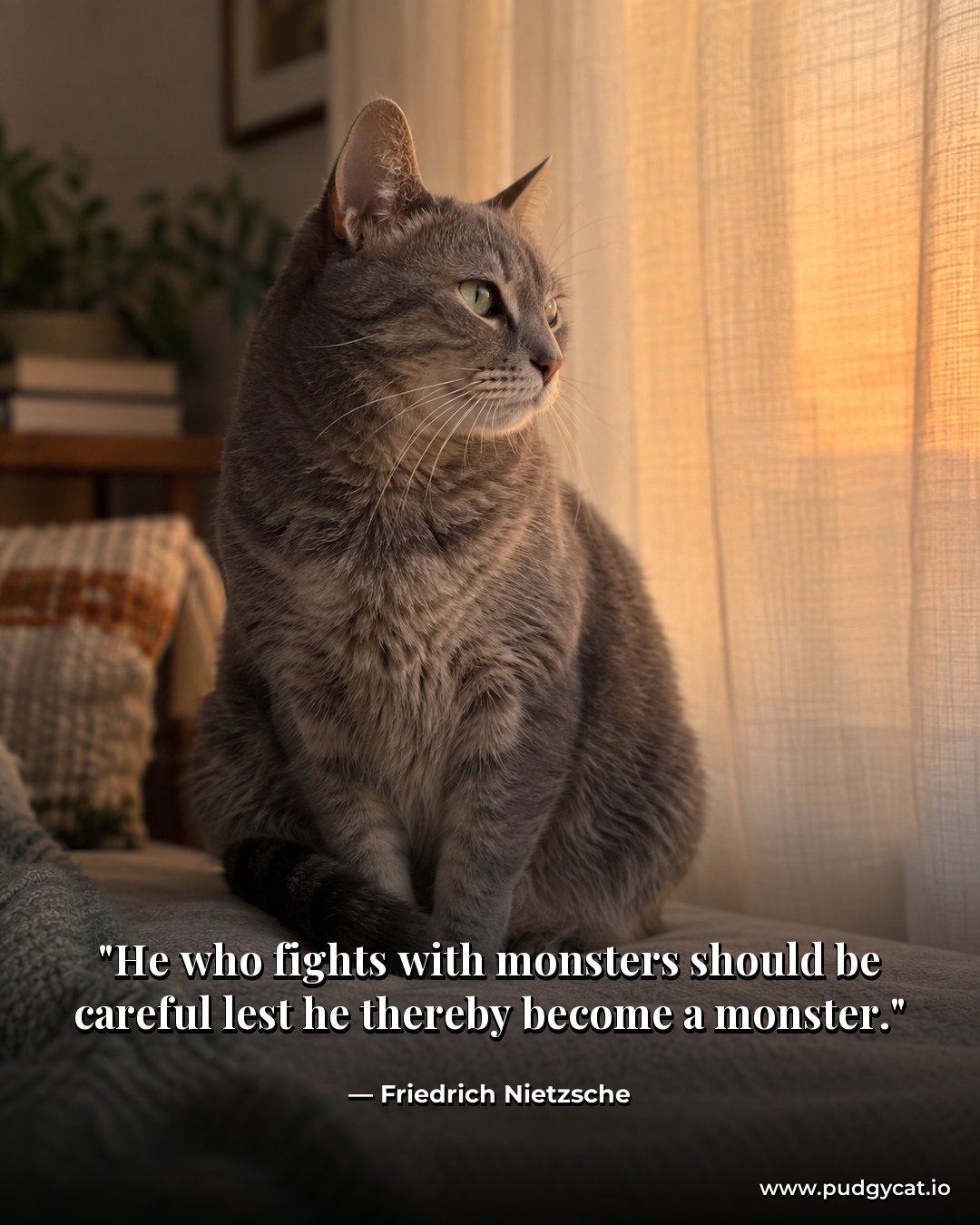
He who fights with monsters should be careful lest he thereby become a monster.
Friedrich Nietzsche
Source, Beyond Good and Evil, 146; English translation by Helen Zimmern
Why This Quote Matters
Friedrich Nietzsche places this warning in aphorism 146 of Beyond Good and Evil. The sentence concerns what an opponent can turn us into. Fighting something destructive may seem to guarantee our own moral position, yet the struggle can teach its habits to the person conducting it. The danger lies in becoming increasingly comfortable with the methods supposedly being resisted.
The thought is useful wherever a cause starts to excuse every action taken in its name. Contempt can become habitual; cruelty can acquire a respectable explanation; attention can narrow until only the enemy remains visible. Nietzsche asks for vigilance toward the self as well as the opponent. That does not make resistance unnecessary. It makes the manner of resistance part of the question, so that winning an argument is not confused with preserving the reasons for entering it.
The grey cat beside a softly lit curtain offers a deliberate moment of stillness next to this severe line. There are no literal monsters and no dramatic confrontation. The image leaves the warning with the reader, where it belongs. An ordinary pause can be a useful visual counterweight to escalating conflict: before answering in the same voice, there may still be time to notice which voice is becoming your own.
🐾 Visit the Pudgy Cat Shop for prints and cat-approved goodies, or find our illustrated books on Amazon.
More Cat Wisdom