 English
Much madness is divinest sense To a discerning eye; Much sense the starkest madness.
Emily Dickinson
Source, Poems, First Series, Life, XI; early printed edition edited by Mabel Loomis Todd and T. W. Higginson, with editorial punctuation
Why This Quote Matters
These lines come from the Life section of Emily Dickinson's Poems, First Series, in the early printed edition. The poem contrasts madness and sense, then points toward the power of the majority to decide which label prevails. Its force is social and poetic: agreement receives one name, dissent another. The speaker asks the reader to notice who controls the naming and what happens to the person who refuses the expected answer.
The quotation works best as a challenge to easy conformity, not as a claim that every unpopular view is correct. A majority can have good reasons, and dissent can be mistaken. Dickinson's sharper concern is the substitution of acceptance for examination. If agreement itself is treated as proof of soundness, a difficult idea can be dismissed before anyone has considered its substance. The poem asks for a discerning eye precisely because the comfortable public verdict may not be sufficient to tell sense from its opposite.
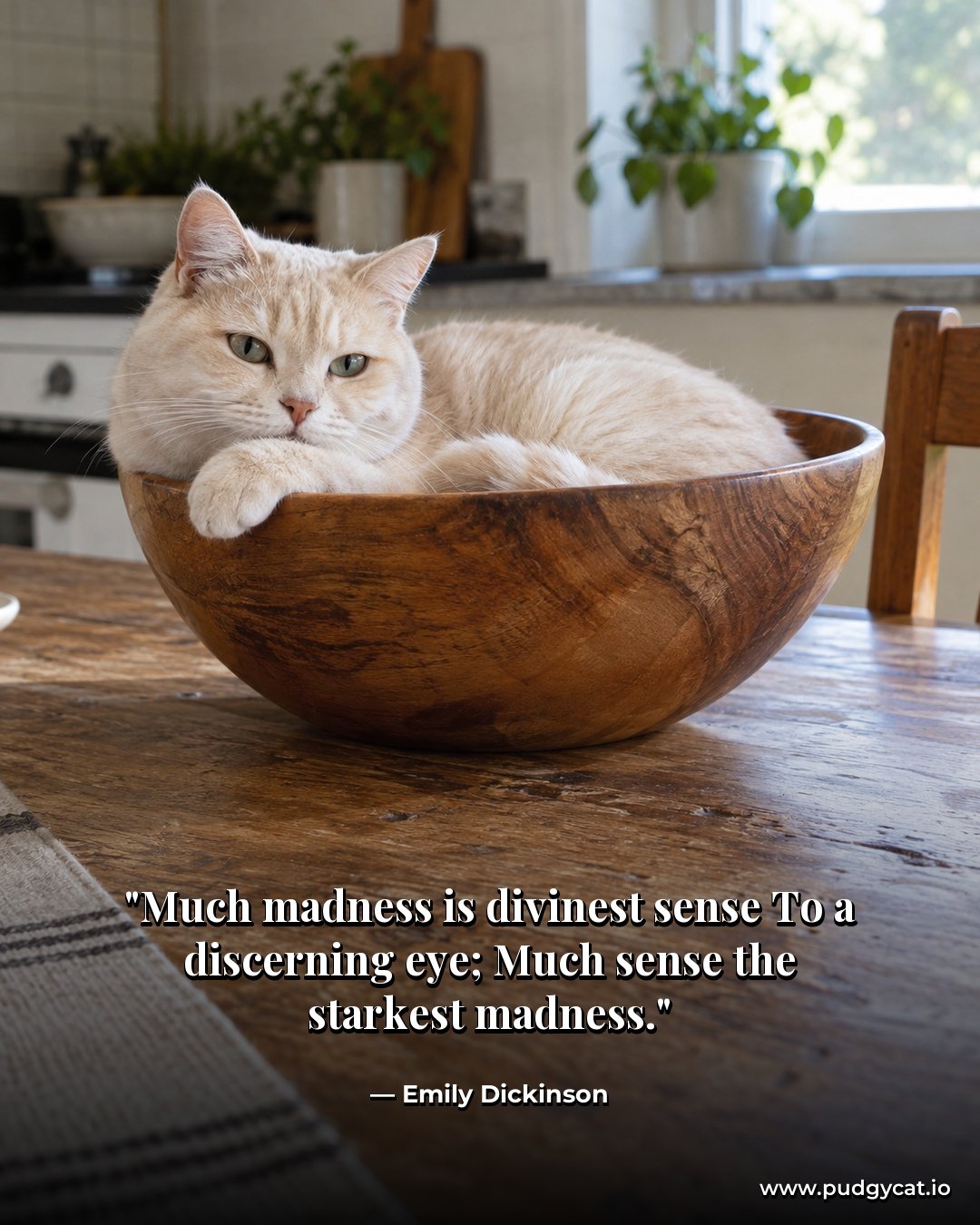
The cream cat resting in an empty wooden bowl supplies a harmless dispute about what counts as a reasonable arrangement. From one angle it looks absurd; from the occupant's angle it appears to be functioning very well. The visual joke cannot settle a serious argument, but it can loosen a habit: before dismissing an unfamiliar choice, it is useful to ask which purpose and which evidence are being used to judge it.
More Cat Wisdom