 English
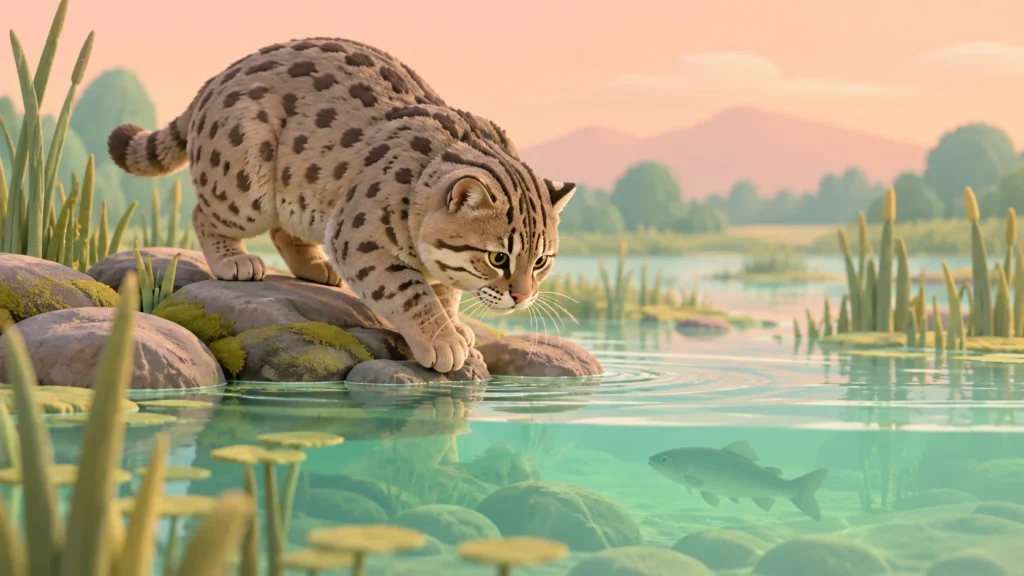
A spotted cat waits at the water's edge, then reaches for prey beneath the surface. For a fishing cat, water is part of the hunting ground.
Prionailurus viverrinus is a wild species found in patches across South and Southeast Asia. Its life offers a useful correction to the idea that every cat has the same relationship with water.
Built close to the ground
The Fishing Cat Conservation Alliance describes a stocky animal with a broad head, short legs and a relatively short tail. Dark spots and stripes break up its grey-brown coat.
A dense undercoat sits beneath longer guard hairs. Around marshes, mangroves and other wet habitats, keeping insulation close to the body is useful to an animal that enters the water.
Fish are important prey, although the species also takes other animals. Observations include cats scooping prey from the edge and diving after it. The popular name describes a real skill without covering the whole diet.
The paws are not flippers
Fishing cats are often introduced through their webbed feet. The IUCN Cat Specialist Group adds a useful qualification: the webbing is not much more developed than in a bobcat.
That makes a better story than an exaggerated claim about a cat halfway to becoming an aquatic mammal. Behaviour, habitat use and several ordinary-looking features work together. A single unusual body part does not have to explain everything.
The species has also been recorded outside an idyllic wilderness setting, including human-modified landscapes in Sri Lanka. Such records show how incomplete a simple forest-versus-city picture can be.
A wetland is more than open water
The Cat Specialist Group lists the fishing cat as Vulnerable. Habitat loss and fragmentation, together with conflict and killing, threaten its survival.
A pond alone does not replace a functioning wetland. Cover, prey and connected places to move through all matter. The same landscape may support people fishing, farming or raising poultry, so conservation has to account for their livelihoods too.
That is why local work with communities belongs alongside habitat protection. An animal that takes fish from a private pond can be seen very differently by the person who depends on that pond.
A habitat photograph can be as revealing as a close-up of the animal. Look at the boundaries between water, vegetation and dry ground, and imagine how many activities depend on moving between them.
This is a better starting point for understanding conservation than asking only whether a species can swim. A cat may enter water successfully while still depending on cover and places to rest nearby. The appeal of one striking behaviour should lead us back to the range of conditions that make the animal's everyday life possible.
Look beyond the most famous cats
Large predators tend to dominate wildlife imagery. Smaller species can disappear from the conversation even when the places they need are changing quickly.
Camera traps and AI-assisted wildlife monitoring help researchers work with sightings that would otherwise be difficult to collect or sort. Those records are especially useful for elusive animals.
The fishing cat earns attention through its hunting behaviour. Keeping that attention on the marshes and mangroves around it gives the curiosity somewhere useful to lead.