
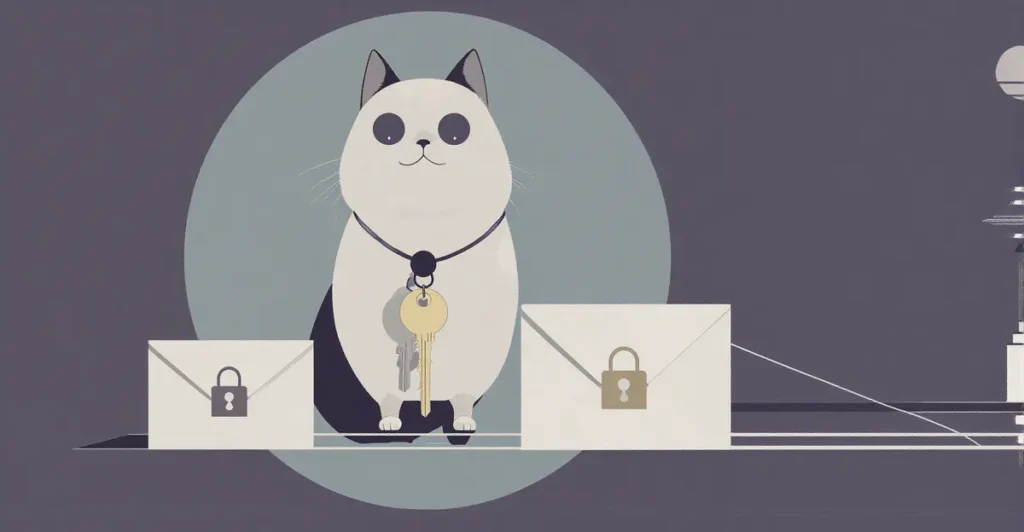
How does end-to-end encryption work, and why does every messaging app keep bragging about it like it is a personality trait? End-to-end encryption (often written E2EE) scrambles your message on your device, sends the scrambled blob across the internet, and only unscrambles it on the recipient’s device. Nobody in the middle, not the app maker, not your ISP, not a government with a subpoena, can read the content. They see that something moved. They cannot see what it said.
That is the promise. The reality is more interesting, because E2EE is not magic, it is math. This guide walks through it in plain English: what encryption is, how keys work, what makes E2EE different, and where it breaks.
Table of Contents
- What Is Encryption, Really
- Symmetric vs Asymmetric Keys
- How End-to-End Encryption Works Step by Step
- The Signal Protocol and Why Everyone Copies It
- E2EE vs TLS vs At-Rest Encryption
- What E2EE Actually Protects
- What E2EE Cannot Do
- FAQ
What Is Encryption, Really
Encryption is a reversible transformation. You take readable data, called plaintext, and run it through a function that produces an unreadable mess, called ciphertext. The function takes two inputs. One is the data itself. The other is a key, which is just a very long random number. Without the right key, the ciphertext is statistically indistinguishable from noise.
Modern encryption algorithms are public. The math behind AES, ChaCha20, RSA, and elliptic curves is published and beat on by cryptographers for decades. The secrecy is not in the algorithm. The secrecy is in the key. This is Kerckhoffs’s principle, and it is the reason a competent cryptographer never trusts a system that hides its math.
A good key is long. AES-256 uses a 256-bit key, so there are roughly 2 to the 256 possible keys. Brute-forcing it with every computer that has ever existed, running for the entire age of the universe, still leaves you laughably short. Nobody attacks the algorithm. They attack the key, the implementation, or the human holding it.
Symmetric vs Asymmetric Keys
There are two big families of encryption, and end-to-end encryption needs both.
Symmetric Encryption
Same key to lock and unlock. Fast, simple, and used for the actual message content. AES and ChaCha20 are the two heavyweights here. The catch is obvious: if you and your friend both need the same key, how do you give it to her without somebody else grabbing it on the way? You cannot send the key through the channel you are trying to secure. That is the key distribution problem, and for most of human history it involved couriers, sealed envelopes, and burning the original after reading.
Asymmetric Encryption
Also called public-key cryptography. Each person has two keys that are mathematically linked. A public key, which you give to everyone, and a private key, which you guard with your life. Anything encrypted with your public key can only be decrypted with your private key. Anything signed with your private key can be verified with your public key. RSA and elliptic-curve schemes like X25519 and Ed25519 are the common choices.
Asymmetric encryption is slow and produces large outputs, so nobody uses it for message bodies. It is used to safely exchange a fresh symmetric key, then symmetric encryption handles everything else. This hybrid pattern is the foundation of every modern secure protocol on the internet.
How End-to-End Encryption Works Step by Step
Now the main event. How does end-to-end encryption work in a modern messaging app, from the moment you install it to the moment your friend reads your message. We will use a simplified Signal-style flow, since most serious E2EE apps copy the Signal protocol or a close cousin of it.
- Key generation on install. Your device generates several key pairs locally: an identity key pair (long-term), a signed prekey (medium-term), and a bundle of one-time prekeys (single-use). The private halves never leave your phone. The public halves get uploaded to the server.
- Friend wants to message you. Her app asks the server for your public key bundle. The server hands over your identity public key, the signed prekey, and one one-time prekey, then deletes that prekey.
- Key agreement. Her device performs a sequence of elliptic-curve Diffie-Hellman operations, mixing her own keys with your public bundle. The math produces a shared secret. Your device performs the symmetric operations when it receives the first message. Both derive the same shared secret without ever transmitting it.
- Session keys. The shared secret is fed into a key derivation function that spits out a chain of session keys. Every message rotates the key forward. This is the double ratchet. Even if an attacker steals one session key, she cannot decrypt past or future messages. The properties are forward secrecy and post-compromise security.
- Message encryption. The message body is encrypted with the current session key using symmetric encryption, usually AES-256 in GCM mode or ChaCha20-Poly1305. The ciphertext goes out with a small header telling your friend which key to use.
- Transit. The ciphertext travels across your Wi-Fi, your ISP, the app’s server, and your friend’s ISP. At every hop, anyone watching sees random-looking bytes. Nobody in the middle can read it.
- Decryption. Her device uses the matching session key to decrypt the ciphertext into plaintext. The message appears on her screen. The ratchet rotates forward, the used key is destroyed, and the loop continues.
That is the entire happy path. Keys are generated locally, public halves are exchanged through an untrusted server, the math produces matching secrets on both ends, and messages stay encrypted from one device to the other. End to end. Hence the name. If you want a deeper dive into how data actually moves between devices, our article on how DNS resolution works covers the part of the journey that happens before encryption kicks in.
The Signal Protocol and Why Everyone Copies It
The Signal Protocol, originally developed by Moxie Marlinspike and Trevor Perrin at Open Whisper Systems, is the de facto standard for modern E2EE messaging. WhatsApp uses it. Facebook Messenger uses a variant of it. Google Messages RCS uses it. Skype’s private conversations use it. Even ProtonMail’s secure chat is built on related ideas.
Three things make Signal the reference design. First, the double ratchet, which gives forward secrecy and post-compromise security in one package. Second, the X3DH key agreement, which lets two parties establish a shared secret even when one of them is offline at first contact. Third, the entire stack is open source. Anyone can read the code, audit the math, and break it if they can. After a decade of public scrutiny, nobody has. The alternative is trust me bro cryptography, a closed system that might use the same algorithms or might quietly leak metadata, reuse nonces, or store plaintext copies somewhere. You cannot tell from the outside. With Signal, you can. The auditability is the feature.
E2EE vs TLS vs At-Rest Encryption
This is where most users get confused, and most marketing departments quietly take advantage of that confusion. There are three layers of encryption in any normal online conversation, and they protect against different things.
- Encryption in transit (TLS). Protects data between your device and a server. Every HTTPS site uses it. The server can read the plaintext on arrival. The endpoint is the server, not the other human.
- Encryption at rest. Protects data sitting on a hard drive. The cloud provider holds the key. If the provider is subpoenaed, hacked, or curious, the data can be unlocked.
- End-to-end encryption. Protects data from the moment it leaves your device to the moment it arrives on the other device. The server sees only ciphertext. The endpoints are the two humans.
When a service says it uses encryption, ask which kind. Most cloud email is encrypted in transit and at rest, but not end-to-end. Gmail can read your Gmail. Slack can read your Slack. SMS has no encryption worth mentioning. Even iMessage, technically E2EE between Apple devices, gets pulled into iCloud Backup as effectively plaintext unless you enable Advanced Data Protection. The label on the box is rarely the whole story. We covered a related browser-vs-app trust shift in our piece on how Google turned your cursor into an AI agent.
What E2EE Actually Protects
End-to-end encryption gives you a specific, limited set of guarantees. It is important to know exactly what they are, because the difference between what E2EE does and what people think it does has cost a lot of journalists, activists, and lawyers a lot of trouble.
- Content confidentiality. Nobody between the two endpoints can read the message body.
- Forward secrecy. If a key is compromised today, past messages stay protected because their keys were already destroyed.
- Post-compromise security. If a key is compromised today, future messages stay protected because the ratchet moves forward and the attacker cannot keep up.
- Tamper detection. Authenticated encryption modes like GCM and Poly1305 will refuse to decrypt a message that has been modified in transit. Either the message arrives intact or it does not arrive at all.
- Authentication of the sender, provided the recipient has verified the sender’s identity key fingerprint. This last part is the catch. If you do not verify, you do not have authentication, you have hope.
Pudgy has a soft spot for systems that fail loudly rather than quietly. Authenticated encryption is one of them: a modified ciphertext does not slip through, it throws an error and refuses to play. If you like things that fail loudly, our piece on an AI coding agent that wiped a database in nine seconds is a darker example of the opposite.
What E2EE Cannot Do
This is the part the marketing pages skip. End-to-end encryption protects message content. It does not protect everything else.
Metadata Leaks Anyway
Who you talked to, when, for how long, from where, on what device. All of that is visible to the app provider and anyone watching the network. Metadata is often more revealing than content. Signal goes to extreme lengths to minimize it. Most providers do not.
Endpoint Compromise Wins
If somebody owns your phone, they own your messages. E2EE protects the channel, not the endpoint. A keylogger, Pegasus-style spyware, or a shoulder surfer all bypass the encryption entirely. The cleartext exists on your device. This is why your choice of password manager and the discipline of keeping a clean device matter more than which app you picked.
Backups Often Break the Promise
This is the dirtiest secret in messaging. Your E2EE chat history often gets backed up to a cloud service in a form the provider can read. WhatsApp’s default cloud backups were unencrypted for years and only got optional E2EE backups in 2021. iMessage in iCloud is the same story: without Advanced Data Protection, the messages exist as effectively plaintext on Apple’s servers, E2EE notwithstanding. The chain is only as strong as its weakest backup setting.
The Recipient Is Not Bound to Silence
Cryptography cannot stop the person on the other end from screenshotting your message and posting it on Twitter. This sounds obvious. It is repeatedly forgotten. E2EE means nobody in the middle can read it. It does not mean the recipient cannot share it.
Group Chats Get Weird
E2EE in a group of twenty is possible but operationally painful. Every new member requires a new session, key rotations cascade, and adding or removing members is a coordination problem. Most providers solve this by having the server manage group membership, which means the server learns who is in the group. Content stays encrypted. The social graph does not.
You Have to Trust the App
E2EE is implemented in code that runs on your device, code written by the app developer. If a future update quietly copies your messages to a server before encrypting them, the math is irrelevant. This is why open-source clients and reproducible builds matter. With closed clients, you are trusting the developer to not insert a backdoor, ever. That is a trust statement, not a cryptographic guarantee. Our writeup on Project Mariner, the screenshot AI that watched your screen, is a reminder of how thin the wall between encrypted app and watching app can be.
FAQ
Is end-to-end encryption legal?
In most countries yes. Several governments periodically propose laws requiring providers to install backdoors or scan messages before encryption, usually framed as child safety or counter-terrorism. None has produced a workable mandatory backdoor in a major Western jurisdiction, mostly because a backdoor for the good guys is also a backdoor for everyone else. A few countries restrict or ban specific encrypted apps. The math itself is not illegal.
Can the police read my end-to-end encrypted messages?
Not from the wire and not from the provider. They can read them by seizing your phone or the recipient’s phone, by compelling you to unlock it, by exploiting a phone vulnerability, or by getting the recipient to hand them over. The cryptography is rarely the weak link. The endpoints almost always are.
Is WhatsApp really end-to-end encrypted?
The message protocol is, yes, based on the Signal Protocol. Metadata about who you messaged and when is collected by Meta. The cloud backup is optionally E2EE since 2021, but you have to turn it on. If you want minimal metadata and a strong default, Signal itself is a stricter choice. WhatsApp is end-to-end encrypted in the same way that a bank vault with a glass roof is secure: technically yes, with caveats.
What is the difference between encryption and end-to-end encryption?
Regular encryption protects data in transit or at rest, with the service provider holding a key or seeing the plaintext at some point. End-to-end encryption keeps the keys only on the two endpoint devices, so the provider never sees the plaintext. Both use the same underlying math. The difference is who holds the key.
Will quantum computers break end-to-end encryption?
Eventually a large enough quantum computer could break the elliptic-curve key exchange used in current protocols, exposing past messages somebody captured years ago. This is called a harvest now, decrypt later attack. Signal and other providers started rolling out post-quantum key exchange in 2023, layering a quantum-resistant algorithm on top of the existing one. The symmetric encryption used for message bodies only loses half its key strength to quantum attacks, which is still way more than enough.
Conclusion
End-to-end encryption does what it says on the tin, within a narrow scope. Content stays private from sender to recipient. Math, not vibes, makes that promise. Everything outside that scope, the metadata, the endpoints, the backups, the person on the other end, is your problem. Knowing the difference between what the cryptography guarantees and what the rest of the stack quietly leaks is the entire skill. For normal humans on Signal, WhatsApp, or iMessage with sensible settings, the protection is real and good enough for everyday life.
Visit the Pudgy Cat Shop for prints and cat-approved goodies, or find our illustrated books on Amazon.


Leave a Reply