
There Is a Skeleton at the Bottom of a Roman Well in Frankfurt. Next to It, a Bronze Goddess.
Somewhere beneath the streets of Frankfurt, under a school playground in the Nordweststadt district, archaeologists have been quietly excavating one of the most significant Roman cult sites ever found in northern Europe. The sanctuary belongs to the ancient city of Nida, a Roman settlement that thrived from the early 2nd century through the mid-3rd century CE. It was found during construction of a new school between 2016 and 2022. And the things they pulled out of the ground are, to put it mildly, unsettling.
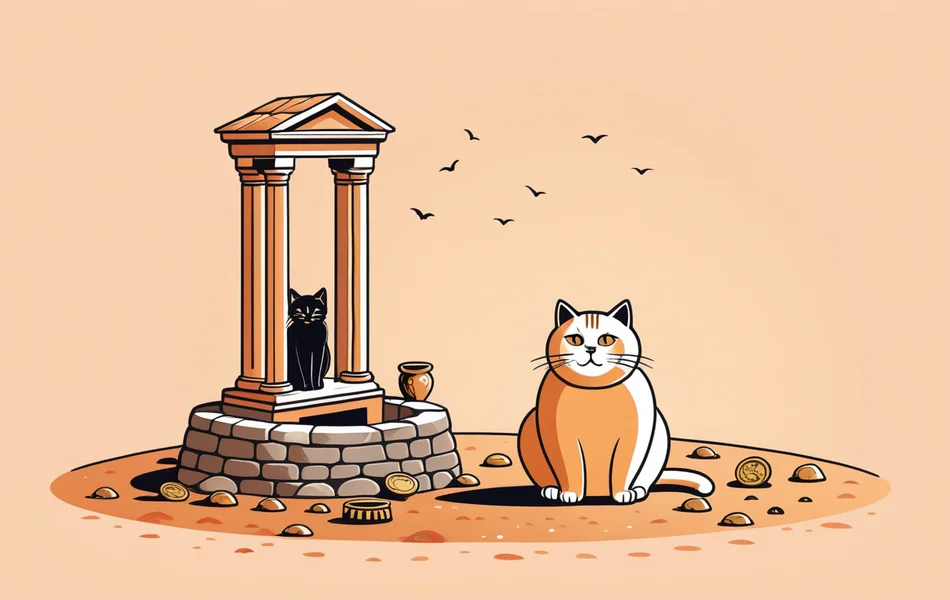
Let’s start with the well. At the bottom, researchers found a human skeleton. Beside it, a bronze statuette of the goddess Diana. And a dedicatory inscription to Mercury Alatheus, dated with uncomfortable precision: September 9, 246 CE. Coins found in the fill suggest the well was sealed no earlier than 249 CE. So someone (or something) put a body, a goddess, and a dedication to Mercury into a well, then closed it up. That is not how you dispose of trash. That is a ritual.
The Numbers Are Staggering
The excavation covers more than 4,500 square meters. Within that area, archaeologists uncovered eleven stone buildings constructed across several phases, roughly 70 shafts, and ten pits used for ritual depositions. The layout has no known parallels in the Roman provinces of Germania or Gaul. Nobody has seen anything quite like this before.
The artifacts read like an inventory of a civilization’s spiritual life: over 5,000 fragments of painted wall plaster, bronze fittings from doors and windows, 254 Roman coins, and more than 70 silver and bronze fibulae (garment clasps, some still intact after nearly two millennia). This was not a modest roadside shrine. This was a major religious complex, richly decorated, serving an entire region.
Six Gods, One Address
The inscriptions and imagery point to a remarkable mix of deities: Jupiter, Jupiter Dolichenus (a Syrian solar god popular with Roman soldiers), Mercury Alatheus, Diana, Apollo, and Epona (a Celtic horse goddess adopted by the Romans). If you know anything about the weird things that happened in ancient European cities, this kind of syncretism will feel familiar. The Romans were collectors. They absorbed gods the way modern franchises absorb IP. If a local deity had a following, Rome would adopt it, build it a temple, and move on.
But this particular mix, Syrian and Celtic and classical Roman gods all sharing the same walled complex, suggests Nida was a crossroads of cultures. Soldiers, merchants, and locals all coming to the same place to ask different gods for different things. The sanctuary was less a single temple and more a spiritual shopping mall.
The Human Sacrifice Question
Here is where it gets genuinely dark. The research team, now backed by more than one million euros from the German Research Foundation (DFG) and the Swiss National Science Foundation (SNF), has flagged the skeleton in the well as potential evidence of human sacrifice. This is extremely rare for the Roman provinces. Rome officially frowned on the practice (while conveniently watching people die in arenas for entertainment, but that is a different conversation). Finding a body deliberately deposited in a ritual context, alongside divine offerings, in a Roman provincial sanctuary, is almost unheard of.
We do not know yet who this person was. Male or female, young or old, willing or not. The million-euro research project will attempt to answer those questions through osteological analysis, isotope studies, and DNA extraction. The skeleton may have been a sacrifice, a punishment, a voluntary offering, or something we do not have a category for. Ancient religions did not always operate within boundaries we would recognize.
What 5,000 Fragments of Painted Plaster Tell You
The painted wall plaster is worth pausing on. Five thousand fragments means these buildings were lavishly decorated, their interiors covered in colored scenes. This was not a functional military outpost. This was a place designed to impress, to overwhelm, to create atmosphere. Think of it as the ancient equivalent of walking into a cathedral with floor-to-ceiling stained glass, except the glass is painted plaster depicting gods you have never heard of, and there might be a body in the basement.
The 70 ritual shafts are equally telling. Ritual deposition (placing objects in pits or wells as offerings) was a widespread practice across pre-Roman and Roman Europe. It is how we ended up with 12,000-year-old dice at the bottom of archaeological sites. People have been putting meaningful objects into holes in the ground for as long as people have had meaningful objects and access to shovels.
Why This Matters Now
Frankfurt is the financial capital of Europe. It is home to the European Central Bank, glass towers, and people in expensive suits arguing about interest rates. And directly underneath a school in the northwestern suburbs, there was a 1,800-year-old cult complex where six different gods were worshipped, animals (and possibly humans) were sacrificed, and walls were painted in colors that have survived almost two millennia.
The research team includes scholars from Goethe University Frankfurt, the Frankfurt City Monument Office, and the University of Basel. Key figures include Dr. Carsten Wenzel, Prof. Anja Klockner, Prof. Markus Scholz, Prof. Astrid Stobbe, Prof. Sabine Deschler-Erb, and Dr. Barbara Stopp. The DFG and SNF funding ensures this will be studied properly, not rushed into a headline and forgotten.
There is something deeply satisfying about the idea that modern cities are built on layers of things we have forgotten. Frankfurt’s bankers walk over Roman gods every day without knowing it. The school children who will eventually use the Romerstadtschule are playing on top of a mystery that took 1,800 years to surface. If scientists can now plant problems into your dreams, imagine what dreams were planted in the minds of the people who visited this sanctuary, standing in painted rooms, watching offerings descend into shafts, knowing that the gods were listening.
Or at least hoping they were.
🐾 Visit the Pudgy Cat Shop for prints and cat-approved goodies, or find our illustrated books on Amazon.


Leave a Reply