
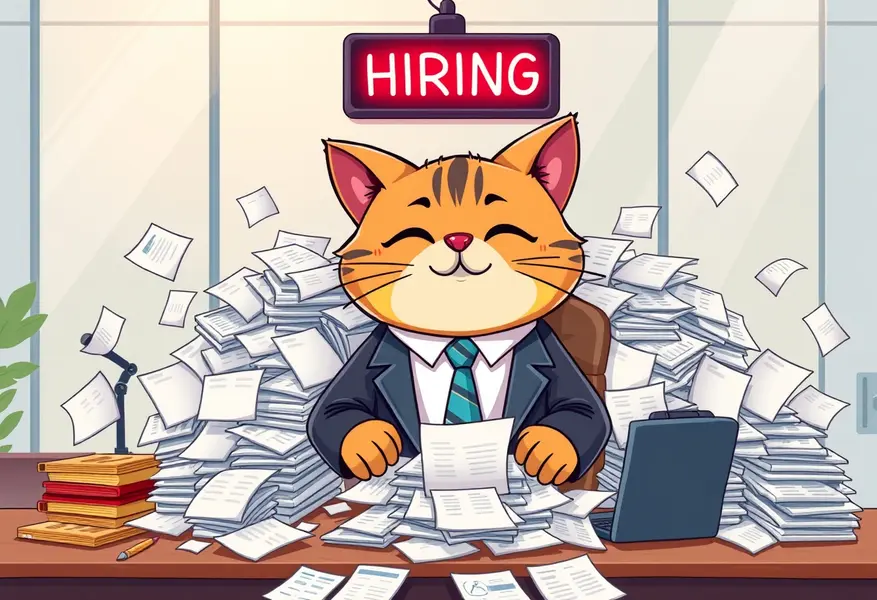
In recent years, the tech industry has turned layoff announcements into something of a competitive sport. Restructuring, efficiency, a renewed focus on priorities: the corporate vocabulary is remarkably consistent, even when the reasons for the cuts differ. AI is part of that conversation, but not an explanation for every lost job.
And then there’s OpenAI, casually doing the exact opposite.
According to a Financial Times report published on Saturday, March 21, and covered by Reuters, OpenAI plans to expand from around 4,500 employees to 8,000 by the end of 2026. That would be a net increase of roughly 3,500 people, rather than confirmation that all those hires have already happened. Reuters said it could not immediately verify the report and that OpenAI had not immediately responded to its request for comment.
The reported plan includes people whose job would be to help other companies use AI properly. While building the AI that might automate some of those companies’ work. The irony is… a lot. “Replace everyone else” is the joke, of course, not a forecast that every job will disappear.
Who They’re Actually Hiring
The FT report breaks down the hiring push into several categories:
- Product and engineering: building and maintaining the products around the models.
- Research: continuing the work on model capabilities.
- Sales: reaching businesses that could use the technology.
- Technical ambassadorship: the report’s term for specialists helping businesses make better use of OpenAI’s tools.
It’s a reminder that selling AI and implementing AI are two very different things.
The Anthropic Problem
The competitive backdrop matters. Ramp’s March 11 AI Index says Anthropic wins about 70% of first-time buyers’ head-to-head choices against OpenAI in its business-spending data. That is not the same as saying it is “70% more likely” to be chosen, and it is not a 70% share of the entire AI market.
OpenAI launched ChatGPT. OpenAI helped make generative AI a household topic. Yet brand recognition does not guarantee winning the next business customer. Ramp still describes OpenAI as the provider used by the most businesses in its data, while showing strong momentum for Anthropic among new buyers. Both things can be true.
Why are buyers choosing differently? Product experience, recommendations from colleagues and brand perception are plausible influences. But transaction data does not, by itself, establish that Claude is more reliable or that corporate buyers dislike ChatGPT’s consumer image.
The reported recruitment push makes sense against that competitive backdrop. Treating it as a proven emergency response to Anthropic goes further than the evidence. Nor does a company-wide increase of 3,500 mean 3,500 salespeople: the reported plan spans several functions.
The DoD Deal and the PE Play
Two other pieces of context matter here.
First, OpenAI announced a Pentagon agreement in late February to deploy AI in classified environments, amid the government’s dispute with Anthropic. Its description explicitly includes cleared engineers and safety researchers. Whatever one thinks of the agreement, it is a concrete example of deployment requiring people as well as software; it is not simply evidence that OpenAI took over Anthropic’s existing contract.
Second, Reuters reported on March 16 that OpenAI was in advanced talks with private-equity firms, including Brookfield Asset Management, about a venture distributing its enterprise products across their portfolio companies and beyond. These were reported talks, not a completed deal. The idea offers a route to customers through groups that own multiple businesses, rather than one subscription at a time.
Hence the appeal of people who understand both the tools and the organisations expected to use them. Buying an API key is the short part of the meeting.
What This Actually Means
There’s a narrative in the AI world right now that says AI companies will eventually replace most knowledge workers — and the AI companies themselves will be small, lean operations with a handful of engineers and a lot of compute.
The reported OpenAI hiring plan complicates that narrative. A growing AI company can still need more staff even if its tools make individual tasks faster: it may also be trying to do considerably more work.
The plan suggests an organisation taking on some familiar enterprise-software responsibilities: selling, integrating and supporting a product alongside the research that makes it possible. The futuristic part still appears to require rather a lot of calendar invitations.
This isn’t hypocrisy, exactly. More like a reminder that even the most automated future still needs people to bridge the gap between what the technology can do and what organizations are actually willing to do with it. Change management is not a problem you solve with gradient descent.
The Bigger Picture
One company’s expansion cannot tell us the overall effect of AI on employment. Hiring at a model developer and automation elsewhere can coexist, but neither proves that every AI company is growing or that AI caused every job cut at its customers. For another angle on how work is changing, see our discussion of Cursor’s specialist coding tools.
The irony lands differently depending on where you sit. If you are a software engineer at a bank worried about your job, a plan for 3,500 extra people at OpenAI may offer limited reassurance. If you are an investor, you might read it as a bet on expansion. Either way, a hiring target is a plan, not an employment crystal ball.
And if you’re a cat watching all of this from a sunlit windowsill? You’re mostly just grateful that neither “prompting specialist” nor “technical ambassador” sounds like something that requires opposable thumbs.