On April 1, a TikTok slideshow attributed to @heartzz.kyra presented an unusually broad selection of attractive things. Among the fictional characters and aesthetic choices was a math equation: 7×7=49. Know Your Meme’s early-April account traces the joke and some of the responses. Basic arithmetic had acquired romantic competition, which was not in the school prospectus.
By the following week, people were making skits in which an equation could steal your date. There were explanations, arguments, and elaborations on an idea that barely needed a sentence. The internet, in its usual fashion, had decided that a multiplication fact was hot. It is difficult to know what flowers to send.
Why a number, of all things
The first instinct is to dismiss the whole thing as Gen Z absurdism, the same energy that gave us boy kibble and fibermaxxing as a public personality. And it is partly that. The joke works because nobody can defend the proposition. You cannot argue with somebody who tells you they find a multiplication fact attractive. There is no logical handhold. The conversation ends.
One explanation circulating around the joke invokes synesthesia, especially ordinal linguistic personification. This is a documented tendency for some people to experience numbers, letters, or other ordered sequences as having personalities or genders. Julia Simner and Emma Holenstein studied it in 2007. Their work examined automatic associations and their consistency over time, rather than people joining in with a passing meme.
The connection is interesting, but a funny post does not tell us whether its author has that experience. Someone may have a stable personal association, be enjoying the rhythm of an equation, or simply be participating in a joke. We do not need to diagnose the comment section to appreciate any of those possibilities. Seven has enough responsibility already.
The aesthetics of obvious things
There is also a non-neurological reason the equation works. 7×7=49 has a particular kind of symmetry. Same number on both sides of the times. The result lands cleanly, no decimals, no remainder. It rhymes with itself. If you are the sort of person who notices that 13 has sharp edges and 12 is soft and round, this equation is a tidy little performance.
The internet has always rewarded this kind of thing. Aesthetically pleasing numbers are a recurring undercurrent. People queue to be the millionth visitor. Programmers feel a small joy when a counter hits a power of two. The Fibonacci sequence shows up in pop science articles every year because it scratches a similar itch. The 7×7=49 meme just dragged the feeling out from under the rug and dressed it up as a romantic comedy.
A meme about not having to explain yourself
One way to read the trend is as a joke about liking things without having to defend the preference. The equation is an especially good answer because it gives the argument nowhere sensible to go. A fictional character has cheekbones. A restaurant has lighting. Forty-nine has the confidence of someone who knows exactly how it got here.
There is something appealing about refusing the demand to rate and explain every preference. “I just like this, the math is hot, leave me alone” is a small comic mutiny. The equation does not need a personality. It does not have a brand voice. It does not want your engagement.
The cat take
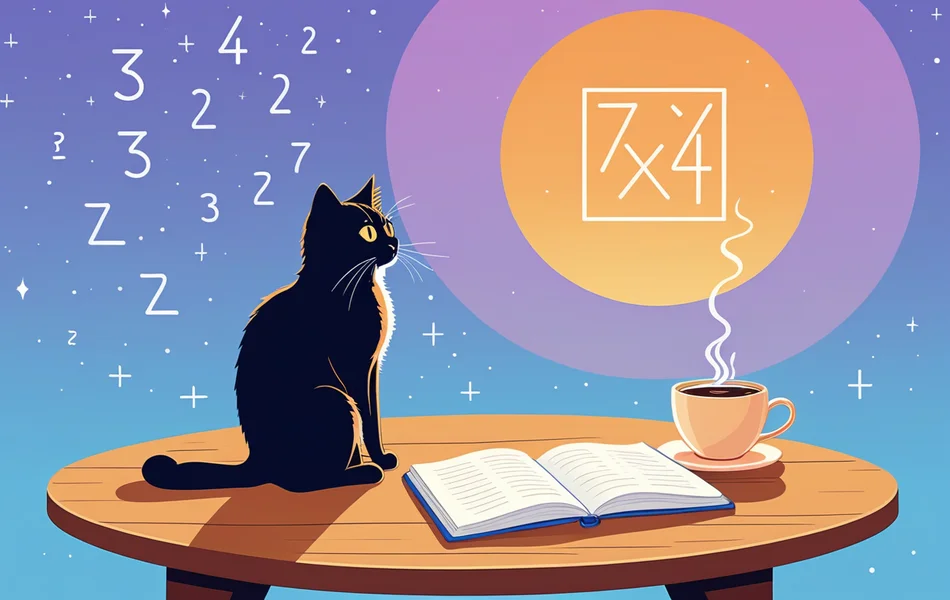
Here is the part nobody on TikTok said out loud. Cats have been doing this their entire evolutionary career. A cat will stare at the corner of a wall for forty minutes. A cat will reject the expensive bed and sleep inside a cardboard ring. A cat will fall in love with a specific drawer. Ask why and you get a slow blink. The answer is the equivalent of 7×7=49. It just is. The arithmetic is internal.
Maybe the meme is the human attempt to access a state cats live in by default. The state of finding something inexplicably correct, refusing to translate the feeling into a justification, and going back to sleep. We dressed it up in a TikTok slideshow because we have to dress everything up. The cat would have just stared at the equation, walked away, and knocked a glass off the table.
What it tells us about online attention now
Memes do not need a face. Text jokes, catchphrases, and deliberately bad arithmetic were circulating long before this one. The compactness is still useful: drop the equation into another scene and people who recognize it have the setup immediately. You do not even need to persuade an actor to look mysterious across a restaurant.
The format makes a tiny amount of information carry a whole imagined scene. That is a familiar pleasure in online humor, not proof that people’s brains have suddenly changed. Our piece on infinite scroll looks at the surrounding delivery system. The joke itself fits comfortably on a scrap of paper, where it could continue being ridiculous without a feed at all.
If you want to know whether you are inside the joke or outside it, here is the test. Read the equation again. Slowly. Seven times seven is forty-nine. If your shoulders dropped half a centimetre, congratulations. You are part of the trend. If you felt nothing, that is also fine. The cat on the windowsill is unimpressed either way, and there is some comfort in that.
For more cultural oddities that refuse to be explained, see the time Strasbourg hired a band for involuntary dancers. Sometimes a phenomenon arrives, refuses to make sense, and leaves before anyone can write the paper.