
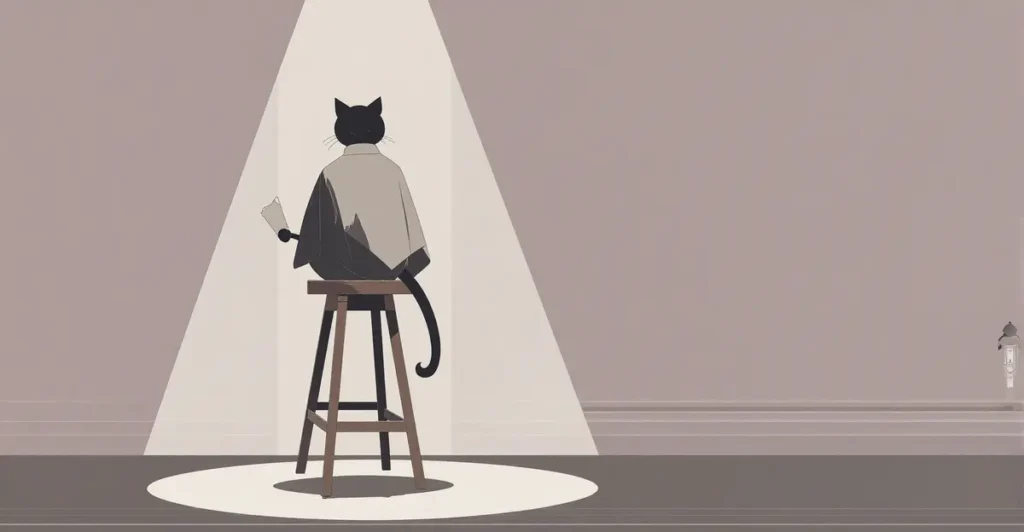
The phrase method acting gets thrown around any time a movie star loses thirty pounds, sleeps in a haunted hotel, or refuses to break character at the craft services table. The cat hears it during awards season, usually right before someone calls a costume “brave.” But a training tradition and a spectacular preparation story are not the same thing.
Method acting has a serious history, competing interpretations, and an extremely energetic publicity department. Understanding the first two makes the third much easier to recognize. No haunted hotel booking required.
What Is Method Acting, Really?
In its specific American sense, the Method is associated with Lee Strasberg’s approach to actor training, drawing on the work of Konstantin Stanislavski. The Lee Strasberg Theatre & Film Institute describes it as training an actor’s capacities for truthful expression, with exercises involving relaxation, concentration, sensory work, and emotional experience.
Emotional memory is an important part of that tradition, but “find your saddest memory and cry” is an impoverished summary. Training concerns a repeatable craft within an imagined situation. The actor still has a scene partner, a text, a director, and a job to do.
In casual film conversation, “method” often means intensive research, physical transformation, or prolonged character immersion. Those practices can overlap with an actor’s training, but none tells you which technique they use. Learning to drive a cab is research. Staying in an accent between takes is a working preference. Neither comes with a certificate signed by Stanislavski.
Stanislavski: The System Before the Method
Stanislavski co-founded the Moscow Art Theatre with Vladimir Nemirovich-Danchenko in 1898. His evolving system investigated how actors could make performance believable through attention, imagination, objectives, circumstances, and action. He did not single-handedly invent subtle acting in a world where everyone else only pointed at balconies.
Useful questions include what a character wants, what stands in the way, and what the actor would do in the character’s circumstances. The imagined situation matters. A performer playing a king does not need a personal memory of owning a kingdom before beginning rehearsal.
Stanislavski’s priorities developed over time, including his later emphasis on physical actions. The American reception also developed through different teachers and institutions. The BFI’s history of the American Method traces this complicated transmission. It is more useful to see a series of adaptations and disagreements than one perfect rulebook that everyone either obeyed or misunderstood.
Lee Strasberg and the American Method
The Group Theatre was founded in New York in 1931 by Lee Strasberg, Harold Clurman, and Cheryl Crawford. Stella Adler and Sanford Meisner belonged to the company, but they were not the three founders alongside Strasberg. The Strasberg Institute’s history describes the Group’s ensemble ambitions and its role in developing American actor training.
A separate institution, the Actors Studio, was founded in 1947 by Elia Kazan, Cheryl Crawford, and Robert Lewis. Its official history describes a place for artists to explore their work and the central role Strasberg subsequently played. The Group Theatre, the Actors Studio, and the later Strasberg Institute are related parts of the story, not interchangeable names for one school.
Strasberg’s work became strongly associated with performances that seemed intimate and psychologically alive. But an actor’s membership of an institution is not a complete account of their training, and a moving close-up does not reveal the exercise that produced it. Viewers see the result. The rehearsal room contains considerably more pencil marks.
Stella Adler and Sanford Meisner: Related Traditions, Different Emphases
Adler: imagination and circumstances
Stella Adler studied with Stanislavski in Paris for five weeks in 1934. Her approach emphasized imagination, the circumstances of the play, and the actor’s engagement with a world larger than personal recollection. The Adler Center’s history recounts that encounter and her subsequent teaching.
Marlon Brando was among her students. His association with Method acting should therefore not be flattened into “Strasberg taught Brando everything.” Adler is an essential part of that lineage, and the disagreement over emphasis is part of what makes this history interesting.
Meisner: attention and response
Sanford Meisner’s approach emphasizes truthful response within imaginary circumstances, particularly attention to a scene partner. His repetition exercise asks actors to respond to each other through a repeated observation whose meaning changes with behavior. The Neighborhood Playhouse describes a broader training sequence that includes repetition, improvisation, independent activity, and scene work.
Reducing this to “Strasberg goes inward, Meisner goes outward” can be a useful first sketch, but it is still a sketch. All these approaches involve more than one exercise. None becomes clearer if we pretend their differences are merely three names for extreme commitment.
How These Ideas Shaped Film Acting
Brando’s work in A Streetcar Named Desire (1951) and On the Waterfront (1954), both directed by Kazan, became landmarks in the public image of psychologically grounded performance. Pauses, physical behavior, and the feeling of thought happening inside a line could be as compelling as a polished speech.
That did not mean earlier screen actors lacked subtlety or that Hollywood suddenly adopted one universal technique. Later performances associated with this broad lineage include De Niro in Taxi Driver, Pacino in The Godfather Part II, and Jane Fonda in Klute. They are worth watching as performances, without treating them as identical demonstrations of one classroom exercise.
The label became commercially convenient: audiences enjoy hearing how much preparation a role required. Unfortunately, “the actor carefully listened to their scene partner” is a harder headline to sell than “the actor lived in a cupboard for six months.” The cupboard gets the interview.
Preparation Stories With Something Firmer Behind Them
Daniel Day-Lewis and My Left Foot
At his 2025 BFI London Film Festival conversation, Day-Lewis described preparing to play Christy Brown in My Left Foot by gradually learning to write and paint with his left foot. He also spoke about the importance of joy in the process. That is a more revealing first-hand detail than treating every story about his dedication as proof of one specific doctrine.
Learning a difficult physical skill can help a performance feel convincing. Whether an actor maintains aspects of a character between takes is a separate question. We can admire the result without deciding that everyone else should adopt the same routine.
Robert De Niro’s taxi license
De Niro’s preparation for Taxi Driver has an unusually tangible artifact: his 1974 New York City taxi license, preserved in his archive at the Harry Ransom Center and reproduced in the Center’s 2022 magazine. The license is better evidence than an endlessly reposted list of extreme actor facts.
It also illustrates a useful distinction. Research can give a performer practical familiarity with a job and environment. It does not tell us everything about how that performer summons emotion or works with another actor. The taxi license was homework, not the entire performance.
Why the most colorful anecdotes need care
Stories about preparation can change as they are retold. A joke becomes a confrontation; a promotional claim becomes an accepted fact; someone else’s explanation gets added years later. Before repeating one, look for the original interview, production account, or archive. Even then, distinguish what a participant says from what every witness agrees happened.
This matters especially when a story accuses a performer of mistreating colleagues or claims that a role damaged their health or career. Those are claims about real people, not harmless trivia just because the surrounding article is about movies. The cat enjoys gossip but would prefer it came with a receipt.
The Backlash: Craft, Cooperation, and Publicity
In an April 2022 GQ interview, Mads Mikkelsen criticized the showy version of Method acting and questioned whether extreme preparation necessarily explains a good performance. His comments are one actor’s position in an ongoing argument, not evidence that the whole profession rejected a technique in unison.
The useful distinction is between choosing a process and imposing it on everyone else. A rehearsal room and a film set are shared workplaces. Staying in character is not a special exemption from consent, agreed boundaries, or professional cooperation. An audience cannot see the preparation anyway; it sees what made it into the scene.
The cat’s verdict is straightforward: a serious teaching tradition deserves more attention than its publicity shorthand. A performer can research intensely, imagine freely, use learned technique, or combine approaches. None of those options requires making a colleague’s day worse to prove commitment.
For more viewing territory, explore these films based on true stories, where research and performance meet, or this look at Méliès and early cinema, a reminder that screen invention has never belonged to only one style.
Frequently Asked Questions
Does Method acting mean staying in character all the time?
No. That is a form of immersion some performers use. The Method refers more specifically to a training approach, and an actor’s behavior between takes does not establish which exercises they use.
Is Daniel Day-Lewis a Method actor?
He is frequently described that way in popular discussion. His accounts of preparation are more informative than the label: research, physical practice, and sustained engagement with a role do not by themselves identify a formal training system.
Is Method acting bad for mental health?
A blanket answer would oversimplify different practices and personal experiences. Emotionally demanding work deserves appropriate boundaries and support, but a dramatic role or an anecdote does not establish a clinical cause of someone’s later difficulties. Extreme exhaustion or physical risk is not a requirement to demonstrate artistic seriousness.
Can I learn about these approaches from books?
Yes. Strasberg’s A Dream of Passion, Adler’s The Art of Acting, and Sanford Meisner on Acting provide different entry points. Reading about an exercise is different from practicing it with feedback. If you want practical training, ask a teacher how their class works and how they handle boundaries.
Why do actors disagree about the Method?
They may mean different things by the word, prefer different ways of working, or object to behavior promoted under its banner. Asking which practice someone is defending or criticizing often clears up half the argument.
Watch the Performance, Not the Press Junket
Method acting is a craft, a disputed lineage, and a publicity cliché all at once. The interesting question is what helps the actor make the scene work. Sometimes that involves months of preparation; sometimes the decisive moment is listening properly to the person opposite. The cat recommends curiosity over reverence, and a normal lunch break whenever possible.