A potato farmer from Pennsylvania hauled a projector around small towns to show off this strange new technology called cinema. His films passed through his family, surviving in storage for generations. Eventually his great-grandson, Bill McFarland, brought the battered reels to the Library of Congress. Among them was a film that had long been considered lost. This is a much better outcome for an old box than “we thought it was probably rubbish.”
The film is called Gugusse et l’Automate. Georges Méliès made it in 1897. The Library of Congress reported the rediscovery in February, identifying it as the first appearance of a robot on screen. More precisely, its unruly figure is an automaton: a human-shaped mechanical performer, made decades before “robot” became the familiar word. It is a very early screen ancestor of a problem science fiction still enjoys.
The Clue Was a Painted Star
Archive technician Courtney Holschuh was examining the reels at the Library’s National Audio-Visual Conservation Center. The work involved separating and inspecting fragile film, a much more delicate process than pointing a phone at an old projector. The reels were damaged, and identifying what they contained took patient examination.
A painted star on a pedestal provided a clue to Méliès’ Star Film company. Méliès made more than 500 films, and many were lost. But this is not the sixteenth surviving example: the Library’s February account says roughly 300 of his films are known to exist. Rediscovering one more remains remarkable without making the surviving body of work almost vanish in the telling.
What Happens in Less Than a Minute
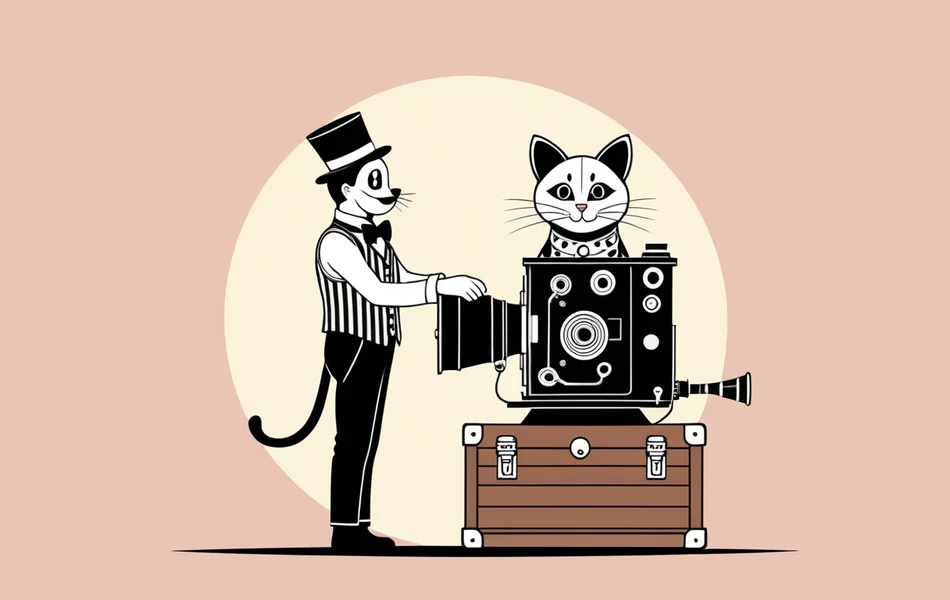
The Library’s catalog describes a wonderfully compact confrontation. Gugusse operates a crank, making the figure on the pedestal move and grow. Then it starts moving by itself and hits him with a stick. He retaliates with a hammer, and the figure gets smaller with each blow until it disappears. The repair manual for this machine apparently consists of one picture of a very large hammer.
The pleasure is in the transformation: a performer appears to change size in a single theatrical setting. Méliès helped develop the language of trick filmmaking, using staged action and edits to make impossible things happen. Describing him as the sole inventor of every cut would miss the collaborative, experimental history of early cinema. His contribution does not need that extra crown.
Why It Matters (More Than You Think)
It is tempting to draw a straight line from this little automaton to every rebellious machine in the movies. The resemblance is fun; a direct family tree is harder to establish. Stories about creations escaping their makers were already old, and Mary Shelley’s Frankenstein appeared in 1818, long before this film. What we have here is an early cinematic version of an enduring idea, told with the magnificent subtlety of a stick to the head.
The anxiety is right there in the frame. You build a thing. You wind it up. The thing attacks you. A century later, filmmakers can spend entire trilogies elaborating on that arrangement. Gugusse gets through the difficult conversation before most modern studio logos have finished appearing.
The Nitrate Problem
Nitrate film requires specialist preservation because it can deteriorate and presents a serious fire hazard. An old reel is not something to test in a domestic projector to see whether it still works. The Library’s restoration makes the material viewable without repeatedly running the fragile physical copy. That is one of the less glamorous conditions behind the apparently effortless act of pressing play.
Méliès’ surviving work is scattered across copies with different histories and conditions. The useful achievement here is recovering this particular film and making it available, not pretending that every surviving reel is pristine. Scratches and missing detail can be evidence of the journey an object has taken.
There is a related pleasure in the Anglo-Saxon ring found in Lincolnshire: a small object can reopen a much larger story. Finding it is the beginning. Working out what it is, and what can responsibly be said about it, takes the less cinematic work that follows.
The Potato Farmer Was the Real Story
William Frisbee was a farmer, teacher, and traveling exhibitor. His collection reminds us that early cinema had to reach an audience physically: someone carried the equipment, arranged a venue, and put on a show. The films were part of a working entertainment business before they became archival treasures. A projector has considerably less charm when you are the person who has to move it.
The family’s decision to keep the material mattered. So did finding an institution able to identify and preserve it. Neither part replaces the other. A box can survive for generations without its contents becoming accessible, and an archive cannot restore a reel that somebody has already discarded.
Watch It (It Is Free)
You can watch the digitized film free on the Library’s website. The catalog lists a running time of approximately one minute. Its brevity is part of the charm: setup, rebellion, escalating hammer, exit. No post-credit sequence is required to explain the automaton’s future in a shared universe.
Old visual tricks keep finding new audiences. The return of rubber-hose animation in games offers a different example. These works come from different eras and techniques, but both invite a modern viewer to enjoy a visual language that does not aim for photographic realism. A clearly impossible movement can be the whole attraction.
What an Old Box Can Hold
An unidentified reel is a question, not a guarantee of another masterpiece. The discovery is exciting precisely because its value was not obvious from the container. Careful identification turns an anonymous object into something people can study, watch, and enjoy. There is room for wonder without predicting what every remaining strip must contain.
Before an old box goes out with the rubbish, it may be worth asking what is inside. In this case, the answer included a magician, an insubordinate automaton, and a very large hammer. Family storage has produced worse surprises.