
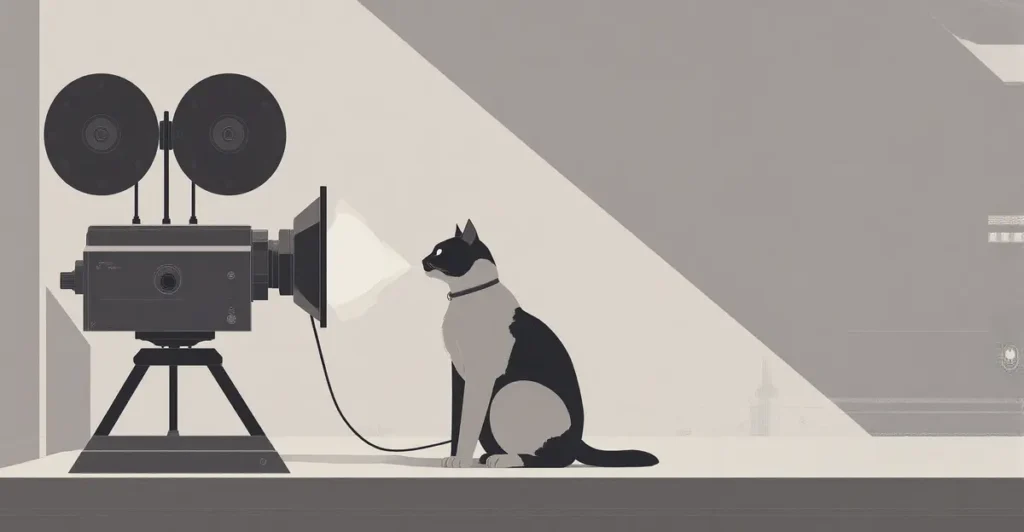
German expressionism in film is one reason your favorite horror movie looks the way it does, even if you have never watched a Weimar-era silent. Crooked staircases, looming shadows, rooms that seem to share a character’s panic: this cinema made mood part of the architecture. Its filmmakers built sets that looked like fever dreams and treated realism as an optional setting. The cat has strong opinions about this, and yes, Nosferatu is still terrifying.
Table of Contents
- What Is German Expressionism in Film
- Where It Came From: Post-War Germany and Painted Shadows
- The Cabinet of Dr. Caligari, the Film That Started Everything
- Nosferatu, Metropolis, and the Greatest Hits of the Movement
- The Visual Language of German Expressionism in Film
- How It Shaped Horror Forever
- How It Built Film Noir Brick by Brick
- Modern Echoes: Burton, del Toro, and Beyond
- FAQ
What Is German Expressionism in Film
German expressionism in film is associated above all with the early 1920s. It uses distorted design and stylized performance to turn an inner state into a visible world. The broader expressionist movement already existed in other arts; film gave that sensibility movement and a screen. It is useful to distinguish this particular style from Weimar cinema as a whole, which also included comedies, realist dramas, and lavish spectacles.
The most recognizable example is a deliberately artificial studio world: leaning walls, painted shadows, and bodies arranged like parts of the set. But that is not a rule for every film discussed alongside the movement. Nosferatu, for instance, finds unease in real landscapes as well. The useful question is what the space does to the mood, rather than whether a crew built every tree.
Where It Came From: Post-War Germany and Painted Shadows
The films emerged amid the upheaval following World War I. Yet it is misleading to picture the German industry as nothing but penniless artists improvising in a shed. The BFI’s Weimar cinema collection emphasizes an industry capable of major aesthetic and technical innovation. Economic instability and ambitious filmmaking existed together.
A painted shadow can do something a lamp cannot: refuse to obey the apparent light source. A crooked street can make the whole town feel unreliable. These are expressive choices, not simply emergency substitutes for equipment. Treating every stylized surface as a budget problem misses the fun of deliberately making a world feel wrong.
Silent cinema had already spent decades experimenting with impossible worlds. For an earlier example, our piece on Méliès’s Gugusse automaton film goes back to 1897. That is an earlier chapter, not a production from the Weimar years.
The Cabinet of Dr. Caligari, the Film That Started Everything
Robert Wiene’s The Cabinet of Dr. Caligari (1920) is the defining starting point. Its hypnotist and murderous sleepwalker inhabit a jagged, painted town. The BFI’s centenary essay describes artistic and economic motives behind that design. “They could not afford real shadows” is a good gag, but a poor production history.
Watch how little the setting offers your eye a comfortable place to rest. A normal doorway lets someone enter a room. A doorway here looks capable of taking sides. The design does more than decorate the story: it makes looking at the story feel uncertain.
Why Caligari Still Works
Watching Caligari today, the painted sets feel less dated than you would expect. They feel like a fever, like a place where logic has slipped sideways. That quality of unease is exactly what modern liminal-space horror tries to recreate with digital tools, the same impulse behind projects like the Backrooms A24 movie with its 30,000 square feet of constructed liminal hell. The materials change, the principle does not.
Nosferatu, Metropolis, and the Greatest Hits of the Movement
Two essential companion films show how different the wider landscape could be.
F.W. Murnau’s Nosferatu (1922) adapts Dracula without authorization. As the BFI’s teaching material explains, Florence Stoker’s successful copyright action led to an order that prints be destroyed. Surviving copies kept the film alive. Its landscapes and location photography also complicate the idea that expressionist horror must live entirely inside painted sets.
Fritz Lang’s Metropolis (1927) offers a vast future city divided between industrial labor and privilege. Its scale alone should discourage the idea that German silent cinema was uniformly cheap. It has a long restoration history: the Murnau Foundation’s 2010 project incorporated footage discovered in Buenos Aires, building on earlier work, including a 2001 restoration. The 2010 version was a major advance, not the first restored version.
For a compact starting list, add The Golem (1920). Then branch into the broader Weimar period with Lang’s Dr. Mabuse the Gambler (1922) and M (1931), or Murnau’s Faust (1926). These films do not all belong to one tidy stylistic box. A watchlist can explore connections without turning them into an official membership register.
The Visual Language of German Expressionism in Film
The signature of German expressionism in film is a set of visual choices that you can spot in five seconds if you know what to look for. The lighting is high-contrast, with deep blacks and bright highlights and almost nothing in between. Faces are often lit from below or from the side, creating dramatic shadows under the eyes and across the cheekbones. Backgrounds dissolve into darkness rather than fading naturally.
The compositions favor sharp diagonals over horizontals. Staircases tilt. Hallways narrow toward distorted vanishing points. Shadows are often a full character, sometimes drawn directly on the wall instead of cast naturally, because the effect is more important than the realism. Frames are crowded, claustrophobic, and unstable. Even the act of walking through a doorway becomes ominous.
Performance as Architecture
Actors in these films do not perform like modern naturalists. They use stylized gestures, exaggerated facial expressions, and slow deliberate movements that match the architecture around them. Max Schreck’s Orlok glides. Conrad Veidt’s Cesare in Caligari moves like a puppet. The body itself becomes part of the expressionist composition, an angular extension of the painted sets.
How It Shaped Horror Forever
Expressionism is one important ingredient in horror’s visual language. Compare a threatening doorway in Caligari with the theatrical spaces of Universal’s Frankenstein (1931): architecture can make a person seem trapped before anything attacks. That comparison is more useful than claiming every horror director inherited the same blueprint. And Universal’s The Wolf Man belongs to 1941, not the 1930s.
When watching later horror, look for spaces that feel emotionally loaded: an impossibly long corridor, a staircase that dominates the person climbing it, or darkness that seems more substantial than the room. Those are useful connections to draw, not proof of a direct influence on every shot. For a very different approach to making a place frightening, see our history of found-footage horror.
How It Built Film Noir Brick by Brick
The Nazi seizure of power in 1933 brought persecution, exclusion, and the forced emigration of filmmakers; it did not make German film production disappear overnight. Nor did every filmmaker leave at the same time. Murnau was already making films in America in the 1920s. The movement of people and techniques across the Atlantic has a longer, more complicated history.
Film noir mixes several traditions. The BFI’s noir survey points to both German lighting and French poetic gloom. “Expressionism in trench coats” is a memorable shorthand, provided the coat has room for other influences. Try Double Indemnity or Out of the Past, and notice how a room can make a conversation feel like a trap.
That genealogy is still visible in modern noir-influenced cinema. Even a project as recent as Nicolas Cage’s Spider-Noir, which gives viewers a choice between black-and-white and color, is consciously playing in the visual sandbox that Lang and Murnau built a hundred years ago.
Modern Echoes: Burton, del Toro, and Beyond
Tim Burton is a rewarding modern comparison: tilted architecture and exaggerated silhouettes make the environment feel like an extension of a character. Start with Vincent (1982). MoMA’s account of Burton’s stop-motion work connects the puppet’s movement with the character’s exposed feelings. It is a short, accessible way to think about emotion becoming design.
You can use the same viewing exercise with Guillermo del Toro’s Crimson Peak or David Lynch’s Eraserhead. Ask what the setting makes you feel before dialogue explains anything. These are comparisons of what is on screen, not a claim that a single 1920s movement explains every choice either director made.
The point is that German expressionism in film never really ended. It went underground, scattered itself across genres, and now lives in horror, noir, fantasy, animation, music videos, video games, and any frame of cinema where mood matters more than realism. If you have ever loved a film for the way its shadows fell, you have loved expressionism, even if no one ever told you the name. For more curated film deep dives, our piece on underrated movies based on true stories is a good next stop.
FAQ
What is German expressionism in film in simple terms?
It is a 1920s German cinema movement that used distorted sets, sharp shadows, and theatrical performance to show how characters felt rather than what the world actually looked like. The Cabinet of Dr. Caligari is the defining example.
When did German expressionism in film start and end?
The early 1920s, with Caligari in 1920 as a defining landmark, are the core period. Wider surveys often follow related developments through later Weimar cinema. Treating 1931’s M as an agreed final expressionist film makes the boundaries look more settled than they are.
What are the most important German expressionist films?
Begin with The Cabinet of Dr. Caligari (1920), The Golem (1920), and Nosferatu (1922). Then explore Metropolis (1927) and the wider Weimar period. Not every major German film of that era is expressionist.
How did German expressionism influence Hollywood?
Filmmakers working in Hollywood helped carry European visual approaches into American cinema, both before and after the forced emigration of the Nazi period. Horror and noir show important connections, alongside influences from other theatrical, literary, and film traditions.
Is German expressionism only about horror?
No. Caligari is a famous horror example, but the broader interest is in expressive design and psychology. Related films extend into science fiction and crime. Mood does not need a vampire, although a vampire rarely makes a room feel less ominous.
Conclusion
German expressionism in film is the quiet ancestor of almost everything moody and stylized in modern cinema. Artists working in Weimar Germany showed that movies did not have to look like the world, and a century later their painted shadows are still falling across our screens. Watch Caligari once, watch Nosferatu twice, and you will start spotting the bloodline in every horror movie, noir thriller, and Burton fairy tale you see. The cat recommends popcorn and a dark room. The movement designed itself for both.