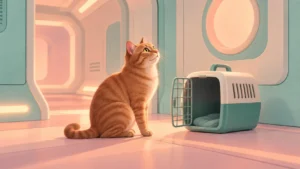
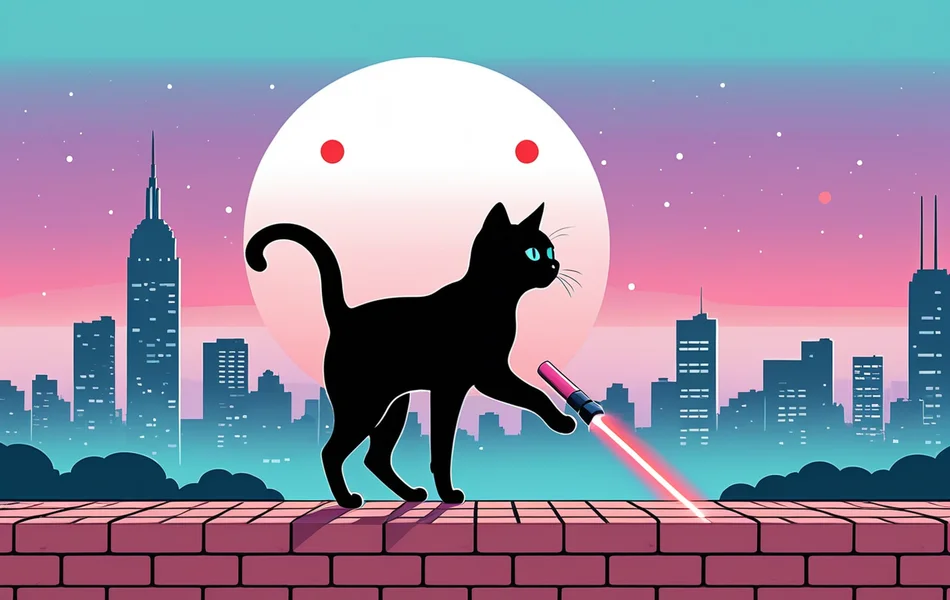
Laser-Gato, also presented as Laser-Cat, has won First Prize in the 2026 La Cinef competition at Cannes. Lucas Acher’s short represents NYU, and its premise has an obvious point of interest for this particular corner of the internet: a teenager’s terrible night revolves around saving a cat.
The festival announced the result on May 21. La Cinef selected 19 student films from 2,747 submissions representing 662 film schools. First Prize carries €15,000.
That is a substantial achievement. It is also the student-film prize, not the main competition’s Palme d’Or or the separate Short Film Palme d’Or. The cat has earned its headline without needing to steal anyone else’s trophy.
A Small Prank, a Very Bad Night
The official synopsis follows an anxious teenager whose laser-pointer prank has disastrous consequences for the cat belonging to his crush. He crosses São Paulo trying to save the injured animal while guilt and paranoia intensify.
Cannes lists the running time as 22 minutes, with the United States, Brazil and United Kingdom as production countries. Acher is credited as director, screenwriter and editor.
The synopsis establishes an accident and a rescue attempt; it does not explain the exact physical mechanism of the injury. It would be a leap to turn that into “the laser beam critically injured the cat.” It would also spoil the appeal of discovering how this particular disaster unfolds.
Why the Premise Has Our Attention
This is a reaction to the announced premise and award, rather than a claim to have watched the full short. On that basis, the setup offers an appealingly concentrated problem: a young person makes a bad decision and cannot simply apologize his way out of it.
The cat makes the stakes immediate. A rescue attempt gives the protagonist something concrete to do, while the crush adds an uncomfortable extra layer. It is one thing to cause a disaster; it is another to cause it while hoping someone thinks you are charming.
That combination can support tension without requiring a world-ending threat. The urgent question is whether someone can put one small part of the world right again. For a cat, of course, its own small part already qualifies as the world.
None of that tells us exactly why the jury chose the film. The official announcement records the result, not a detailed account of the jurors’ reasoning. There is no need to invent a Cannes rule about cats being the most efficient narrative device, however tempting that would be for our editorial brand.
The Jury and the Next Confirmed Screening
Carla Simón chaired the Short Film and La Cinef jury, joined by Ali Asgari, Salim Kechiouche, Ji-Min Park and Magnus von Horn.
The award announcement also gives a concrete next opportunity to see the winners: a screening at Paris’s Cinéma du Panthéon on June 2 at 6 p.m. That is a confirmed plan, unlike guessing a Toronto, San Sebastián or Sundance itinerary.
For an immediate introduction, Cannes has published an official trailer. A trailer should not be confused with availability of the complete film, and there is no basis here for promising an online release in exactly twelve months.
A Cat-Sized Story Worth Following
A student-film award can bring attention to a filmmaker’s next work. It cannot guarantee a production deal or a future place in the main competition. For now, the achievement already announced is enough: Laser-Cat took the top prize in this year’s La Cinef selection.
We will happily follow a story that gives one injured cat enough dramatic gravity to pull a teenager across a city. For a much less anxious feline mystery, there is also Feline Forensics and its museum-heist investigation. Different medium, same reliable way to get our attention: put the cat near the center of the story.