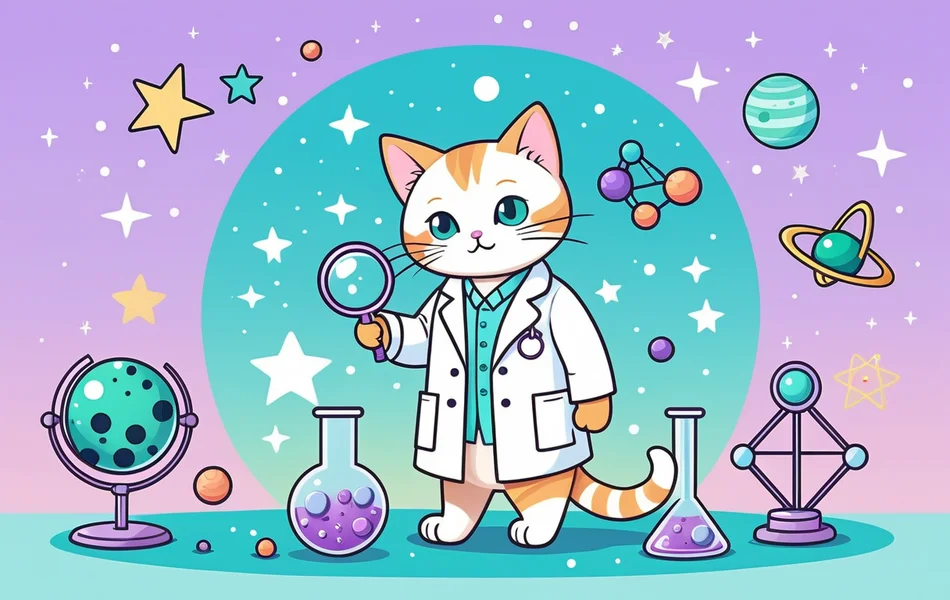
The phrase strange science facts that are true gets thrown around a lot, and most of the time the payoff is a recycled list about how your stomach lining replaces itself. We are skipping the body. The cat is more curious about parts of the universe that read like a typo in a textbook. Eight verified entries, each one dinner-table worthy, with commentary from the cat.
1. A Teaspoon of Neutron Star Would Weigh About a Billion Tons
Neutron stars pack stellar amounts of mass into an object roughly the size of a city. NASA uses the comparison of a teaspoon weighing more than a billion tons to convey the density. This is a scale analogy, not a practical suggestion that you could bring home a stable spoonful. The kitchen drawer is not equipped for stellar matter. Mass and volume are not the same conversation.
2. Tardigrades Survive the Vacuum of Space
In the 2007 Foton-M3 experiment, dehydrated tardigrades were exposed to space conditions, with different groups receiving different ultraviolet exposure. The published study reported survival after vacuum exposure, while solar UV was much more damaging. Some animals survived even the combined conditions. “Some survived this experiment” is remarkable enough without turning it into “all tardigrades are indestructible.” The tiny water bear still wins the packing-light competition.
3. More Color Receptors Do Not Necessarily Mean Better Color Discrimination
Some mantis shrimp have many more color-sensitive channels than humans. Yet experiments reported by the University of Queensland in 2014 found that a species with twelve channels was worse than humans at discriminating tested colors. An elaborate visual system need not work like an upgraded human one. It is a different solution to a different animal’s needs, not simply the deluxe paint-sample package.
4. Clumps of Bacteria Survived Years Outside the Space Station
The Tanpopo experiment tested dried aggregates of radiation-resistant Deinococcus bacteria outside the ISS. After three years, sufficiently thick samples still contained surviving cells, with outer layers providing protection. The researchers’ results inform questions about survival during travel through space. They do not demonstrate that life actually travelled between planets, or that an isolated bacterium survives every dose of radiation. Teamwork, even at this scale, can improve the accommodation.
5. Laboratory Experiments Support the Idea of Diamond Rain
In 2017, researchers at SLAC produced tiny diamonds by subjecting polystyrene to extreme conditions intended to model part of an icy giant planet’s interior. The experiment supports a diamond-precipitation mechanism relevant to Uranus and Neptune. It was not a direct observation of diamonds falling inside those planets, nor a measurement of a centimeter-thick planetary jewel. The cat would still like to skip the next vacation to Neptune.
6. Helium Becomes a Superfluid Near Absolute Zero and Flows Uphill
Below about 2.17 kelvin, helium-4 enters its superfluid state under the relevant pressure conditions. CERN uses this remarkable low-temperature behavior in its cryogenic systems. Thin helium films can also spread over surfaces and escape an open vessel, a phenomenon investigated in early helium-II experiments. It is not a violation of energy conservation, but it is profoundly disrespectful behavior from a liquid.
7. A Pond Ciliate Uses Two Familiar Stop Codons for Different Amino Acids
The standard genetic code uses UAA, UAG, and UGA as stop codons, but exceptions were known long before 2026. A 2023 study of a ciliate identified a particularly unusual assignment: UAA codes for lysine and UAG for glutamic acid, rather than both coding for glutamine. See our ciliate article for the story. Biology had not just discovered its first asterisk; it had found another interesting dialect.
8. A Houseplant’s Leaf Veins Resemble a Voronoi Diagram
A May 2026 study of Pilea peperomioides found that major veins within its leaves approximate a Voronoi diagram around pores called hydathodes. This concerns the network inside a leaf, not the arrangement of leaves around a stem. The authors proposed a developmental model; they did not show a houseplant beating every computer search for minimum shading. Our fuller explanation is here. The plant has interesting geometry without needing to replace your CPU.
Why Strange Science Facts Stick With Us
These stories are fun because they complicate familiar categories. More receptors need not mean finer discrimination. A familiar stop signal can mean something else in a different organism. Liquids can behave in ways that make a perfectly good container seem underqualified. For another research story, see the RAVEN exoplanet search.
Frequently Asked Questions
Are these strange science facts really true or just popular myths?
The entries link to research or institutional explanations. Some describe direct observations, while others concern models or experiments that support a possibility. Those distinctions are part of the story: “diamond formation in a laboratory” is not the same observation as “diamond rain seen on Neptune.”
Why exclude human body facts from this list?
Pudgy Cat already published a dedicated list on the human body. The body is fascinating, but the cosmos, microbes, and physics are a much wider playground. This piece is the cosmic, animal, and material counterpart.
What is the strangest science fact on this list?
The cat votes for the surviving bacterial aggregates. Their endurance under the tested conditions is extraordinary, without needing to claim that a radiation dose would sterilize an entire planet. It is a good reminder that the details of the packaging can matter.
The Cat’s Closing Note
The universe provides more than enough strange material without invented numbers. Some of the best discoveries become more interesting when you keep their limits in view. The cat will be here for the next batch, ideally with a container the helium agrees to stay inside.