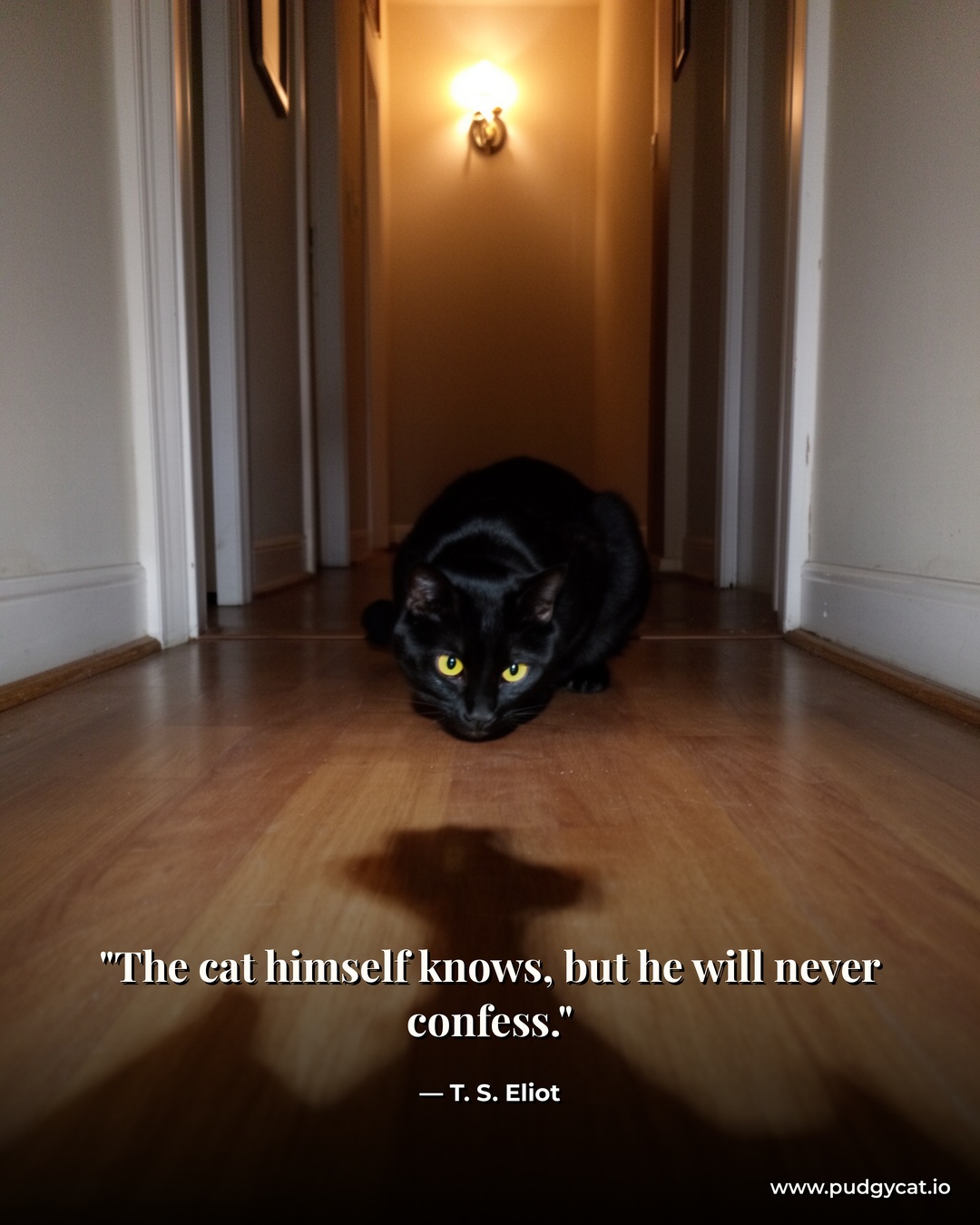
The cat himself knows, but he will never confess.
T. S. Eliot
Source, Old Possum's Book of Practical Cats, 1939
Why This Quote Matters
T. S. Eliot wrote Old Possum's Book of Practical Cats in 1939, originally as poems for his godchildren. The book is frequently underestimated because it spawned a musical. It is also the only work in which Eliot, otherwise the high-priest of modernist difficulty, admits that cats are a more interesting subject than most of his contemporaries. This line appears in The Naming of Cats, and it is the quietest moment in the collection.
The couplet is about the third cat name, the secret one, the one the cat will never tell. Eliot is describing something a person who has lived with a cat already knows. There is a private life going on. Behind the loaf, behind the bathed-in-sun pose, behind the routine of the food bowl, the animal is keeping its own counsel. The relationship is real, but not transparent. Something is always being withheld, and that withholding is, to the cat, a form of dignity.
We tend to pathologize this in humans and call it emotional distance. In cats we call it mystery and keep them anyway. The quiet lesson Eliot leaves in the line is that privacy is not the opposite of intimacy. You can love something completely without requiring it to explain itself. A black cat walking the hallway shadow at night is not keeping secrets. It is simply refusing to mistake you for its entire audience.
🐾 Visit the Pudgy Cat Shop for prints and cat-approved goodies, or find our illustrated books on Amazon.
More Cat Wisdom