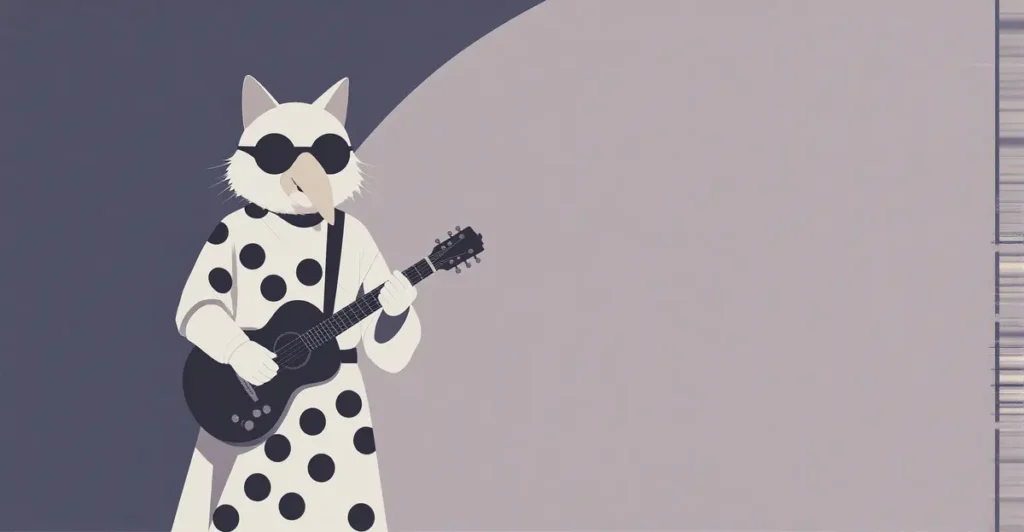
Two musicians in oversized papier-mâché masks and polka dots are making a surprisingly persuasive case for stopping the scroll. Angine de Poitrine, the Quebec duo of Khn and Klek, combine an immediately recognisable appearance with music that refuses to sit politely in the background.
They look like the entertainment booked for a geometry conference after the organising committee lost control. That is part of the invitation. The other part is that the performance has enough going on to reward attention after the initial “what on earth is this?”
The KEXP Session That Travelled Far Beyond Its Niche
KEXP recorded the duo during its visit to Trans Musicales in Rennes in late 2025 and posted the session in February. The festival’s own account places their first European concert at Le Liberté on December 6, 2025.
In a March 25 feature, KEXP reported more than 7.5 million YouTube views across video clips and 6 million on Instagram. Those figures describe the station’s reported reach, not a count of unique fans or tickets sold.
The station’s staff described choosing the band for both its sound and its striking presentation. That is a helpful reminder that this was not simply an algorithm discovering a strange object in the forest. A festival booked the musicians, people at a radio station chose to record them, and audiences helped the performance travel.
The masks attract attention. A strong recording gives that attention somewhere to go. Getting the enormous headwear across the Atlantic presumably required a separate logistical philosophy.
What Does Angine de Poitrine Sound Like?
Khn handles microtonal guitars and Klek drums and percussion. The music combines repeating instrumental patterns with rhythms and pitch choices that can feel unfamiliar. “Math rock” is a useful doorway, not a requirement to bring a calculator.
Microtonality involves pitch intervals beyond the familiar twelve-note equal-tempered framework. It is not random wrong notes, and it is not a recent invention. Here it forms part of a deliberately distinctive musical language.
The duo’s Vol. II Bandcamp page lists an April 3, 2026 release and six tracks: “Fabienk,” “Mata Zyklek,” “Sarniezz,” “Utzp,” “Yor Zarad” and “Angor.” The credits identify music and arrangements by Klek and Khn, with production by Fabien Peterson and Angine de Poitrine.
For a first encounter, the KEXP session offers the visual performance as well as the music. The album offers another route in, without requiring you to stare at the masks while trying to work out where the beat has gone.
Is This Really a Backlash Against AI Music?
It is an appealing interpretation, but it should remain an interpretation. In Northeastern Global News’s discussion with music scholars, James Gutierrez connects the duo’s appeal to a desire for distinctive, recognisably human expression amid the spread of generated music.
Fellow scholar Andrew Mall points to the pleasure of unfamiliarity and the playful mystery of the costumes. He does not expect the success of one experimental act to make Spotify abandon its existing approach to recommendations.
Those are thoughtful readings of a cultural moment. They do not demonstrate that listeners as a whole are leaving streaming services, or that the duo’s popularity has one cause. Someone may be drawn by the playing, the humour, a friend’s recommendation or the simple fact that a triangular head has entered their afternoon.
Our earlier article about unauthorised releases on jazz artists’ streaming profiles raises a different question: attribution and control over an artist’s identity. It helps explain why authenticity is being discussed, without turning this band into proof that a whole industry has already changed direction.
A Costume Is an Invitation, Not a Human Verification Badge
There is an obvious temptation to declare the music impossible for a machine to imitate. But unusual clothes, complex rhythms and a distinctive sound are not technical guarantees about what software can or cannot produce.
The more interesting point is the specific act itself: these musicians, this performance and this deliberately odd presentation. Art does not have to win a permanent contest against every future tool to be worth someone’s attention.
Nor does the success provide a reliable recipe for every struggling band. Buying a large mask does not entitle you to millions of views. It may entitle you to an awkward conversation with the person sharing your rehearsal room.
Start With the Music
Watch the session, try the album and see whether the combination works for you. There is no obligation to enjoy it because it has become a symbol in an argument about technology.
What makes the story enjoyable is that something so particular found a broad audience. It leaves room for surprise in a conversation that too often treats listeners as predictable inputs.
Khn and Klek do not need to have solved the future of music. Getting people to spend half an hour with an eccentric instrumental duo is already a pleasing achievement. The cat is withholding its verdict until it establishes whether the masks are potential furniture.