A Roman shipwreck has yielded something less glittering than treasure and, in its own way, just as interesting: clues to the work that kept it afloat. Think of an ancient service history, except the paperwork is pollen trapped in sticky hull coating. The mechanic has been unavailable for roughly two millennia.
The wreck is Ilovik–Paržine 1, discovered in 2016 near the Croatian island of Ilovik and dated around the middle of the second century BC. A study published on April 24 in Frontiers in Materials examines its waterproofing using molecular, pollen and statistical analyses.
The Goo Deserves Some Attention
The team analysed ten coating samples. Pine-derived pitch was the main component; one sample also contained beeswax. The authors relate that mixture to zopissa, mentioned by Pliny the Elder.
A named preparation is not automatically a brand in the modern sense. There is no evidence here for a Roman marketing department selling premium Zopissa™ while sailors compared loyalty schemes. The name connects a material finding with an ancient description; it does not supply a manufacturer, price list or advertising campaign.
Likewise, finding different formulations on one hull does not prove that the crew deliberately used expensive material in important places and cheap material everywhere else. That is an amusing modern analogy, but the samples do not come with receipts.
Pollen Leaves Clues, Not GPS Coordinates
Pitch can preserve pollen from surrounding vegetation. Comparing the plant traces helps researchers investigate where material was produced or applied. The results suggest four to five distinct coating batches and possible activity on different Adriatic shores. A connection with the Brindisi area remains a hypothesis, supported by earlier ballast research.
This is what makes the service-history comparison appealing. A repair can unintentionally preserve information beyond the repair itself. Material chosen to protect a boat may also record something about the place where people worked on it.
But “four to five batches” should not become four or five precisely dated workshop appointments. Nor should a possible region become an identified dock. A pollen signature is evidence to interpret alongside other findings, rather than a map pin the ship conveniently left for future archaeologists.
Why the Ordinary Work Is the Interesting Part
Treasure makes an easy headline. Maintenance asks a different question: what had to happen repeatedly for this object to remain useful?
A ship is not finished, in the everyday sense, when it leaves the shipyard. It has a working life. Thinking about coatings, repairs and materials brings that life into view rather than treating the vessel only as a container for its final cargo.
It also changes the cast of the story. Alongside merchants and captains, there is room for people preparing materials and working on the hull. We do not need to invent their names or reconstruct an exact day in the yard to recognise the skill their tasks required.
The study’s authors—Armelle Charrie-Duhaut, Quentin Couillebault, Igor Miholjek and Giulia Boetto—bring different kinds of evidence together. That combination is the useful advance: asking more questions of a material that could otherwise be dismissed as residue.
A Better Question Than “Where Is the Gold?”
The attraction is not that this one wreck gives us a complete shipping atlas, or that its coating is the oldest maintenance record in the world. Neither claim is needed to make the discovery compelling.
What it offers is a more textured picture of an ancient working vessel. Some conclusions remain tentative, and other wrecks would need their own investigation. That is how an interesting method earns its place: by producing clues that can be tested, compared and refined.
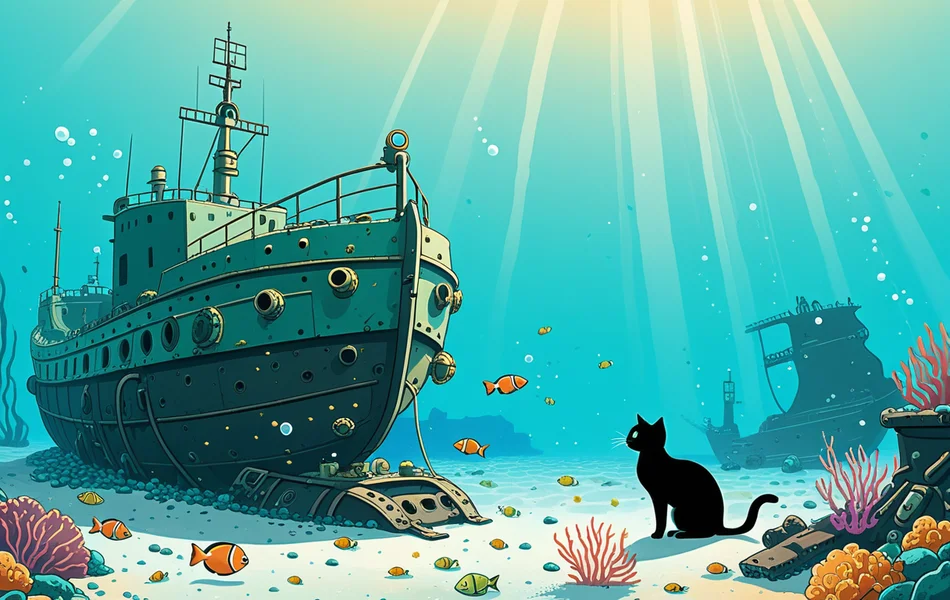
The cat would almost certainly prefer an artefact it can bat off a table. The archaeologists have chosen sticky residue and pollen. This time, the less photogenic option has the better story.