In September 1868, a mid-level manager at the London Money Order Office wrote to his boss asking for money to buy cats. The mice were eating the paperwork. Three cats were hired on probation at one shilling a week between them, and they were given six months to prove they were worth the money. They kept the job. That memo is a wonderfully specific paper trail for a habit that public institutions have never really abandoned, and library cats are its most visible modern form: an animal that lives in a public building, appears in the minutes of council meetings, and occasionally has a job title.
What follows is the record. Names, dates, wages in pre-decimal currency, one municipal eviction vote, and a Russian cat whose staff arranged a veterinary passport along with his honorary appointment.
Table of Contents
- The 1868 Shilling That Put Cats on a Public Payroll
- The Hermitage Had Been Doing It Since 1745
- How Library Cats Became a Recognized Job
- Library Cats Outside the United States
- When Library Cats Go to a Vote
- What a Library Cat Is Actually For
- Frequently Asked Questions
The 1868 Shilling That Put Cats on a Public Payroll
The British Post Office supplies a particularly good set of employment records. Frederic Rowland Jackson, Controller of the London Money Order Office, put the proposal to John Tilley, Secretary of the Post Office: add cats to the establishment. Three cats went on probation in September 1868 with an allowance of one shilling a week, and the terms were blunt. Reduce the mouse problem within six months or the allowance stops.
The cats passed their trial, and the allowance rose by sixpence in 1873. The British Postal Museum & Archive’s historical factsheet records the arrangement and its later wage disputes. This was more than sentiment: someone really did have to account for the cat food.
Tibs the Great, 23 Pounds of Civil Servant
The most famous was Tibs, born in November 1950. The museum’s factsheet identifies him as one of Fluffy’s offspring, rather than Minnie’s son. Accounts of his career credit the enormous mouser and his human caretaker, Alf Talbut, with keeping headquarters free of mice; that is the celebrated service record, rather than an independent audit of every corner.
Tibs was reported to weigh 23 pounds and died in December 1964. He became an unusually well-documented feline celebrity: a name, a keeper, an allowance and a place in postal history. The public-service metaphor hardly needs embellishment.
The Last Headquarters Cat
Blackie, the last Post Office headquarters cat, died in 1984. The museum connects the wider decline in postal cats with changes such as replacing vulnerable mail sacks with plastic ones. That is a gradual change in working conditions, not proof that one new material ended every postal cat’s job on a particular day. Even the feline civil service could not entirely escape technological change.
The Hermitage Had Been Doing It Since 1745
Britain was late. In 1745 Empress Elizabeth, daughter of Peter the Great, ordered cats brought to the Winter Palace in Saint Petersburg to deal with rats. The city of Kazan in Tatarstan, which had a reputation for producing exceptional mousers, supplied them. The story belongs to the palace’s history before it became a public museum, rather than to an uninterrupted employment contract.
The State Hermitage Museum’s cellar cats have continued the association between art and pest control. In a 2015 AFP report from the museum, staff described caring for around seventy animals, with feeding, treatment and adoption work as well as mousing. That is a dated headcount, not a permanent staffing level. The same report describes interruptions in the population’s history, including the siege of Leningrad. The tradition survived; an unbroken feline family tree is another matter.
How Library Cats Became a Recognized Job
One of the best-known library versions of this arrangement began in January 1988, when staff at the Spencer Public Library in Spencer, Iowa opened the outside book drop and found an eight-week-old kitten that had been pushed through it overnight. A public naming contest called “Name the Kitty” produced Dewey, after Melvil Dewey and his classification system. Staff added the rest: Readmore Books.
He lived in that library for almost nineteen years and died on 29 November 2006. He accumulated pen pals in England, Canada, South Africa, Belgium and France, and appeared in Cat Fancy and Country Magazine. In 2008 the librarian who found him, Vicki Myron, published with Bret Witter Dewey: The Small-Town Library Cat Who Touched the World, which took the story to readers far beyond Iowa. The library’s own account of Dewey’s life records his arrival, the naming contest and his death.
The organizing came before the fame. Phyllis Lahti founded the Library Cat Society in 1987. A feature interviewing Lahti and filmmaker Gary Roma describes its six-dollar newsletter and Roma’s three years making Puss in Books: Adventures of the Library Cat. His 1997 documentary and later map helped preserve the stories. The map included former residents as well as living cats: its accumulated entries should not be read as a census of animals simultaneously on duty, or all assigned to the 1990s.
The other canonical pair arrived earlier, but not as accidental strays. In 1983 librarians at the Douglas County Public Library in Minden, Nevada selected Baker, a Scottish Fold, to help with rodents. Taylor followed with support from the book distributor whose name the pair shared. A January 1986 library newsletter already describes them as company spokes-cats. Their faces on posters and tote bags carried them far beyond Nevada. Jan Louch, one of their caretakers, later told their story with Lisa Rogak in The True Tails of Baker and Taylor.
Library Cats Outside the United States
The American examples dominate the coverage because someone wrote the books. The practice is older and wider.
Kuzya, the Cat Who Needed a Passport
Kuzya became a minor international celebrity in 2013 after settling at a children’s library in Novorossiysk, on Russia’s Black Sea coast. Contemporary coverage in the library trade press described staff arranging a veterinary passport, identification chip and rabies vaccination, followed by an assistant-librarian title and bow tie. It is an account of this library’s arrangements, not a reliable summary of every Russian rule about animals in public buildings. The bow tie, at least, needs no legal interpretation.
Campus Cats With Staff Cards
Campus cats belong to a related tradition, although a popular campus visitor is not necessarily a resident library employee. At Essex, Pebbles became known as Campus Cat and acquired a registration card, as the university’s own playful profile records. An institution capable of issuing a cat a card has clearly accepted that student life cannot be explained entirely by the prospectus.
Edinburgh supplied an especially literary example: its library cat Jordan helped inspire Alex Howard’s Library Cat: The Observations of a Thinking Cat, published in April 2016. The university’s author profile distinguishes the awards: the novel was a People’s Book Prize finalist, while Howard won the Beryl Bainbridge Award for Best First Time Author in 2017. The novel gives its feline observer a voice; it is fiction inspired by library life, not a transcript from the returns desk.
Japan applied a similar idea to transport. Tama became stationmaster at Kishi Station on 5 January 2007. The railway’s own history dates her executive-officer promotion to 2010, followed by further honorary promotions. Her fame helped turn the threatened line into a visitor attraction, alongside the humans running and promoting it. A cat cannot operate a railway, but she can give people a rather good reason to buy a ticket.
When Library Cats Go to a Vote
Because these animals live in public buildings, they are subject to public procedure, which is where it gets genuinely strange. On 14 June 2016 the city council of White Settlement, Texas voted 2 to 1 to give the White Settlement Public Library thirty days to rehome Browser, a cat who had lived there for about six years. Councilman Elzie Clements, who voted to evict, said city hall and city businesses are no place for animals.
Mayor Ron White suggested the eviction was retaliation after a worker was refused permission to bring a puppy to city hall. That was his explanation of the dispute, not an independently established motive. Browser’s supporters took the argument far beyond the town.
On 1 July 2016 the council unanimously reversed its decision. Contemporary reporting on Browser’s reprieve records the reversal and the international attention. Browser kept the job. Few municipal staffing decisions have received quite so much free publicity.
The Accessibility Question
The serious objection is not about mice or dignity. It is access. A public building has to be usable by the public, and a resident cat makes a building difficult for people with severe cat allergies or asthma.
A reported dispute over Penny at Swansea Public Library in Massachusetts also raised allergy-related access concerns. Such stories show why the argument cannot be reduced to whether a majority likes the cat.
Signage and arrangements for separating visitors from an animal may be part of a local response, but moving the cat does not automatically remove its allergens. The American College of Allergy, Asthma & Immunology explains that allergens can spread beyond the room containing the animal. A petition is not an accessibility assessment. Welcoming one group of readers should not mean dismissing another group’s ability to use the building.
What a Library Cat Is Actually For
Pest control explains much of the history, but it is not the whole modern appeal. Nor has every library ceased to have a mouse problem. The balance between practical mousing, companionship and publicity depends on the building and the animal.
For some libraries, the cat also becomes a reason to visit. Spencer’s account of Dewey describes people travelling to see him; that does not let us attribute every library visit to the cat. The attraction is easy to understand without a suspiciously tidy statistic. Cats choose their own visitors and make the interaction feel earned rather than provided. How they pick is partly a question of how cats see the world, which is nothing like how you do.
An animal can also make reading aloud feel less intimidating. The cat does not correct pronunciation, which is an excellent qualification in an audience. But that appealing idea should not be confused with a proven literacy treatment: a 2016 systematic review of children reading to dogs found encouraging possibilities alongside generally weak evidence and uncertain mechanisms. Results about structured dog programmes do not automatically establish benefits from a resident library cat. The pleasure of reading with one can stand on its own, including for anyone rebuilding the habit of remembering what you read.
None of this is separate from the broader fight over what public libraries are for. The same institutions absorbing record numbers of book challenges are the ones defending a cat in a council chamber, although these are different decisions with different consequences. They do share a question: who gets to shape a public room? The commercial side, where independent bookstores have grown sharply since 2020, worked this out too. A shop cat is a business decision.
The cat, meanwhile, is running an older program. Nine hours asleep on a warm radiator near the reference desk, three hours of surveillance, one public appearance near closing. It is a working model of slow living, run by a species that never read a book about it.
Frequently Asked Questions
Do library cats get paid?
Sometimes institutions assigned a food allowance. The British postal example began with one shilling a week for three cats together, not one shilling per cat. Library arrangements can instead rely on staff or supporters: Spencer’s account describes donations and staff fundraising for Dewey. An honorary job title does not necessarily mean a salary from the public payroll.
How many library cats are there?
There is no reliable current census here. Gary Roma’s historical map gathered both living and former library cats, so its cumulative totals are not a count of cats working at one time. The Library Cat Society and documentary helped record the tradition, but their history does not establish a precise present-day population.
Who was the most famous library cat?
Dewey Readmore Books, found in the book drop of the Spencer Public Library in Iowa in January 1988 and resident there until November 2006. Vicki Myron’s 2008 book about him became an international bestseller. The Scottish Folds Baker and Taylor of Minden, Nevada are more widely seen, because of their long association with the book distributor’s promotional materials.
Are library cats legal in public buildings?
There is no universal permission attached to the title “library cat.” Local rules, building policy and access needs matter. Kuzya’s reported paperwork and Browser’s council votes describe particular cases; neither provides a general legal answer for another library.
Why are cats associated with libraries and not dogs?
The original reason is functional. Cats hunt rodents that eat paper and glue, they need no walking, and they are quiet. The cultural association came later and is heavily loaded with older folklore about cats as guardians and omens, a history covered in more depth in the record of black cat superstitions. Dogs have their own library role too, including organised reading programmes. Cats do not hold an exclusive contract on the companionship of books.
The Bottom Line
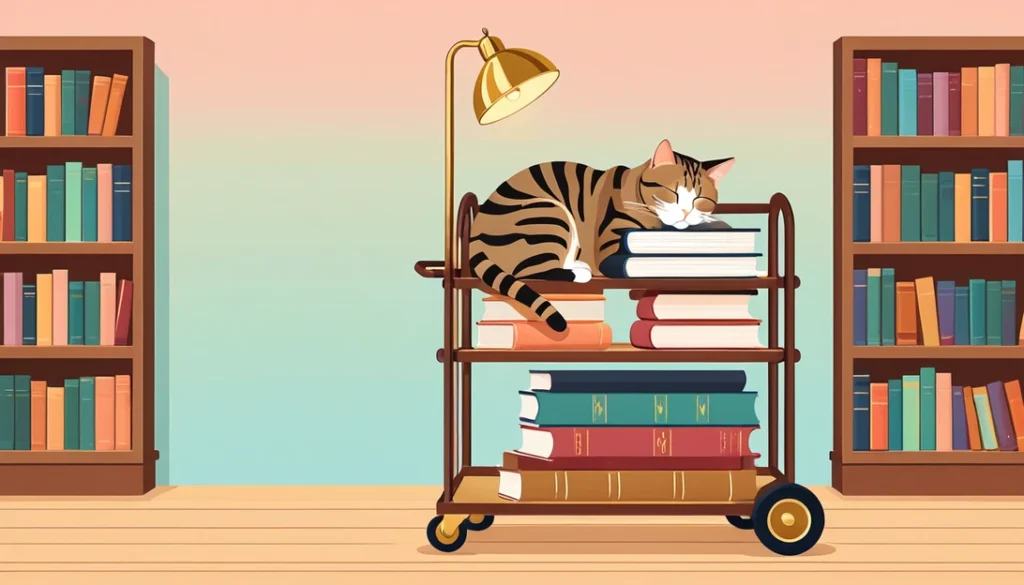
The thread from a shilling a week in 1868 to a Texas council reversing itself in 2016 is not sentimentality. Public institutions kept cats because cats solved a real problem, and kept them after it was solved because the animals did something else useful: they make an official building feel like a place rather than a facility. Library cats are a particularly visible branch of a very old institutional tradition, and the paperwork is more thorough than most people expect. Somewhere right now a cat is asleep on a returns trolley, technically on duty.