The first time someone asks what is slow living, the honest answer is that it is the small rebellion of doing one thing at a time on purpose. It is not a productivity hack and it is not a mood board with linen aprons. It is a practical philosophy that says speed is not a virtue, attention is, and the way you spend an ordinary Tuesday is the way you spend your life. The cat, of course, has been running this protocol since the domestication of the Fertile Crescent. We are the slow learners here.
What follows is a clear, unhurried walk through the idea, where it came from, what it actually looks like in a normal apartment with a normal job, and how to start without quitting anything or buying a farm in Tuscany.
Table of Contents
- What Is Slow Living, In Plain Language
- Where Slow Living Came From
- The Core Principles of Slow Living
- Slow Living vs Minimalism vs Hygge
- How to Start Slow Living Without Quitting Your Job
- Common Misconceptions About Slow Living
- The Cat Method, A Field Guide
- FAQ
What Is Slow Living, In Plain Language
Slow living is a deliberate approach to daily life that prioritises depth over speed, presence over output, and quality over volume. It does not mean moving slowly in a literal sense. A surgeon practicing slow living still operates at speed. A line cook still flips eggs in three seconds. The slowness is in how the day is structured, how attention is allocated, and how decisions about time and energy are made.
At the centre is one question. Does this activity deserve my attention, or am I just filling silence with motion. Slow living says that filling silence is expensive, because attention is the only currency you cannot earn more of.
Practically, this shows up as fewer commitments, longer meals, single-tasking, more time outside, less time on apps designed to fragment your focus, and a kind of unhurried calm that other people often mistake for being lazy or rich. It is neither.
Where Slow Living Came From
One important root of the modern slow movement is Italy’s Slow Food campaign. Slow Food traces its beginnings to the protests surrounding a fast-food restaurant near Rome’s Spanish Steps in 1986, with Carlo Petrini among its founders. The international movement followed in 1989. That is a history of an organization, rather than a birth certificate for every idea now called slow living.
From Slow Food to Slow Everything
The wider slow movement reaches into travel, fashion, parenting, and work. Canadian journalist Carl Honoré helped bring these ideas to a broader audience with his 2004 book In Praise of Slow, published in the US as In Praise of Slowness. His argument is not that speed is always bad: it is that faster is not automatically better. That distinction matters when your train is leaving in two minutes.
Why It Came Back in the 2020s
The current wave is not a 1980s revival. It is a direct response to the attention economy. Phones became infinite, work became remote and therefore boundaryless, and a generation realised that always-on does not mean always-useful. Slow living offers a vocabulary for the resistance. The same impulse is visible in the rise of dopamine fasting, in the strange popularity of rawdogging boredom, and in Gen Z’s surprising love affair with dumb phones that do less on purpose. Different surfaces, same underground current.
The Core Principles of Slow Living
There is no single rulebook for slow living. The following four ideas are a practical way to organize it, rather than an official checklist you can fail.
1. Intention Over Reaction
Most modern life is reactive. A notification arrives, you react. An email lands, you react. A trend appears, you react. Slow living asks you to choose, on purpose, what you will respond to and what you will ignore. The ignored category is large and that is the point.
2. Single-tasking
When two activities both demand attention, repeatedly switching between them can cost time and increase mistakes. The American Psychological Association summarizes experiments on those switching costs. That does not mean nobody can walk and talk at once. It does make a reasonable case for closing the chat window while tackling a difficult paragraph. One thing, then the next thing.
3. Less, But Better
Think fewer commitments accepted automatically, fewer subscriptions you no longer use, and fewer tabs open in the brain. The room you keep is for the things that actually matter. This is a useful organizing idea, not a demand to count your possessions or prune your friends to a fashionable number.
4. Local and Seasonal
Slow living has roots in Slow Food, and the food principle generalises. Eat what is in season, walk where you can, know the names of three trees on your street, recognise your neighbours, treat your immediate physical world as worthy of attention. The world is not somewhere else. It is here.
Slow Living vs Minimalism vs Hygge
These three get blended in lifestyle media until they look identical. They are not. The differences matter if you are trying to figure out which one you actually want.
Minimalism is about stuff. It is a philosophy of fewer objects, less clutter, and intentional consumption. It says the things you own start to own you. A minimalist can still live a fast life. Some of the most aggressive Silicon Valley founders are minimalists by closet, maximalists by calendar.
Hygge is the Danish concept of cosy comfort. Candles, blankets, warm drinks, low light, the company of a few good people. Hygge is a mood and an aesthetic. It is achievable in a single evening and does not require a worldview.
Slow living is the operating system underneath both. It is about time and attention rather than objects or moods. You can be a slow-living maximalist with too many books and not enough shelves, as long as the books are read and the reading is unhurried. You can be a slow-living person without a single candle in the house.
If you want a cleaner take on the minimalism question specifically, we covered the problem with minimalism when it becomes a performance in more detail.
How to Start Slow Living Without Quitting Your Job
The lifestyle media version of slow living usually involves a cottage, a sourdough starter, and a remote freelance income. That is not slow living, that is a tax bracket. Real slow living starts in the life you already have, on the budget you already have, in the city you cannot leave.
The 5 Practical Starting Moves
- Pick one daily ritual and stop multitasking inside it. Morning coffee, evening shower, the walk to the metro. One activity, no phone, no podcast, no audiobook. Just the activity.
- Cut one notification source per week. Email push, group chat preview, news app alerts, social red dots. The goal is a phone that only interrupts you for things a human being actively decided to send to you specifically.
- Add a buffer to your calendar. Fifteen minutes between meetings. Thirty minutes before bed without screens. A clean two hours on a weekend that nobody else can book. Buffer is not laziness, it is structural slack.
- Eat one meal a day at the table. Not the desk, not the couch, not the phone. The table. With cutlery. It is a small experiment in giving a meal your attention, not a competition for the most life-changing lunch.
- Take a walk without a destination. Once a week. No fitness app counting steps, no errand to combine it with. The walk is the point.
None of this requires a sabbatical. The point of slow living is not that you escape your life. It is that you stop outsourcing it.
Common Misconceptions About Slow Living
A few wrong ideas keep circulating, mostly because slow living photographs beautifully and that pulls the conversation toward aesthetics.
Misconception 1. Slow living requires an expensive lifestyle. Small changes can cost nothing, but control over your time is not distributed equally. Shift work, caring responsibilities, disability, and money pressures matter. Start with whatever room you have; a packed day is not a personal failure.
Misconception 2. Slow living means low ambition. Some of the most accomplished people you can name protect long blocks of unhurried, undistracted time precisely because that is where the work happens. Slow is how serious work gets done.
Misconception 3. You have to log off completely. You do not. Slow living is compatible with a smartphone, with a job in tech, with a city, with email. It just asks for boundaries that are yours rather than the platform’s default.
Misconception 4. It is just self-care with better lighting. The useful distinction is between an occasional treat and how you arrange your week. Self-care can also be preventive and practical; the two ideas overlap. A candle cannot cancel an impossible workload, however flattering the lighting.
The Cat Method, A Field Guide
It is impossible to write about slow living without acknowledging the original practitioner. The domestic cat, observed honestly, is a small four-legged manifesto.
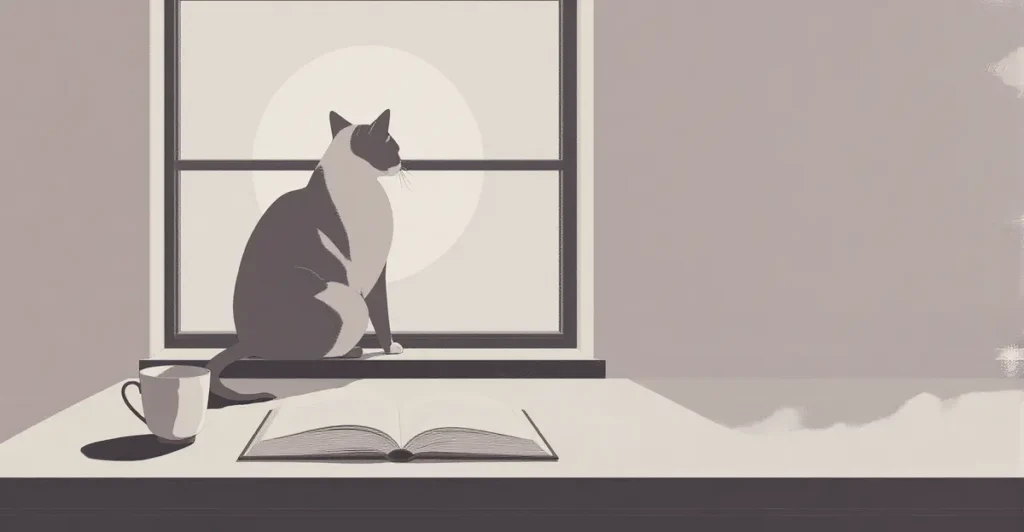
A cat does not multitask. When the cat is eating, the cat is eating. When the cat is at the window, the cat is at the window with the full force of feline attention, watching a pigeon for forty minutes without checking a feed. When the cat sleeps, the cat does not sleep guiltily, with a small voice whispering about productivity. The cat sleeps the way Marcus Aurelius wrote, like a person who knows the day is finite.
The cat is also picky about commitments. A cat does not say yes to social events out of guilt. A cat does not answer the door to be polite. A cat curates. Slow living is, in some real sense, learning to curate the way a cat curates.
We have written about why cats purr and what happens when they knead the blanket like a baker. Those behaviors have their own explanations. The cat-as-life-coach comparison is a useful joke, not evidence that purring is a philosophy degree.
FAQ
Is slow living the same as being lazy?
No. The idea is to choose where effort goes, rather than keep busy for its own sake. It need not produce more work to be worthwhile. Rest does not have to submit a productivity report.
Can you practice slow living in a big city?
Yes. The original Slow Food movement was urban. Slow Cities is literally a network of towns and cities that signed up to the idea. The city is not the problem. The default settings on your week are the problem, and those travel with you to any countryside.
Does slow living mean giving up technology?
No. It means using technology with intention rather than being used by it. That can be a smartphone with most notifications off, or a laptop with no social tabs in the browser, or a deliberate choice of one streaming service instead of four. The aim is not abstinence, it is sovereignty.
How long does it take to feel a difference?
There is no reliable universal timetable. Try one manageable change and notice whether it helps your day feel less fragmented. Keep what works, adjust what does not, and resist turning “being slower” into another target you are behind on. Slow living is, fittingly, slow to install.
Is slow living a trend or a permanent shift?
The aesthetic version is a trend and will pass. The underlying idea, that human attention is finite and worth defending, is not new and is not going anywhere. The Stoics were on this. The monastics were on this. The cat is on this. Slow living is the modern label for a very old observation.
Conclusion
Slow living, stripped of the linen and the candles, is a way of refusing to live your life on autopilot. It does not require a new town, a new income, or a new wardrobe. It requires one honest conversation about what you actually want your days to feel like, and then a set of small structural choices that protect that feeling from being eaten by defaults. The cat, watching from the window, already knows. We are catching up.