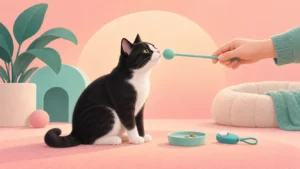
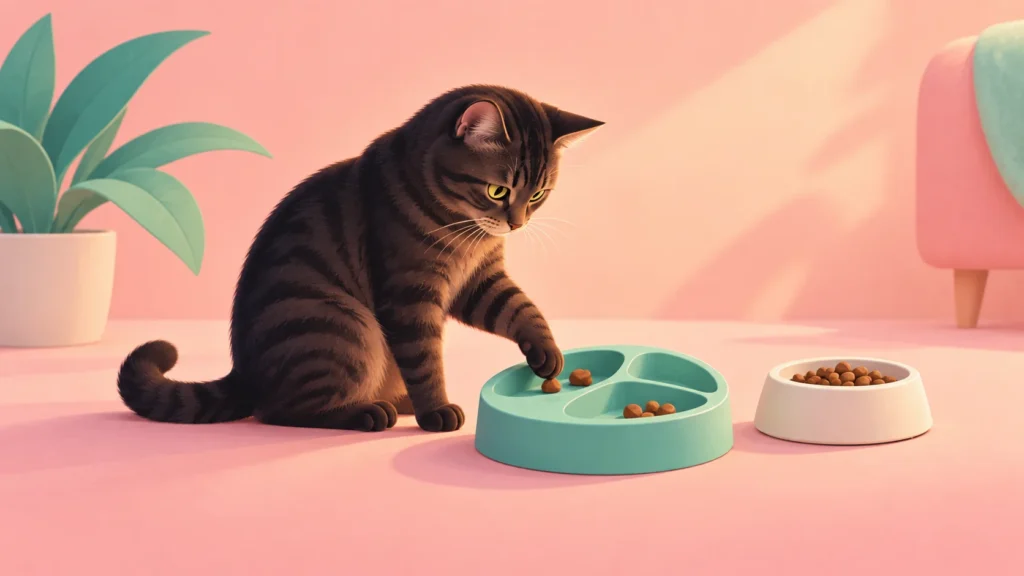
The food is visible. The cat looks at it, looks at the puzzle and walks over to the ordinary bowl. Has an enrichment experiment failed, or has the cat simply made a perfectly understandable choice?
A food puzzle asks an animal to manipulate something to reach a meal or a small portion of it. It can add variety to a day. That does not make the hardest puzzle the best one, or prove that a cat should prefer working for food whenever an easier option exists.
Begin with access, not a challenge
A veterinary review of food puzzles describes them as possible tools for physical and behavioural enrichment. It also emphasises introduction and the need to suit the puzzle to the animal.
A first attempt should make food easy to find and obtain. An uncomplicated, stable feeder with broad accessible spaces may provide a gentler introduction than a rolling device that immediately disappears under furniture.
Use a small part of the cat’s usual food allowance, allow observation and keep the normal feeding arrangement available during introduction. The purpose is to discover an activity the cat can use comfortably, not to make hunger force a solution.
What the free-food experiment found
In a study of 17 household cats, researchers offered a puzzle alongside a tray containing freely available food. As UC Davis explains, the cats generally ate more from the tray, spent more time there and chose it first more often.
Some cats still used the puzzle. The result does not mean that enrichment devices are useless, nor that the animals were lazy. It shows why we should distinguish willingness to use a device from a preference for it over an easier meal.
The research paper also makes the tested conditions visible. A particular puzzle, a particular choice and a small study population cannot answer every question about every feeder. It is evidence against an easy assumption, rather than a verdict on all feline play.
Watch the effort the device actually requires
From a human viewpoint, two puzzles may both look simple. From the cat’s position, one may require reaching into an awkward opening while the other releases food after a gentle touch. The relevant difficulty is the action the animal must perform.
Consider stability, comfortable reach and ease of cleaning. Check that there are no sharp edges, unsafe loose parts or openings that could trap a paw. Supervise a new device and stop if it causes distress or an animal cannot get enough food.
Households with several cats need to consider access as well as mechanics. A clever feeder can become an unhelpful resource if another cat controls the approach to it. Our understanding of enrichment has to include the room around the object.
Success can be a modest amount of interest
A cat need not use every puzzle or spend a long time with one for the experiment to teach you something. You may discover a preference for a stationary device, a different texture or a quieter location. You may discover that this activity does not appeal to this cat.
Food puzzles are not a guaranteed weight-loss programme or a treatment for illness. If your cat has a prescribed diet, mobility limitations or changes in appetite, ask your vet how to adapt feeding safely.
For another activity built around small voluntary successes, see our guide to clicker training. In either case, the animal’s response is the useful information. An enrichment plan is working when it improves the cat’s options, not merely when the human has found a more ingenious container.