
 English
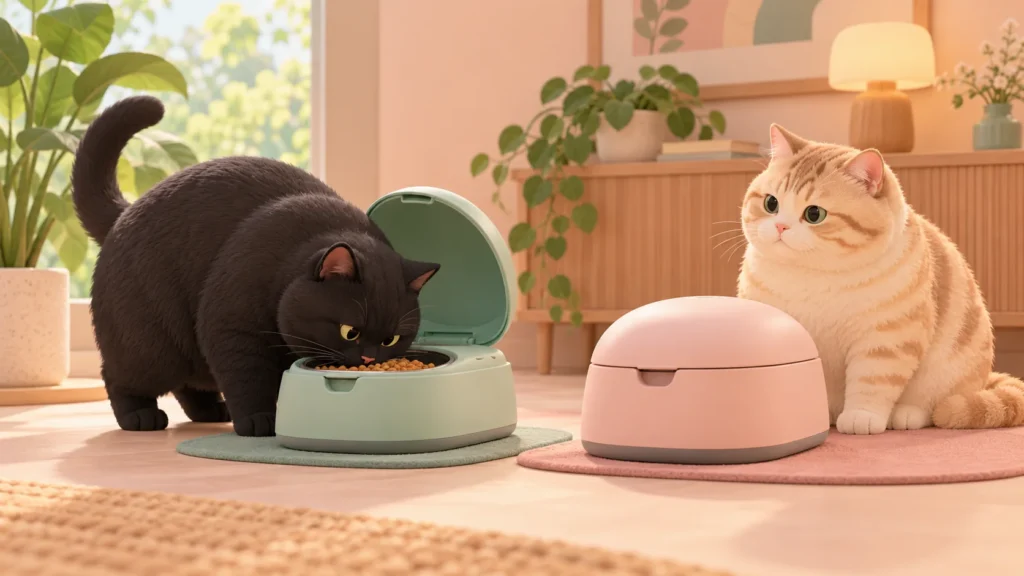
One cat approaches dinner carefully. The other has already finished its own meal and is making plans for the neighbour's. Two bowls on the floor do not always produce two separate dinners.
A selective microchip feeder tackles the access problem. It recognises an enrolled pet and opens a lid over the food. For households managing different meals, the attraction is obvious. The device does not, however, take over every part of feeding.
What the microchip actually does
Sure Petcare's description of its Microchip Pet Feeder explains that an animal's identification number is stored in the feeder. The lid opens when a registered pet approaches and closes after it moves away. The model also accepts a compatible RFID collar tag.
The chip supplies identity. It does not contain the cat's diet plan, measure its hunger or tell the mechanism what a veterinarian prescribed. Someone still chooses and portions the food.
The principle will be familiar from our explanation of microchip cat flaps. In both cases, the device reads an identifier and decides whether to allow access. A door controls entry to a room or home; a feeder controls entry to a bowl.
Give the moving lid time to become ordinary
A cat that has never eaten beneath a moving cover may need a gradual introduction. The feeder's training mode exists for this reason. A technically correct device can still be useless if the intended cat avoids it.
Set up the feeding position with the animal in mind. There should be space to approach and leave without being cornered. If another cat waits beside the bowl or blocks the route, an electronic lid has not solved the social problem.
Observe several meals rather than assuming success from the first opening. Can the intended cat settle and eat? Does the other animal interrupt? Is the feeder clean and functioning normally? Those observations tell you more about the household result than the product photograph.
Before ordering, sketch a normal mealtime. Mark where each cat approaches, whether either tends to follow the other, and where a person can reach the bowl for cleaning. A feeder that fits on the kitchen floor may still make an awkward station beside a busy doorway.
Keep packaging and instructions until the animal has had time to become comfortable. Acceptance is something to observe over ordinary meals.
Access is only one part of feeding
Selective access can be useful when food needs to stay with a particular animal, but the exact benefit depends on the household and the device. A feeder is not proof that a prescribed diet is being followed, especially if the cat can obtain food elsewhere.
It also differs from an automatic portion dispenser. A bowl with a controlled lid may simply hold food that a person placed there. Check the specific model before expecting weighing, meal scheduling or app reports.
For enrichment, food puzzles serve another purpose: they change how a cat obtains a meal. A selective feeder changes who can reach it. Some homes may need one of those functions, some both, and some neither.
The useful question is whether the arrangement lets each animal eat comfortably and reliably. A slowly eaten dinner is perfectly acceptable. It just needs to remain available to the cat whose dinner it is.