 English
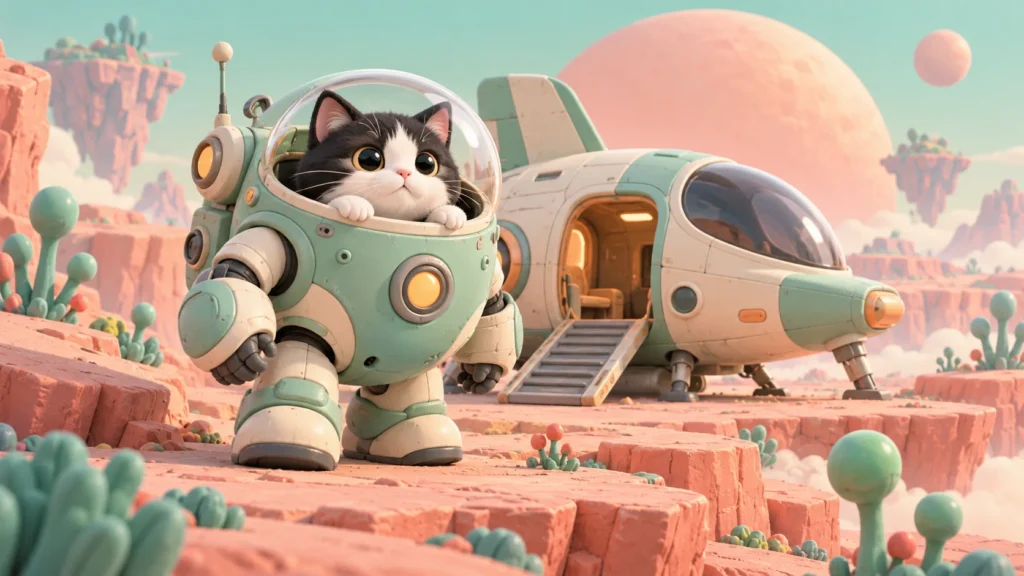
Giving a cat a robot suit solves a number of practical problems. Heavy doors, hostile creatures and machinery suddenly become easier to deal with. It also creates a new problem: the suit is much larger than the cat.
Gato Roboto makes that difference part of its adventure. Developed by doinksoft and published by Devolver Digital in 2019, it sends a feline rescuer into an alien underground environment after a spacecraft crash. The compact premise leaves plenty of room for movement to do the storytelling.
Armour changes what a body can do
Devolver's description emphasises two modes of exploration. Inside the mech, the player can use weapons and equipment to confront obstacles. Outside it, the cat can enter places that the larger machine cannot reach.
That is a good use of the animal rather than a cat-shaped decoration placed on an unrelated hero. Smallness becomes an ability. The player has a reason to notice narrow passages even after acquiring more powerful equipment.
It also changes how the same space can be read. A gap might be inaccessible to the machine but inviting to the animal. The map contains routes for different bodies, and the player has to consider which body the current problem requires.
A useful complication in the power fantasy
Many action games make progress visible by giving the player stronger tools. Leaving protective equipment behind introduces another kind of decision. Something useful has to be surrendered, temporarily, to gain a different opportunity.
The contrast does not need a long explanation. A large suit looks durable and capable of carrying machinery. A small cat looks capable of fitting through gaps. The visual difference prepares the player to understand the mechanical one.
That economy suits a game with a very direct identity. A feline protagonist, a rescue objective and an unfamiliar place are enough to establish a direction. The interesting design question is what happens between the obvious routes.
The idea becomes especially clear if you draw a simple imagined room: one wide doorway, one narrow opening and an obstacle the cat cannot tackle alone. The route changes depending on which form the player currently controls.
A designer can build decisions from that small set of differences. The player may see a destination before having the right way to reach it, then return with a better understanding of the space. That kind of recognition makes revisiting a room feel purposeful rather than merely repetitive.
A different answer to playing as a cat
Our article on cat simulator design looks at the difficulty of giving an animal a useful set of actions without handing it invisible human fingers. Gato Roboto supplies actual machinery, then makes the boundary between animal and machine relevant.
That provides a useful comparison with games built around climbing, knocking objects over or moving unnoticed through a human environment. Here, a cat's body and a technological body can take turns supplying the answer.
The next time a game shows a narrow tunnel beside a much larger doorway, consider what its hero is carrying. In Gato Roboto, the equipment that makes a cat powerful is also the equipment that sometimes needs to be left behind.