 English
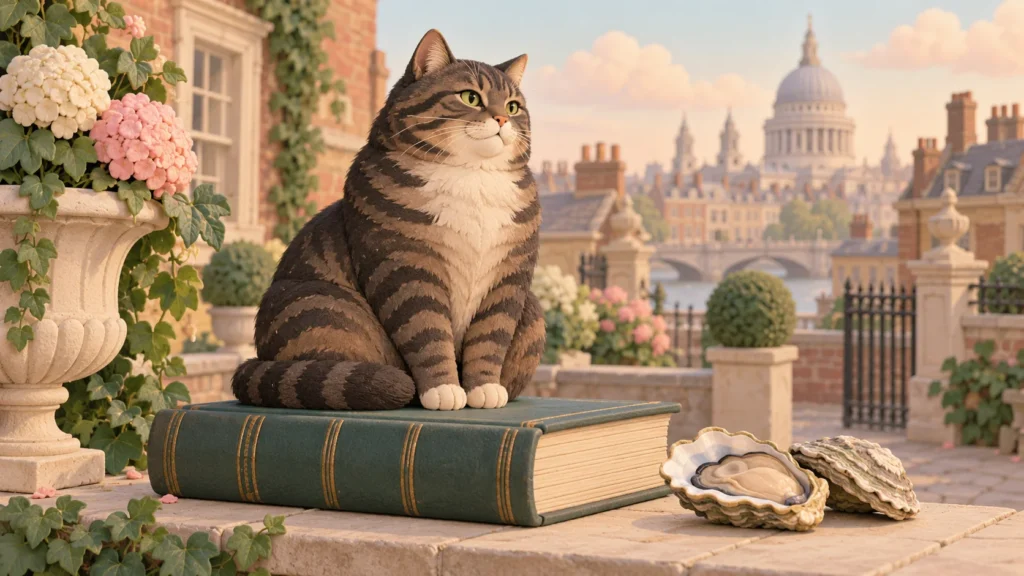
A cat sits on a large book in London's Gough Square. Beside him are oyster shells. It is an unusually specific arrangement for a monument, and almost every object helps tell the story.
The cat is Hodge, companion to the writer and lexicographer Samuel Johnson. Visitors looking for Johnson's house can find themselves meeting the household's other celebrity first.
A small scene preserved by Boswell
James Boswell included Hodge in his Life of Johnson. As Dr Johnson's House explains, he remembered the cat climbing onto Johnson while the writer smiled and stroked him. The scene gives a domestic scale to a man usually encountered through quotations, portraits and his dictionary.
That is one pleasure of animal anecdotes in literary biography. A cat has no use for an author's reputation. It wants access to the person, the chair or the next meal. For a moment, the famous figure has to answer a demand familiar to anyone whose work has been interrupted by paws.
Boswell's recollection is also why Hodge has remained identifiable. Many writers kept animals; fewer left behind such an easily pictured encounter in a biography that people continued reading.
The oysters were the inexpensive part
Hodge's meals sound extravagant to a modern reader. In eighteenth-century London, however, oysters were cheap food. Johnson bought them himself because he worried that making servants run errands for the cat could lead to resentment and mistreatment.
The revealing detail is the errand. Johnson accepted the inconvenience of feeding the animal rather than passing it to someone who might object.
It gives the anecdote a practical warmth. Affection takes up time, involves shopping and creates small obligations. Even a dictionary-maker has to leave the desk when a dependent animal needs something.
A small historical detail can change the scale of a famous life. A writer remembered for books and conversation also had to arrange food for an animal. The errand puts him in a street, making a practical decision that would be recognisable to a present-day cat owner.
When visiting a memorial or reading a retelling, compare the physical object with the account that inspired it. Which detail has been selected for emphasis? A statue cannot reproduce an entire biography, but a carefully chosen cat can direct attention towards one revealing piece of it.
Reading the monument
Sculptor Jon Bickley's statue places Hodge on a dictionary next to those shells. The book identifies Johnson; the shells supply the domestic story. You can understand their relationship without a full-length statue of the writer supervising the scene.
That makes Hodge an appealing stop on a literary walk. Look at the objects as well as the face. They turn a brief passage in a biography into something readable from the pavement.
There is a related pleasure in the history of cats living among books in libraries. Human institutions acquire an unexpected second identity when an animal becomes part of daily life.
Hodge's place in London rests on a much smaller institution: one household, one remembered cat and a writer willing to go out for dinner.